


To the San Jose fans who took umbrage with what I said in today's Monday Breakdown. I'd like to clarify the meaning of my comments.
Showing posts with label San Jose Earthquakes. Show all posts
Showing posts with label San Jose Earthquakes. Show all posts

Robert Jonas - Center Line Soccer
“So you’re telling me there’s a chance. Yeah!”
With those simple words born from the mind of Lloyd Christmas in the movie Dumb and Dumber, optimists have a rallying call and continue to believe they are destined to succeed whenever it looks like the odds are heavily against them. Heading into Wednesday’s MLS super-special sixth draft of the preseason — a weighted lottery for the rights to goalkeeper David Bingham — many of the teams participating were probably muttering Lloyd’s words to themselves. One of those teams, the San Jose Earthquakes, had just an 8.8% chance of landing the vaunted prospect and newly minted Generation adidas signing, but they beat the odds to land the California ‘keeper.
“So you’re telling me there’s a chance. Yeah!”
With those simple words born from the mind of Lloyd Christmas in the movie Dumb and Dumber, optimists have a rallying call and continue to believe they are destined to succeed whenever it looks like the odds are heavily against them. Heading into Wednesday’s MLS super-special sixth draft of the preseason — a weighted lottery for the rights to goalkeeper David Bingham — many of the teams participating were probably muttering Lloyd’s words to themselves. One of those teams, the San Jose Earthquakes, had just an 8.8% chance of landing the vaunted prospect and newly minted Generation adidas signing, but they beat the odds to land the California ‘keeper.

The Colorado Rapids, a member of the Western Conference based 600 miles due west of the westernmost Eastern Conference club, will host the San Jose Earthquakes, another Western Conference club based east of nothing but the the world's largest body of water, in a game that will be officially titled the Major League Soccer Eastern Conference Final.

San Jose shocked New York 3-1 at Red Bull Arena last night, thanks to a pair of goals from Bobby Convey and a well placed header by Chris Wondolowski. Despite playing at home with a 1-0 aggregate lead, New York came up short against a determined Earthquakes team. The Red Bulls controlled much of the game and a majority of the possession, but defensive lapses ultimately doomed them.
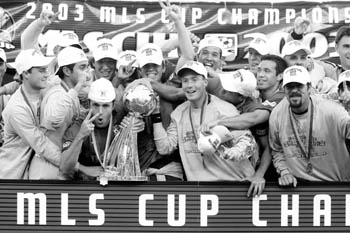
As Major League Soccer nears the conclusion of its sixteenth season, the organization is making the transition from a struggling fringe league to an important part of the American sporting landscape. Attention from the classic and on-line media and the availability of games both in live venues and on television have never been higher in this country.

by Robert Jonas - Center Line Soccer
Turn on your radio or television and you can’t miss them — campaign advertisements for politicians and propositions hoping to earn your vote ahead of state and local elections in early November. Most of these ads end up being of the mudslinging variety, but some try to focus in on the positive attributes politicians support and the promises they hope to bring forth if elected. Discussions and debates rage on between supporters on either side of each race and issue, while those few left in the middle and undecided try to weigh the merits of the opposing campaigns. In a few weeks’ time, all the fuss, all the arguments, all the vitriol will give way to a slate of winning candidates and new laws, and the losers will soon be forgotten.

by Robert Jonas - Center Line Soccer
Normally a mid week game at tiny Buck Shaw Stadium in Santa Clara attracts a small crowd of diehard fans to watch their San Jose Earthquakes in action. However, this past Wednesday night saw a nearly full house turn out to watch the Black-and-Blue take on a struggling Chicago Fire side that was winless over their last seven games. Instead of a comfortable win over Chicago, as many commentators — myself included — predicted prior to kickoff, the Earthquakes were taken apart by the Fire 3-0. Matching their worst loss of the season, the Quakes did little on the field to impress the many new faces that sprinkled the Buck Shaw crowd. Nowhere to be seen was the club that had played with poise and confidence during a 5-1-1 streak this month and last.

San Jose's first ever Designated Player signing is already making a difference. Geovanni set up a goal and scored his maiden MLS tally in the Quakes 2-1 win over the Dynamo in Houston last night, showing a readiness to contribute sorely lacking in some of his mid-summer DP peers.

Editor's Note: MFUSA is happy to present the first edition of a weekly column from Center Line Soccer's Robert Jonas.
by Robert Jonas
As MLS stocked up on a new batch of Designated Players in the summer signing window, it was clear that these big-money earners fell into three categories. The first was the big name, big pedigree players personified by Thierry Henry and Rafael Marquez, while the second was the returning World Cup contributors still playing at a high level — Blaise Nkufo and Alvaro Fernandez being chief among that group. And what was the third category you ask? Simply, they are the players that have plenty to prove — I’m looking at you Nery Castillo and Geovanni — to MLS supporters.
The Chicago Fire's signing of 26-year old Mexican International Castillo came as somewhat of a surprise. Not so much in that the Fire were looking to reconnect with a Mexican fan base that was drifting away with the departure of Cuauhtemoc Blanco, but that Chicago convinced a young player with high aspirations to come stateside. The loan away from Shakhtar Donetsk should help gain him playing time, but he misses out on potential Champions League experience for MLS.
Geovanni found himself out of a job after his previous club, Hull City, was relegated from the English Premier League after last season, and has been searching for a new home since early this summer. His arrival in San Jose is certainly a coup for the relatively small market Earthquakes, and would never have happened without the convincing arguments put forth by former Cruzeiro and current Quakes teammate Andre Luiz. Lured by the promise of a sunny and vibrant Bay Area, Geovanni welcomed the chance to move his young family out of England. He now has the opportunity to make San Jose relevant again in MLS.
Looking at the situation in Chicago, the ink on Castillo’s contract wasn’t even dry before the rumors of a second DP signing were already flying around the club. Instead of complementing the attacking player Castillo with a defensive midfielder, the Fire traded for similar attacking player in Freddie Ljungberg. Almost nonsensical, the young Mexican playing on a contract that pays him over $1.4 million a season would be fighting for space in the center of the Chicago attack with the ex-Seattle Swede.
I dare say that the timing of the two signings suggest that they were not made with each other in mind. We are already seeing that this is not working well for the Fire, as Castillo has been asked to play more as a winger, when he clearly is more comfortable as part of central midfield. In just his last game, where he featured for only 45 minutes against the Houston Dynamo, Castillo had no impact on the Fire’s attack. Chicago fans cannot be pleased with what they saw of his obviously disappointing performance down in Texas.
As for the other aspect of DP signings — the idea that they can provide “butts in seats” — Castillo is not paying any dividends in that regard. Chicago fans are clearly not embracing him in the same way they initially did Blanco. Filling Toyota Park will not be accomplished by just any signing from south of the border. That fact is even more evident on the road, where Castillo is simply not the draw that the charismatic and controversial Blanco was during his 2+ seasons in MLS.
So where does that leave Castillo? His mark in MLS will be measured by how much he can help in leading Chicago to the MLS Cup playoffs. Even in that regard, Ljungberg is likely to get most of the credit. But Castillo can comport himself well by excelling on the wing and creating scoring opportunities up top for Brian McBride, Ljungberg, and the other Fire strikers. Throw in a half-dozen goals over Chicago’s remaining 12 games, and Castillo makes his mark. Playing for just half a game, then being out played by your substitute — Calen Carr is certainly gaining my attention — will only qualify you as a disaster.
Over in San Jose, the signing of the 30-year old Geovanni was met was a resounding chorus of “hurrah!” from long suffering fans of the Quakes 2.0 version that has struggling to make a mark in the Bay Area. Where the Fire failed in meeting a need on their roster, the Earthquakes addressed a gapping hole in their line-up by signing the Brazilian striker. Since the injuries that pushed Darren Huckerby into retirement last summer, the Quakes have lacked for a creative force in their offense. Geovanni is no target forward — a position they are still lacking at — but he has proven in the past that he is very effective as an attacking midfielder or withdrawn striker.
And like the Castillo signing, Geovanni was not brought to San Jose to fill tiny Buck Shaw Stadium. That was never an issue for this team, as they have constantly approached sell-out crowds over the last 2+ seasons — not hard to do when your leased stadium barely holds over 10K supporters. Rather, Geovanni’s arrival in San Jose was all about winning games and qualifying for the playoffs. He clearly understands those expectations given his comments at his introductory press conference, and wants to contribute to the club as soon as possible.
The paperwork necessary to make him eligible to play was completed in record time, and Geovanni made his debut for San Jose as a late game substitute in their 1-0 win over the Los Angeles Galaxy. Geovanni was clearly lacking fitness, and made no impact in the match, but he did get a huge ovation from the Quakes faithful. It will take the Brazilian another couple of weeks to get up to speed, and at that point will definitely be inserted into the Starting XI for coach Frank Yallop’s side.
So what should Quakes fans expect from their first DP signing in franchise history? Nothing short of a dynamic force that plays the dual role of offensive instigator and goal scorer for a team that is in desperate need of a finisher. A goal + assist total over 10 for the remaining 11 games of the season seems a fair benchmark of success. With that level of production, the Earthquakes should comfortably qualify for the postseason.
The opportunities are there for both Castillo and Geovanni, but must be grasped and not just taken for granted. The expectations are high — rightly so — and the fans will not be forgiving if either team fails to make the playoffs. Deliver some November soccer for their respective clubs, and their signings should be considered a success. Anything less will be a failure.
Robert Jonas is a writer and podcaster at Center Line Soccer and a frequent contributor to CSRN’s Around The League MLS show. He can always be reached on his twitter @robertjonas.

The San Jose Earthquakes are taking a bit of a gamble with 30-year old Geovanni, late of Hull City; talented but coming off of a rough season, the Brazilian could be a massive creative presence. Or he could land in California, treat the whole experience as a vacation, and find himself going the route of Denilson.
Not that I want to rain on the San Jose parade, I just feel the need to mention the possibility.
And I'll admit that I'm mildly uncomfortable with the idea of Geovanni as a DP; I'm sure his wage demands dictate he must be one, but that doesn't mean I'm sold he's worth it. The Quakes need for a playmaker is pressing, and Geovanni brings the skill set to get the job done.
Geovanni, despite the cool name, isn't a player that is going to drive ticket and jersey sales all by himself. He's a guy brought in to help the Quakes get to the playoffs, pure and simple. In addition to Boskovic in DC (though it's more likely fans will have heard of Geovanni than Boskovic before their respective arrivals), the Brazilian is a pragmatic choice on the low end of the DP scale. The range of players filling these spots across the league, from 30+ stars with marquee names down to younger less-known players like Fernandez in Seattle with Geovanni smack in the middle, is interesting. In each case, the nature of the DP says something about the character of the club, their aspirations, and whether they view the DP rule as an opportunity to market the team or just as a way to make themselves better on the field.
Frankly, if San Jose can't keep their tiny venue filled on a regular basis, they have more problems than a name DP can fix anyway. Lower cost, even with the risk of a disinterested Geovanni, is certainly the way to go for the Quakes.
With the Quakes becoming members of the DP club, eight clubs now have at least one (though Omar Bravo won't arrive in Kansas City until next season). FC Dallas and Houston are making noise about signing a DP for next season, so it may be awhile before the next one joins the league. The new rules haven't drastically increased the number of teams with DPs, but it has enticed a few teams to sign more than one.
Here's a truly important question...does Geovanni immediately become the best one-name player in the league?
Back with more shortly.

Major League Soccer teams are unique. They stray far from the traditional club setup that is prevalent the rest of the world over, and are beholden on the league as whole for their existence. The franchise system is the law of the land, and no matter the issues we might have with it, won't be going away anytime soon.
The reality that MLS teams are franchises means that they're technically mobile; as we've seen with San Jose/Houston, the league is willing pick up and move a team, like a game piece on the Risk gameboard of American soccer, if the situation becomes untenable in a given city. The league can't afford franchises teetering on the edge of failure or dealing with the prospect of an debilitating stadium situation long into the future. Get them somewhere where they're wanted, or where there is at least a chance they can get a stadium deal put together.
It's on the ownership of these teams to work as hard as they possibly can to get a deal done. This is a problem for some, because the negotiation process for a land acquisition, infrastructure, or public/private deals are typically secretive by nature. Fan perception of their club's efforts suffers because it, especially when exacerbated by executives who fail to assuage fear or make comments that add fuel to the dissatisfaction fire.
In DC, the lack of real news on where the club is looking, made worse by the interest of Baltimore in luring the team, causes nervous feelings amongst their rabid fan base. Revolution fans couldn't be happy to hear more than one official claim the club is happy to stay in Gillette for the foreseeable future; even if the team is actively pursuing a new stadium, public perception might be that they aren't doing enough. San Jose's situation is slightly better, and it would be unfair to say that Lew Wolff isn't working diligently towards a permanent home for the Quakes; but the process has taken longer than most would have hoped. Do the fans put that on ownership, or place the blame squarely on local officials or the struggling economy?
And so I'm curious. For those of you out there who support a club without a settled stadium situation, how happy are you with the work being done by leadership?
With just the county to go in Houston, I'm guessing Dynamo fans would give their team a 100% approval rating, while New England, DC, and perhaps even San Jose supporters can't be too comfortable.
Here's the scale:
Strongly Approve: I'm extremely happy with the club's efforts and am confident they will get a stadium built in the near future.
Approve: I have doubts, but believe the club is doing their due diligence to get a stadium built, and am comfortable with the level of communication.
Somewhat Approve: The club could be doing more, and is not communicating clearly with the fans, but I can't find fault with their commitment.
Somewhat Disapprove: The club is making an effort I am comfortable with, but is moving too slowly or without enough urgency for my liking.
Disapprove: I have little faith in the leadership to get a stadium built, and haven't seen enough effort or communication to make me happy.
Strongly Disapprove: Ownership has made a mess of the situation and has alienated me with their public statements (or lack thereof) on a possible stadium deal; as a result, my support for the team might be affected.
Please identify your club and your rating, and of course you're more than welcome to expand on the subject with your thoughts.
While this particular post is on the stadium issue for the clubs in question (DC, New England, San Jose, and Houston), the may be a wider-reaching question on overall satisfaction with front office performance in the future.
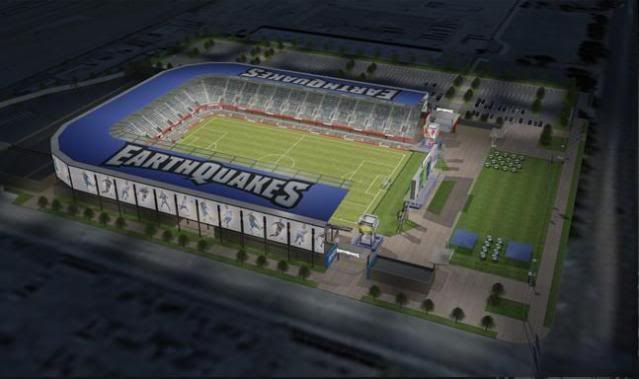
Buried in the last paragraph in a story this morning about the San Jose city budget is something MLS fans should be gladdened to hear:
In other news, the council voted 10-0 — with Constant absent — to approve rezoning the 95-acre former FMC property on Coleman Avenue near Mineta San Jose International Airport to allow development of a professional soccer stadium of up to 18,000 seats for the San Jose Earthquakes team.
Great news for the Quakes and Major League Soccer, who relaunched the club in 2008 with the expectation that there would finally be a stadium deal to be found. San Jose's plight was a black eye, especially because the original Quakes left for Houston.
The council vote doesn't necessarily mean that the new stadium will be built, and as we saw with the Wizards' travails, even a proposed site and ground clearing might not mean the Earthquakes will be playing in their own place in a few years.
But this is clearly a step in the right direction, and gives me hope that the day is coming when all MLS clubs have proper homes purposely built to maximize atmosphere.
Quakes owner Lew Wolff will privately fund the stadium build, though he is still on the hunt for a naming rights deal and sponsors. The council's zoning approval will help him in that endeavor, giving a level of certainty to the project that should entice companies to buy into the project.
The stadium design is a horseshoe, partly in deference to neighborhood concerns over noise; the other major design element is a roof with the lights underneath, something that will keep down the light pollution in the area. The Mercury News published a story on those matters prior to the vote on Tuesday.
For more on the stadium design and renderings of the project, check out my post from way back in September when the Earthquakes announced the plans.
Stadiums designed for soccer are crucial not only to the growth of MLS from an atmosphere, attendance, and therefore business standpoint, but as a guarantee against the disappearance of top-level professional soccer in the US. With soccer stadiums around the country, it makes it less likely that MLS (or a subsequent league in its place, though that's obviously not something anyone wants to see happen) will simply disappear.
The San Jose Earthquakes have revealed the design plans for a 15,000 seat stadium that they hope to build near Mineta San Jose International Airport.
The team has yet to obtain the necessary financing, however, and a projected 2012 opening may be out of reach. Owner Lew Wolff hopes to use the stadium plans to spur new investor interest, and declined to predict when the project might be completed.
San Jose also announced that they will cut ticket prices next year, a move that seems aimed at placating a fan base frustrated by the lack of movement on the stadium front.
Images courtesy of MLSnet.com
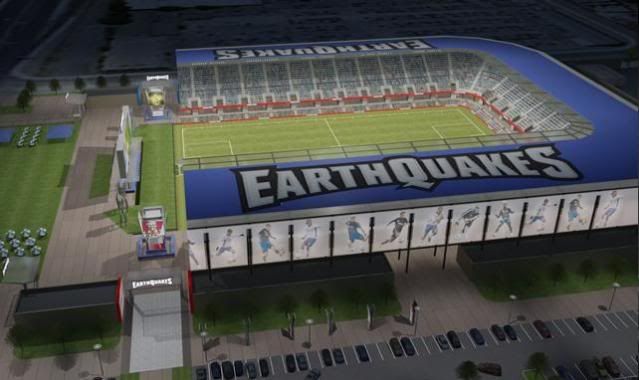
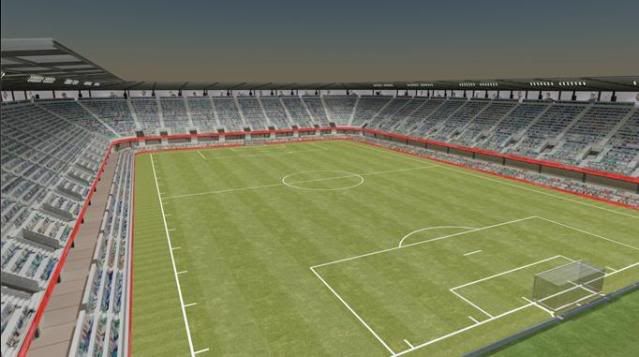
Although the disclosure of the stadium renderings is exciting news, it does not necessarily indicate that the Earthquakes are any closer to getting their stadium off the ground as they have been to this point. Lew Wolff continues to push in the right direction, but without an infusion of cash, San Jose may be stuck playing in Buck Shaw Stadium and the Oakland-Alameda County Coliseum for the foreseeable future.

"Fool me once, shame on you. Fool me twice, shame on me."
The San Jose Earthquakes, the only MLS franchise to be "reborn" after the original version of the club was relocated to Houston, is in a tough spot. Owner Lew Wolff is struggling to get a stadium project off the ground, has seemingly overestimated the city as a soccer market, and is lashing out at fans in the press.
When the league awarded an expansion franchise to Wolff in 2005 to fill the void created by the relocation of the original team to Houston, a jaundiced eye or two were pointing in Don Garber's direction. Despite the big money Wolff as owner, many questioned the wisdom of granting a team to a city that had already proven once their inability to get a proper stadium built for the club.
Wolff assuming allayed the league's fear by convincing the owners back in 2007 that he'd be able to get the deal done. AEG had pulled out in frustration, but as owner of the A's and a real estate maven, perhaps the league believed Wolff had the wherewithal to give San Francisco Bay Area professional soccer a fitting venue. Major League Soccer's anxiousness to return to the Bay Area, a hotbed for the sport in the US, brings us to today; Wolff's stadium efforts have stonewalled, the team is one of the worst in MLS, and there future is looking bleak once again.
Hindsight is always crystal clear, and the bet here is that Garber and Co. are kicking themselves over the decision to rescind the "no stadium, no team" policy, at least in the case of the Wolff and the Earthquakes. Without a concrete stadium plan, San Jose will continue to be stuck in the ill-suited and entirely too small Buck Shaw Stadium, a venue that team does not control and the league cannot be happy with. Despite original plans to "barnstorm" around the San Francisco area, the club has settled into a rotation of the aforementioned Buck Shaw and Oakland's Coliseum, used when the club has "big" matches that are certain to attract larger crowds.

What to do? Should the league take another hit, admit defeat in San Jose (again), and move the club to another market? St. Louis seems to have more stadium plans than they know what to do with, and would certainly welcome the club with open arms. Should MLS stick it out and hope that Wolff is able to finally secure the money necessary to break ground on a facility? The only problem there is that the owner's plans aren't exactly for a soccer palace; what was to be a step-up from a purely-functional no-fills facility and seat 18k is now slated to be a bare-bones 15k seater with zero amenities. If having a dedicated stadium for the Earthquakes is the only goal, I suppose that will do; but with other venues like Rio Tinto and Red Bull Arena opening, an austere and smallish stadium would looks terrible by contrast.
The Earthquakes have dedicated fans. They manage to fill up, or close to it, Buck Shaw Stadium for the majority of home games. While the excitement over the team's return hasn't met Lew Wolff's expectations, that doesn't mean that San Jose and the Bay Area is not a worthwhile market for MLS. But for the time being, while the league focuses its attention on new and excited fan bases in cities like Toronto and Seattle with high hopes for Vancouver, and Portland, San Jose's small crowds and undetermined future make it an obvious candidate for relocation.
Moving the team would take some serious pride-swallowing on the part of MLS. Wolff's protestations over the club's relative lack of popularity and his frustrations over the stadium deal give the impression that he might be happy to get out of the league. MLS knows it has willing parties in a couple of cities, and finding a buyer shouldn't be too difficult. But will Garber and the decision makers admit defeat for a second time in San Jose, thereby shining a light directly on their folly to return to the city in the first place?
It's likely not gotten that far. I can't see the Quakes moving anytime soon, but the question of their future is worth asking. MLS can't afford to leave clubs struggling in markets without viable stadium futures (other than the New England Revolution), and after Garber's comments/threats regarding DC United earlier this year, we know that no team is untouchable. With a shaky recent history, and "failure" already on the resume, San Jose could be staring at the prospect of losing another Major League Soccer franchise.

San Jose Earthquakes owner Lew Wolff has backed off of a projected 2012 opening date for a new stadium for the club, citing lack of sponsor interest and financial delays.
Wolff says the club needs $5 million in sponsorship to get the $50 million stadium project off the ground, and that only twenty percent of that has been secured.
There are also questions about the area's ability to support the club, or to show potential sponsors that the soccer fan base there merits significant investment. Wolff hopes that unveiling architectural renderings of the no-frills stadium design will spur new interest.
Wolff's disheartening statements throw a wrench into yet another stadium project; while Houston's march towards a full go on their new facility is encouraging, the lack of movement in DC and New England still leaves the league several problem locations.
The return of MLS to San Jose seemed a no-brainer at the time according to Wolff, who has been disappointed with support and season ticket sales.
He also reaffirmed Frank Yallop's job security despite the club's struggles and their place at the foot of the Western Conference standings.

It's Monday morning, and predictably, I'm dragging just a bit. It's so hard to pack it in and call it a night when you're doing something enjoyable, and last night was no exception. The podcast session with Mark Fishkin was so good that I put a couple hours of good work in to get it ready for release this evening.
On other fronts, another MLS weekend has come and gone. While the Nats qualifier occupied most of my attention on Saturday, I do have a few observations that I would like to share, and I've put them in a handy-dandy top five format.
All the nonsense after the jump.
Bear in mind that all of these thoughts are off-the-cuff and reactionary, and bound to be filled with entirely too much emotion; I'm sure I will back down a bit from most (if not all) of them rather quickly.
1. What the hell is going on in Dallas?
I hate to drink from the same well that my friend Ginge is already draining (and rightly so), but it's absolutely shocking how poorly that team drew yesterday. Listed attendance was 6,500, though independent sources say that it might have actually been much lower than that. On the podcast (COMING THIS EVENING!), Mark and I discuss MLS marketing for some of the original clubs, and Dallas was top of mind; something is fundamentally wrong there that cannot be excused by a small budget. People much more knowledgeable of the situation than I have claimed that FC Dallas is in no danger of relocation, though I wonder if that's even a good thing at this point. Dallas' attendance reflects on the league, something which the suits at MLS headquarters are hopefully keenly aware. For all the good that Lamar Hunt did for American soccer, his legacy is being sullied by the ineptitude of the current HSG leadership.
2. Seattle is the greatest thing ever!
Of course I jest, but only slightly; the American soccer community is going batty over Seattle and their early success, and it seems unlikely to stop as long as the team keeps wining. At the risk of beating a dead horse, I'll say it again: expect great home form from the Sounders, but let's hold off on crowning them MLS Cup final favorites until they prove that they can get points on the road. The Sounders are the feel good story of MLS, though my enthusiasm is tempered this week by collection of poor attendance numbers around the rest of the league. Mitigating factors abound in most locales, so I won't break out the panic alarm quite yet. I do think, however, that it's important to keep the big picture in mind. Anyway, one more item of business with Seattle, and then we'll move on: MONTERO! MONTERO! MONTERO!
3. Columbus-Toronto: The Aftermath
Things weren't exactly peaceful in Columbus, and I think it would have naive of anyone to think it was going to be smooth sailing. A couple of arrests, some disbursed pepper spray and mace, and angry missives from Columbus supporters all resulted from what was a fairly pedestrian match. I can't truly say I'm disappointed in anyone's behavior, though I worry that the focus on soccer supporters when it comes to violence makes the light that shines on the league because of incidents like this even harsher. No matter that dust-ups between fans of opposing teams in other sports happen fairly regularly, soccer will continue to be treated unfairly on that front for a litany of reasons. Hopefully, the leadership of both the TFC supporters groups and the Crew Nordecke faithful will denounce those from their sides that were involved in altercations.
4. Houston-San Jose First Half, or A Goal Every 9 minutes!
The first forty-five in San Jose was chock full of offensive gold, with all five goals the match produced occurring before the half-time whistle. You have to wonder if both teams simply ran out of gas in the second forty-five. As I was unable to watch the game, I saw the scoreline and immediately thought I had missed a barn burner; turns out I only missed half a barn-burner. Week two, and I still have no idea if either team is very good; it appears as though that Dynamo defense which used to be so solid has some serious chinks in the armor. San Jose, after a fairly ugly game with New England last week, showed some signs of life, and even got a contribution from the up-and-down Arturo Alvarez. One thing from the highlights: I loved the fact that Frank Yallop was giving an in-game interview when Ryan Johnson scored San Jose's opener. While I usually hate those things while play is going on, at least something interesting was happening at the same time.
5. Club or Country, It's Not Just For Players Anymore
With MLS playing through the FIFA mandated international match weekend, there were bound to be some conflicts for American soccer fans. Not only was the U.S. National Team playing on Saturday night, but the home nations of large communities of immigrants all around the country were playing as well. Attendance certainly took a hit due to the evening matches competing with the World Cup qualifiers, and it only served to magnify the scheduling issue for the league. Several people have come down on MLS (naturally) and while I'm tempted to join the mob, I'm holding back on my criticism. It would be difficult for me to believe that Garber and league officials want to play through a weekend like we just had, so give them the benefit of the doubt. When the league's position is strong enough and the stadium issues are a thing of the past, and not until then, will an international break be part of the MLS schedule.

For all the love and good will that Major League Soccer has gotten recently from Seattle, Vancouver and Portland, today's stadium news for two of the league's premier franchises has put a massive damper on my enthusiasm.
In Houston, Glenn Davis is reporting that the proposed Dynamo stadium may still hit snags, despite the fact that the team has secured the necessary financing to get the thing built.
In DC, Prince George's County, the team's apparent future home after the District failed to make good on Poplar Point, cut the team at the knees with a 5-0 vote against moving forward with the idea (the stadium isn't dead, just on life support).
Ugh. And these are just two of several stadium issues that threaten to linger long into the future.
Here are the worst stadium situations in MLS, from most critical on down. Call it a Big Four if you will (with an added bonus: me handicapping the likelihood based on current information):
DC United
Current: RFK Stadium
Efforts: Prince George's County Project
Likelihood: 20/1

No offense to any of the other teams, but United's situation is clearly the most distressing. A team with vocal support, solid attendance, and on-field success, DC is one of the premier clubs in MLS. For a team on the level of United, torchbearers for the league since its inception, not to have a proper soccer stadium is a black eye for American soccer. The District led United around by the tail for years, and now Victor McFarland has decided that enough is enough. Desperate for a locality that makes sense for both the fans and the team, United headed to the Maryland suburbs, where it appeared they expected a warm reception. It didn't happen, as the county's committee recommendation proves. There have even been whispering that United could move out of the DC metro completely if the PG County stadium falls through. That would be a severe blow to the reputation of both the league and professional soccer in the U.S., and shouldn't be allowed to happen no matter the cost.
As a potential alternative to PG County, a local radio show that I've posted about before suggested that United team up with George Mason University (yes, that George Mason University) here in Fairfax (30 miles outside of the city, and where I spend eight hours of hell everyday), as the school is looking to start a football (American) program and might be willing to share the costs with the team. Two problems spring to mind for me, as I'm intimately familiar with GMU and Fairfax: one, I have no idea where they would put it; two, the city of Fairfax (or county of Fairfax if it would be outside the city limits) is unlikely to be too fond of the idea, mainly due to the fact that it will only add to the already ridiculous traffic situation.
*UPDATE* And now this, which I was alerted to by American Soccer News. United in RFK would immediately become the most depressing atmosphere in MLS. The place holds 90,000 people for cripes sakes. It'll be like a school of goldfish in the Chesapeake.
*UPDATE* And now this, which I was alerted to by American Soccer News. United in RFK would immediately become the most depressing atmosphere in MLS. The place holds 90,000 people for cripes sakes. It'll be like a school of goldfish in the Chesapeake.
Houston Dynamo
Current Home: Richardson Field
Efforts: Stadium in the city of Houston
Likelihood: 3/1

What more can the Dynamo do? After moving from San Jose because stadium possibilities had dried up there, the club has worked hard to make sure Houston wouldn't be strike two. Yesterday, all the news was good; the team had secured the loan necessary to pay their portion of the construction costs, and looked like everything was good-to-go. Today, Glenn Davis squashes all of the optimism (not his fault, he's just the messenger) with a blog post that shows that Houston may have complete morons in the city council who could be an impediment to the stadium getting built. While they're not unique in that regard (there are idiot city councilmen and women everywhere), Dynamo fans can't be too happy right now. The Dynamo have about as strong a reputation currently as an American team can have in the region, yet they play on a field that is more suited for buckets and shovels than soccer. I truly hope that today's news is only a momentary hiccup, and that the Dynamo get on their way towards SSS status sooner rather than later.
New England Revolution
Current Home: Gillette Stadium
New Stadium Efforts: Somerville (maybe?)
Likelihood: 1000/1

While United and the Dynamo get first billing, the Revs aren't too far behind. Although they haven't (yet) won a Cup, Nichol's boys are consistently one of the top three or four teams in Major League Soccer. Despite that fact, they continue to play in a cavernous abomination (for soccer at least) that not only sucks all of the atmosphere out of a Revs home game, but also means the team plays on the dreaded "football lines" entirely too often. If nothing else, it makes Revolution games difficult to watch on TV. Foxboro, from my understanding, is about as far removed from the immediate Boston area (which is where they should be) as any other team in the league is from their nominal hometown (okay, so Boston isn't in their name; they're still supposed to be a Boston team). With bad news on the Somerville stadium front, the Revs look to be stuck in Gillette Stadium for at least the foreseeable future.
Just a thought: A couple of years ago, the Patriots threatened to move to Hartford if they didn't get a stadium, and then stayed put when Gillette was finally green lighted. While they were probably just bluffing, it was clear that Hartford is hungry for a team of their own. I'm sure this will piss off my Boston friends up there, but why can't the Revs move to Hartford?
And I just remembered that they're owned by Robert Kraft. Never mind.
San Jose Earthquakes
Current: Buck Shaw/Oakland Alameda County Coliseum
Efforts: SSS Near San Jose Airport
Likelihood: 3/1 (who knows when though)

Things are actually fairly good in San Jose, though the speed at which the process is moving leaves a lot to be desired. Owner Lew Wolff is looking to fund a 15,000 seat facility (again, I ask: why only 15k?) near the San Jose airport, and there have already been preliminary studies done on the potential site. That's good, but I'm impatient. Every time San Jose is forced to play in the tiny Buck Shaw, or the ugly-for-soccer (even by MLS standards) Coliseum, it saddens me a bit. San Jose seems a lock to get to the SSS promised land though, and that's more than most stadium-less teams in the league can say.


