Showing posts with label American Attitudes. Show all posts

In this space on Friday, Robert Jonas discussed the nature of modern sports and the lack of "clubs" in MLS, boiling down the fan-team relationship into one of pure economics.  Teams have owners who sell a product.  Fans, or supporters if you like, either buy that product or they don't.  When the team is struggling on the field or management fails to address the problems, fans only recourse is to not buy tickets.  The word "club" is not applicable to MLS franchises because they fail to meet the basic definition.


Report Says MLS Gaining Fan Traction

Thursday, September 30, 2010 | View Comments
Even small victories matter when it comes to Major League Soccer's visibility in a crowded sports marketplace. Not only does the domestic soccer product compete with the Big Four of American sports (NFL, MLB, NBA, and we'll throw the NHL a bone), other less-popular competitions fight for the very same entertainment dollar and television viewer.  The import given to big time college sports, golf, tennis, NASCAR, etc. makes it all the harder for MLS to convince Joe Sportsfan to give a damn; add in the problem that the league has of convincing fans of European club and leagues to pay a little attention to American soccer, and even tiny movement of the needle is cause for celebration.


Gunpowder Plot, Roman Catholic conspiracy to blow up English Houses of Parliament on 5 November 1605 when James I was due to open a new session. Guy Fawkes, best known of the conspirators, is third from right. From print published Frankfurt 1605.

A listener of the American Soccer Show sent me this email yesterday, asking an interesting question. While I could wait to use it on the next show (and I probably will mention it), I thought I'd share it here first.  It's obviously in response to the debate over Thierry Henry's punishment for injuring Kevin Hartman.


The US National Team as Lovable Losers

Thursday, September 16, 2010 | View Comments

I'm going to go ahead and assume that you've seen the wonderful video tribute to the USMNT's World Cup run entitled "Dying Bravely."  If you haven't, stop what you're doing and watch it now.  It's worth every second of its eleven minute run time.  The video above is part 2 - the link goes to the full version.


Here We Go: The Two Footballs Collide

Thursday, September 09, 2010 | View Comments

Perhaps you've been living in a nuclear fallout shelter for some reason, or have just avoided all forms of mass media over the last two weeks or so and didn't know that the NFL season starts tonight.  Well, it does, and the super spectacular kickoff game features the defending Super Bowl champions versus the Brett Favres.  I'm sure many of you will be watching.


Non-League Day and American Myopia

Tuesday, September 07, 2010 | View Comments

I was thinking about Non-League Day as I fell asleep last night.  If you don't know about Non-League Day, here's a bit of background:

"The "non-league football day" is the brainchild of James Doe, a lifelong football fan, supporter of QPR and follower of Harrow Borough FC. Its aim is to promote the semi professional game in this country by virtue of a fortuitous break in the football calendar. In James' own words:
'WITH ENGLAND PLAYING THE NIGHT BEFORE AND THE PREMIER LEAGUE AND CHAMPIONSHIP TAKING A WEEK OFF, I URGE ALL FANS OF THE BIG CLUBS TO GET OUT AND WATCH THEIR LOCAL NON-LEAGUE TEAM INSTEAD ON SATURDAY 4TH SEPTEMBER. GIVEN THE CURRENT FINANCIAL CLIMATE, CLUBS OUTSIDE THE FOOTBALL LEAGUE NEED ALL THE SUPPORT THEY CAN GET, SO YOUR PRESENCE AT A GAME WILL BE GENUINELY APPRECIATED. WITH TICKETS AND REFRESHMENTS AT A FRACTION OF THE COST, WHAT'S STOPPING YOU?'"


Now They Are Getting It

Tuesday, August 24, 2010 | View Comments
SANTA MONICA, CA - AUGUST 19: (L-R) Kyle Martino, actress Eva Amurri and actress Julia Jones arriveat the after party for the opening of Louis Vuitton Santa Monica to Benefit Heal the Bay at Annenberg Beach House on August 19, 2010 in Santa Monica, California. (Photo by Michael Buckner/Getty Images)

Editor's Note: New MFUSA contributor David T. Hammons has impeccable timing, and presents his perspective on why "Soccer Talk Live" represents a step forward for soccer in the United States.

by David T. Hammons


Kyle Martino is on the verge of offering Fox Soccer Channel and the newly-found American soccer fans something that this sport desperately needs to keep them interested in "The Beautiful Game."


News Corporation's Fox Entertainment Group, which owns Fox Soccer Channel, now comprehends what will attract more Americans to watch their shows - Americans want an American product.


Martino, a former member of the United States Men's National Team, has decided to leave ESPN and to join FSC and host their new show, Soccer Talk Live.


Fox Soccer Channel has decided that this is the perfect time to cash in on the success of the 2010 FIFA World Cup by producing a show purely dedicated to the American game - and not the other "bigger" European or South American leagues.


This proves to be a bit of brilliance by Fox Soccer, because they are bringing a young, bright individual who understands the American point of view.


Martino, who had a six year stint in Major League Soccer, comes across as a hearty, grassroot-American that has played on every level of soccer that this country has to offer.


Whether it was the youth and high School soccer in Connecticut, collegiate soccer at the University of Virginia, or professional level with MLS he will be able to connect to each and every player on those different levels.


This is not to slate Nick Webster or Eric Wynalda, who co-hosted the now-canceled Fox Football Fone-in, in anyway, but having a someone like Martino who has played at each level in the States offers something completely different to their first-time viewers.


Like Wynalda, Martino will offer honest opinions, but he does it in a way that most Americans soccer fans can and will relate to.


However, there is nothing more a proud American dislikes than a cocky Englishman, which Wynalda acted like, and his predecessor, Steven Cohen, clearly was - but that is what the producers wanted back then - not now!


Fox Soccer Channel needs to have British commentators and critics, but for the new soccer fans here, they cannot are not able to relate to them with their different terminology like someone born in Connecticut would offer.


However, being an American does not necessarily mean that you will strike a relationship with the adoring soccer fans and two prime examples of this were Max Bretos and Allen Hopkins, who both could not leave the Los Angeles-based company quick enough for ESPN, or as Dan Patrick refers to it, The Evil Mothership.


Of course, Bretos and Hopkins both appreciate soccer, but their selfish demeanor was very easy to read, and to a growing sport, that is the exact opposite thing that they need and fans were turned off by it.


With one of the major networks, News Corporation's Fox Entertainment Group, now completely on board, soccer should start becoming one of the major sports here in the United States.


Follow David on Twitter


A Reality Check on American Soccer

Wednesday, August 04, 2010 | View Comments
Downtown Boston skyscrapers from below

I'm big on perspective. There are occasions where I write long posts in anguished attempts to provide a bit of it to not only you, the reader, but to myself. Writing is often an exercise in fleshing out my own feelings on a subject as I type, before I have any concrete notions in mind and as my brain considers a topic logically. Soccer fans tend to be a touch myopic, and I can be as guilty as anyone. The desire to present a reasoned blog post that makes a solid argument while acknowledging the potential counterpoints means I tend to be careful about making sweeping proclamations without considering practical concerns.


Criticism is easy. Insight is not.


Perspective too easily takes the tenor of excuse. We avoid mentioning little details like the short existence of MLS, the relative youth of the US program as a serious exercise, and the natural growing pains that should be expected as a result. Criticism is important as a spur to progress, but it's no less valid if it acknowledges mitigating factors. We all want MLS and American soccer to leap forward in Moon gravity-like bounds; that doesn't mean we have to throw perspective out of the window.


Miriti Murungi sums it all up so I don't have to. If you ever find yourself in need of a bit of perspective, I suggest reading and rereading his wonderfully unsubtle and appropriately framed post. We live in a country with a professional top-flight league that is not yet old enough to have a player in it who was born when the league existed. As time passes, Miriti's points will become less and less important. But for now, they carry significant weight.


It doesn't mean we should stop pushing, prodding, asking, and analyzing. It just means we should do all those things while remembering just how new all of this truly is.


NFLPA Executive Director DeMaurice Smith: Unintentionally helping MLS?


National Football League fans will know what I mean when I say 2011 could be a very interesting year. With the country's most popular sports league showing all the signs of heading for a lockout, the possibility exists that there will be no fall Sundays spent watching enormous men battle it out on the gridiron.


Should a lockout happen, a massive sports void will open in the American calendar. From August (when NFL training camp and preseason games begin) until the end of the MLS season in November, the behemoth will be absent. Baseball (through the beginning of November), hockey (starting early October) and basketball (beginning in late October) will have the run of the sports landscape without the dominating and attention-hording presence of the NFL. While baseball still holds a special place in the hearts of many Americans, NFL fans won't be sated by it alone. Meanwhile, hockey is a niche sport that won't capture most casual fans until their playoffs, and early season basketball carries little drama.


The situation seems perfect for a certain American soccer league to step into the void.


As the "other" professional sports competition going on during the early portion of potential lost NFL year, perhaps MLS is in a position to benefit. The league won't convert millions of gridiron fans looking for a stand-in sports product overnight, but it's very possible they can pick up a few more eyeballs. A lack of NFL news might even garner Major League Soccer more time on the prominent sports news shows; without the week of review/preview for each and every NFL game to fill the usual amount of airtime, ESPN and SportsCenter will be scrambling for content. Soccer (MLS included, with all hope) is a natural temporary replacement.


Much of it would be out of the league's hands. They certainly can't make sports fans watch their product, and converting the entrenched anti-soccer crowd is near impossible and hardly worth the effort. Much of the American soccer fan base are also fans of the NFL; the cancelling of a gridiron season won't change their viewing habits anyway, though Euro-focused fans might be swayed to give the domestic game a chance based simply on time zones. When EPL and La Liga matches are over for the day and there is no NFL to watch as they normally would, maybe MLS grabs them.


What the league can control is placing matches in the usual NFL windows on Sunday afternoons during the fall of 2011. This would require a deviation from the norm for those few months, since the majority of the schedule takes place on Saturdays; but a few NFL-less SundayS in September and October are simply be too good to pass up. After years of fall Sundays spent sitting in front of a television watching sports on TV at 1 and 4, 12 and 3, 11 and 2, and 10 and 1 (not to mention the night game), will Americans simply change their habits because there's no NFL?


Most will. There should be no delusion about massive numbers deciding to watch to Fire v. Galaxy because the Cowboys and Giants aren't on. But even a small number represents a net gain for MLS, so switching a few schedules around should be an obvious step to take. Simply moving a handful of Saturday dates to Sunday (allowing for the usual stadium availability and local concerns), would provide Americans with alternate sports viewing in place of the NFL. Getting those games nationally televised in every case might be more difficult, but with contracts up (hello, Versus) and ESPN in a position to utilize a property they already have, it's not beyond the realm of possibility. A clever marketing campaign or two could be enormously effective.


There's a long way to go before we'll know if any of the 2011 NFL season will be lost. The tough talk emanating from both sides now might fade away before the situation comes to a head, and one side or the other may back down in the face of lost revenue and salaries. But this wouldn't be the first time labor strife has hit the NFL, and with the league playing the 2010 season without a salary cap because of the ongoing impasse, several signs point to an "inevitable" lockout. MLS would be remiss if they didn't attempt to put themselves in position to capitalize on wayward sports fans desperately searching for something to watch on their Sunday afternoons come Fall 2011.


The window is short, and it's debatable how much effort MLS should put into trying to leverage the NFL's potential lockout. It would take money and resources to produce a campaign to draw in disillusioned and aimless NFL fans, and there's no guarantee that it would have any effect or that the cost could be justified. Still, MLS isn't in a position to let any opportunity pass, and relying on hope and wishes to turn a few football fans into futbol fans would be just that - Letting an opportunity pass.


It's easy for me to say that no NFL in 2011 could be Major League Soccer's gain, and I'm admittedly way out in front of something that is more than a year away. But if you were running MLS, a league that must press every advantage it has to improve its penetration into a crowded sports market, wouldn't you be considering a strategic plan even now?


- Jason Davis

Should there be pride taken from the provenance of the players on our national team? As a developing soccer nation, how much of our desire to win should be balanced against our desire to produce those winning players here? Is a straight line progression away from the Stewarts and Dooleys a goal we collectively possess, or does it not matter if the players who represent us come from somewhere else?

Germany's multi-ethnic World Cup team, a reflection of that country's new attitude both on soccer and national identity, has received a lot of attention. The side includes players born in several countries other than Germany itself; this would hardly be unique for a second-tier soccer nation like the U.S., but is noteworthy within the roster of a traditional power. The Germans, for lack of a better phrase, are less "German" than they used to be. And, from all appearances both on and off the field, this new look has fit the team and the nation well. German players are German because they learn their football in Germany; the nation of their birth hardly matters.

In the years the United States spent establishing itself as a respectable participant in international game, players with little connection to the U.S. were drafted into the National Team. Earnie Stewart ended his career as an American great, but he'll always be Dutch by birth and upbringing. The story is similar for German-American Thomas Dooley, who never met his American father, but was tapped by U.S. Soccer in 1991 and served admirably for his adopted nation. These men are Americans in the technical sense, and formed bonds with the country because of their National Team status, but neither were products of our system or representative of American soccer's growth.

The reasonable belief is that American soccer is now far enough along that our national team players should, and can, be reared here. Of the twenty-three selected by Bob Bradley to the U.S. World Cup squad, only two were born outside of the country: Stuart Holden, who arrived in the States at the age of 10, and Benny Feilhaber, who was six when his family left Brazil. Neither player is comparable to Stewart or Dooley because they received the bulk of their soccer education in the U.S.; both, in fact, played college soccer, an element that is wholly unique to our system.

Notably, between 1994 and 2006, the number of foreign-born Yanks in the World Cup dropped with each successive tournament (the number went from one in 2006 - Pablo Mastroeni - to two this year). With allowances made for players who, like Feilhaber and Holden, weren't born in the U.S. but spent their formative years here, the reliance on players developed elsewhere is essentially non-existent. The days of calling up a naturalized citizen with only nominal ties to the United States (see: Regis, David) appear to be long over. Thanks to the better utilization of domestic resources, it's no longer necessary; like the new Germany, the U.S. uses its varied ethnic makeup to form a team. Through parental connections, ten foreign nations are represented in the 2010 U.S. World Cup roster; but with twenty-one of twenty-three born in the U.S. and all twenty-three coming of age playing the sport here, the independence of the American soccer nation appears to be complete.

That doesn't mean U.S. Soccer or American fans have closed the door on the old ways. The potential inclusion of German midfielder Jermaine Jones, like Stewart and Dooley the son of an American serviceman, had many hearts racing on this side of the Atlantic. Because Jones was unavailable due to injury, it's impossible to know if Bob Bradley would have called him into the team; the difficult question of Jones' "American-ness" (meaning his worthiness to play for the U.S.) never truly materialized. As a matter of putting together the best team possible, Jones in a U.S. shirt made sense; but because we have largely left behind the days of relying on the other nations to provide us capable players, it's no longer a forgone conclusion that he would be accepted with open arms.

For American fans, the issue of what makes a player "American", and how forgiving we are in accepting "foreign" players like Jones into the team is only now becoming relevant. For some, nothing will ever trump the desire to win; if Jones makes the team better, it matters little how "American" he is, feels, or desires to be. In part because of the trails blazed by Stewart and Dooley, there may even be a bit of nostalgia attached to welcoming in a player of Jones' background. But as the fan base matures and expands, there is likely to be as much push back as there is enthusiasm; should the U.S. National Team be made of up of players meeting a criteria greater than the legal definition of "American"? As a soccer nation we're growing up, twenty years after our return to the World Cup. So...does it matter where our players come from?

Perhaps it's not a matter of philosophy or preference, but one of pragmatism. Jones' pedigree led most observers to believe he would walk into Bob Bradley's roster, if not the first team. Another German with American blood, Freiburg fullback Daniel Williams, received his own wave of will-he-play-for-the-U.S. interest when he broke into his Bundesliga squad. There simply aren't enough Americans of similar quality to reject outright the idea that these players might suit up for the United States. If U.S. Soccer failed to unearth players yet to be cap-tied by their native countries who have U.S. eligibility, certain segments of the fan base would accuse them of shirking their duty. "Leave no stone unturned" is practically a U.S. Soccer credo.

Soccer as the fringe sport, as the sport of outsiders, expats, immigrants and the younger generation in America means that we've never had to contend with analyzing our national team as a reflection of our national image. Nationalism and xenophobia are only cursory parts of the narrative, and even then come only from a discounted minority of marginalized voices. Unlike France, the failure or success of our team is not distastefully connected to the ethnic makeup of our country - win and the variety of ethnicities is lauded, lose and the same variety is a weakness.

Without the weight of national identity tethered to the make up of our soccer team, the U.S. is freer to explore the breadth of its player pool without complication. Despite the widely held belief that American soccer is disproportionately white and privileged at the youth levels, the National Team stands in contrast to perception; that the picture is more complicated is born out in the backgrounds of the men who represent us. Although the newness of the team's relevance means national identity plays a smaller role here than in many countries abroad, politics are still part of the game; the slow integration of Latino Americans into the U.S. setup has long been a point of contention for fans, and as long the national immigration debate remains unsettled, the two will inevitably collide. Thomas Rongen has called in a U-20 roster that indicates a new emphasis on Latin players; how this will shape the future of the team and whether it will hasten discussion of our National Team as reflection of American society is unclear, though it's undoubtedly a positive step from a soccer standpoint.

Meanwhile, the names Mwanga and Najar are on the tips of American tongues. The two young MLSers have burst onto the domestic scene brilliantly, each garnering their own bit of interest as potential U.S. players from anxious fans. Talent is talent after all, and with both players having landed in the U.S. as adolescents (Mwanga from the Congo, Najar from Honduras), they meet our rather low threshold for "American" status. Living and playing here is enough.

In the end, winning is the cure-all for any discomfort. Should another Stewart - clearly the best option at a position we simply don't have an American-raised player of similar quality - present himself and help the team win, fans will quickly get over their misgivings. Principle is a luxury the United States can yet afford; from a slightly different angle, this attitude is one of inclusiveness and opportunism, characteristics often claimed as part of the American mindset, not a condition which to shed as we continue our growth as a serious footballing nation.

In other words, we should be more like Germany.


In the aftermath of a World Cup run that ended too soon for many but nevertheless raised soccer's profile in this country, the marketing minds at Nike have produced a "thank you" spot in honor of the U.S. National Team's somewhat transcendent performance.


The tenor of the ad is well-struck, and while it takes a few liberties with the facts (make no mistake: Americans do dive on occasion), the kids in the commercial speak for most of us when they laud the characteristics so often associated with this American team. Hard work. Dedication. The American spirit.


But not everyone is enthralled with the ad. Noticeably absent from Nike's ode to our boys is any girls; this has rubbed some the wrong way, leading to Amanda (also knows as Commie on Twitter) to file this from a post on her personal blog:

...the reaction is “how awesome, how inspiring, how great, Nike’s getting it right.” And no, they’re really not. Because representation matters. Who’s shown matters, and even more, who’s excluded matters. What Nike is saying here, intention aside, is that only boys can be inspired by the men’s national team. Only boys can take pride in “that goal,” or the other goal. Girls? You’re invisible, and therefore irrelevant, unless you grow up “hot” and we can use your body to sell shirts for the men’s team.

This is not Amanda's first issue with Nike, as she clearly indicates, and she links to a Jennifer Doyle post at From a Left Wing that points out that the company's "Write the Future" ad uses women only as "sex objects and jokes."


In a country with a long history of female participation and a strong following for both national teams among female fans, Nike's marketing output in this vein is never going to go without scrutiny. The lack of girls in the "Thank You" ad, which as Amanda says appears to indicate Nike believes only boys can be inspired by the men's team, is another brick in the wall built by some questionable steps during the World Cup selling season. This includes the aforementioned problems with "Write the Future" and putting a Playboy model in the U.S. home jersey (careful, link goes to Playboy.com). But does this particular ad, taken on its own merits without the added negative weight of Nike's other gaffs, indicate a willful lack of respect for the female fan base?


It may depend on Nike's intentions, and could be a response to the general irrelevance of the men's team on the international stage; if we were to somehow quantify inspiration provided by the like-gender national team, it would be hard to argue that young male soccer players here aren't at a deficit to their female counterparts. Mia Hamm, Michelle Akers, Brandi Chastain, Abby Wambach, Julie Foudy; the list of world class female footballers the United States has produced, players who have helped the national team to win the biggest titles in the game, dwarfs any list possible with an American men's team whose trophy case is empty beyond a few regional titles. The impact of Donovan's moment, the winning goal scored against Algeria in extra time, cannot be understated as a new bit of encouragement for American boys to fall in love with the sport.


From that like-for-like standpoint, Nike's ad is 45 seconds of the next generation of U.S. men taking inspiration from the current one. If there's sexism there, it's passive; while it's unfair to imply by exclusion that girls cannot be as equally inspired by Donovan and Co. as boys might be, the reality of the matter is that boys are perceived to be in greater need of American inspiration. It's impossible to know if Nike was in fact deferring to that perception, or just failed to consider girls as part of the group that would be exhilarated by the World Cup run.


The sexist nature of this latest Nike ad is in the eye of the beholder. Many see a brilliant piece of visual media conveying the feelings of a nation of soccer lovers through the words of kids, never giving a thought to the particular gender of those kids. Others see the ode as exclusionary and unfair, another example of the inherent sexism of sports rearing its ugly head.


We'll conclude with Amanda's message for the suits in Beaverton, a strongly worded admonition for Nike not to forget that women are an integral part of soccer in America:

Think for two seconds about the disservice you’re doing to the next generation’s Mia Hamm (and Hope Solo and Tasha Kai) by writing her out of this video, by telling her that she doesn’t count as a fan. Representation matters, and Nike, in this World Cup, you’ve ignored or mocked women and girls, as fans and players. We deserve more, and we deserve better.


Romance, American Soccer Style

Wednesday, June 30, 2010 | View Comments
What's new isn't romantic, or lacks the age-created absorbent qualities that would allow romantic notions to become part of its character. Romance in sports is built up over time, after decades of existence, and is often applied in retrospect; for American soccer, this is a hindrance to widespread acceptance, especially when contrasted to the heavy amounts of romance surrounding clubs and leagues in Europe. Rich histories, historic grounds, and deep cultural relevance give these soccer institutions which compete for the domestic soccer fan's interest and attention a distinct advantage.


MLS doesn't have romance. Attempts are made to turn a few years of success into "tradition" and "honor", and while there's nothing inherently wrong with these efforts, they feel painfully forced. There's no magic number for when tradition kicks in, but fifteen years seems a bit short of the mark. The cross-generational connection is missing, and the stories of the nascent days of the league, which happened only yesterday in relative terms, offer little attraction.


Sports fans are drawn to romance. Baseball's power over legions of fans is as much about its long history as it is the game's appeal itself. We romanticize the game and its legends to the point of hyperbole; Field of Dreams is a two and a half hour ode to the "magic of baseball", a direct product of the game's mythical past.


Soccer's magic doesn't live here. Sure, we try with the few historical moments we possess, but there's only so much romance we can squeeze out of 1950 and the late Joe Gaetjens. The intervening dark period, one in which American soccer dropped off the international map even when a professional league was in operation (which itself suffers from an issue of timing; the 70's are not generally romantic), cancels out most attempts to give American soccer a baseball-like antique sheen.


Even the actual glory days of American professional soccer, a few years in the 1920's when it seems the game had a chance, are buried beneath decades of apathy. Though there is something romantic about the Fall River Marksmen and Bethlehem Steel, the line was broken too early for any of it to resonate. We've settled for putting our romantic names on t-shirts.


England has romance in abundance. It oozes from the century or more of history most clubs have to their names, is buoyed by the ancient nature of England herself, and rings a special note with Americans who romanticize almost anything English anyway. American soccer, and specifically MLS, is the soccer equivalent of an Ikea dresser side-by-side with England's handcrafted Victorian chest. Which will the discerning choose?


Promotion and relegation - now there's a romantic concept. In theory, the perennial underdogs, hamstrung by small fan bases or lesser budgets, can reach the pinnacle of the sport in their country. It's Hoosiers, in soccer terms.


Practically speaking, it's nearly impossible to defer to romance in the way the sport operates in the U.S. The implementation of such a system now would be for romance's sake and romance's sake only; the game will not be served by a succession of dissolving clubs when the harsh realities of relegation hits. Those with money and a bit of interest in soccer may appreciate romance as an abstract concept, but they'd be loathe to accept it as part of their involvement in the game. Not now, when the lack of a reliable historical foundation means failure is conceivably just one demotion away.


So when will romance kick in? Or is American soccer always destined to pale in comparison, unable to create the type of magic we take for granted with baseball, American football, and even basketball (the relative newcomer of the pro sports group)? If England has a monopoly on common-language soccer romance, how many years will our little league need before it inspires the kind of wispy reflection that even the lowliest clubs in modern day England engender?


Accepting, supporting, and appreciating American soccer is unlike doing the same for leagues and clubs abroad whose tomes are packed with glorious victories from the distant past. It takes a clear recognition that we're not leaning on history, we're helping to write it; it's very possible that none of us will live to see the day Major League Soccer clubs cross the magical threshold into "institution." If the league lasts and grows and becomes a undeniable component the American sports fabric, it will still fail to be the Premier League, La Liga, Mexico's Primera, and scores of others we can see on our televisions week after week in terms of romantic appeal. MLS Cup 1996 has none of the cache of the FA Cup Final of 1948. If soccer fans need the romance of days gone by to become attached to a club, MLS is flat out of luck.


There's hope, though. Local bonds can trump the need for romance. Several clubs have proven that. New stadiums, ones the clubs can call their own and in which history can be written, help. More and more fans of the game are either forsaking the richer histories of clubs overseas for American teams they can see in person, or are adding the joy of live soccer and being a part of the creation of a legacy to their distant loyalties. If the right mindset can be found, this can be the best of both worlds.


Romance is intoxicating. History helps tell us what is important. American soccer suffers from a deficit of both.


The beauty of this seeming disadvantage is that it provides fans with something incredibly unique; the chance to be there in the beginning. There's a certain romance to that, after all.


Image source


Blargh

Wednesday, June 30, 2010 | View Comments
Conversation bubble with curse word symbols

The American sports machine, from the daily sportstalk radio stations down to local columnists banging away at dusty keyboards in backwater towns, is much less resistant to soccer than they used to be. Because of the World Cup, soccer is getting much more run than usual; this is not the first time it has happened, but there is a new edge to it all. Social media and the ubiquitous nature of the Internet have lifted the sport's profile to new heights.


We take the good with the bad. For every positive column in our newspapers, there's a negative one declaring that soccer is something America just won't get behind. Our cherished institutions are too entrenched, our sports culture too rich and crowded. "Sorry world", these blowhard columnists say "we don't like your sport."


Ah, such are the heights of presumption. The world doesn't care if America embraces the game, silly writer. They'll go happily along until the end of time whether we appreciate their game or not. You're only wasting your energy with your sarcastic apologies, though I beg you to keeping hacking away. It's mildly amusing, and your words illuminate your rampant bias. It's not about the game, it's about you.


On sportstalk radio, the discussion is one of soccer's ability to hold the ground it gained during this year's World Cup. Of course it won't; the biggest event draws the biggest crowds, and it would be idiotic to believe that all of those people will hang around when the circus pulls up stakes. Some will migrate to our domestic sideshows, and a few may even find themselves jumping up and down in a supporters section in due time; but it's not an indication that "no one cares" if most of the crowd disperses.


Most galling are the battle lines drawn when the subject comes up. They talk about it because they feel they have to, because, well, people are talking about it. So they give it five minutes, batting around the problems with the game (you know the ones), while bemoaning that the sport is being "shoved down our throats."


Words cannot adequately describe how angry that statement makes me, how nonsensical it is, and how little respect I have for anyone who utters it.


Change the damn channel. Maybe poker is on.


I've heard radio personalities become immediately defensive, declaring that just because they don't follow the sport closely doesn't mean they don't understand it. Their efforts to cut off the soccer fans in their audience before those fans ever had a chance to speak is telling; they view them as the enemy, those wacky soccer lovers, and they wanted nothing to do with being called out on their complete lack of understanding. The few calls they did take were typical and telling; disgust dripping from their voices, the callers belittled the game, those who watch it, and the idea that anyone in American gives a rat's ass about it. The hosts then proceeded to dismiss the sport as a curiosity that will disappear for another four years, then moved on to why John Wall has no tattoos. You know, something people care about.


This is the form the rise of the game has taken; people picking sides, a rabid anti-soccer crowd doing everything in their power to convince the country that no one cares, and the pro-soccer soldiers laying waste to the haters with righteous fury. It's not just a sport's place in the landscape that's at stake, it's the soul of the country. Soccer's mere existence is enough to offend a good portion of America's sports media and vocal chunks of the sport-focused population. It's downright odd.


I hate that I'm writing about this. I hate that the subject is top of mind. I hate that the inclusion of soccer in the general sports conversation, the one that takes place on our radios and in our offices, brings with it this reactionary bullshit.


The game is here, get over it. If you're going to cover it, cover it like anything else and talk about the matches, the story lines, and the players. It's time to stop debating the merits of the game every time it comes up and just accept its place as part of the greater sports culture.


I don't care if you like it or not. I don't care if you think it's special or a ninety minute bore. Stop acting like it's any different than most of the other sports you write or talk about, imbued with some sort of anti-American ethos. It's not, and it shouldn't threaten you, "shoved down your throat" or otherwise.


I'm off. Sorry for the shitty post.


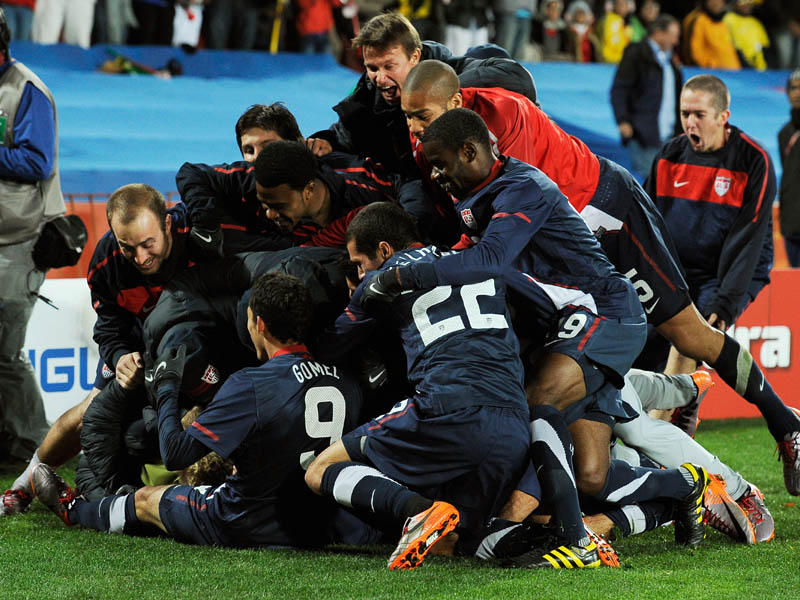
June 26, 2010 - Durban, South Africa - epa02224877 An American soccer fan can hardly watch the USA play Ghana in a FIFA World Cup Round of 16 soccer match in Rustenburg, South Africa, 26 June 2010.

A few days more, and the loss continues to sting. Time heals all wounds, but these wounds will remain open as long as the World Cup continues without the United States as part of it. I certainly can't turn away from the tournament now, not with the greatest drama yet to unfold.


The hangover is debilitating, though. MLS has started up again, and while I peeked in on the opening of PPL Park via ESPN2 yesterday, I had trouble properly appreciating what I was seeing. It was a glorious day for Union fans and MLS as yet another new facility gave the game in America a proper home, and yet I could do nothing but watch dispassionately. The World Cup has stolen my soul.


Oh, I know I'll get it back. Sometime soon, I'll find myself excited again for the domestic league, for watching the silly season exert itself on American interests, and for churning out thousand word essays on the state of this or the problem with that. Something, perhaps just the aforementioned time, will rejuvenate me.


This little dilemma, if it is in fact anything of the kind, has me wondering about anyone not as invested in the sport here as I happen to be. If I'm suffering from burnout, what must half-hearted fans who jumped on the soccer bandwagon with both feet a week or two ago be thinking? Is there any way to conceive of massive numbers of new fans finding solace in the lesser lights of MLS? When put up against the World Cup and the comfortable sports-inspired patriotic fervor of the U.S. National Team, the Philadelphia Union versus the Seattle Sounders will naturally let us down.


So while I love seeing things like the massive TV ratings for U.S.A.-Ghana, and it heartens me to see so many Americans take even a small interest in the game, I know it's all ephemeral. Not because the game can't, or shouldn't, pull people in, but because their palates have been spoiled.


As I wrote for Four Four Two during the heady days post-Algeria (short-lived as it was), soccer gains coverts organically. The big event is actually the worst way to sell the game because appreciating beyond the conclusion of the event requires a commitment to something significantly less attractive. English Premier League followers who reject MLS are prime examples of this phenomenon.


As I write this, MLS has marketing experts desperately searching for ways to leverage the World Cup fad into a positive for the league. I don't envy them their task. Transforming national team excitement into local club interest is not a straight line from "A" to "B", no matter what logic seems to say.


I won't fret if MLS doesn't see some wonderful uptick in attendance and television ratings. I won't process it as a failure on the part of the league or a sign that soccer will never "catch on" here. Instead I'll see it for what it is; another indication that Americans love big events, that millions of minds are at least open to the game, and that slowly but surely the sport will continue to increase in visibility and popularity. The "turning point" is a unicorn. Even a deeper run for our boys wouldn't have changed that from an MLS perspective.


Nothing about the league's mandate has changed because a few million more people watched the world's greatest event for a few weeks in June.


Soccer will continue to grow as a spectator sport in the United States. How quickly that happens has little to do with the World Cup.


photo caricature of a young caucasian man in all blacka and wearing glasses looking snobbishly over his book

Perhaps a bit of dimestore psychology to pass the time? Sure, why not.

Meet George. He writes for a blog called "Chicago Pain", which is part of a site called Chicago Now. I'd never heard of either before today, but then again I don't live in Chicago.


George has a problem with soccer fans. He thinks they're smarmy, arrogant elitists with fancy foreign cigarettes and holier-than-thou attitudes.

You know the type. He's the guy who had the little patch of hair under his lip in college, who later was the first to shave his head as an expression of style. He's the guy who drove a Volkswagen Jetta because of it's efficiency. He's the guy who always had some obscure answer to the "What's your favorite song?" question, and he's the guy who smoked Dunhill cigarettes, but only when he didn't have the time to roll his own.

And now, with the World Cup in full swing, he is -- for once -- an authority on sports.


Ouch, George, ouch.


First, George is generalizing, something I usually take offense to. I've never had a soul patch (well, not just a soul patch anyway), I've never smoked Dunhills, and I've never driven a Jetta. I've also never corrected someone for saying "Two-Nothing", as George describes a soccer-loving friend of his as doing.


But George has a point. Too many soccer fans are elitist jerks, always ready to correct a neophyte's lingo or scoff at someone's lack of in-depth knowledge. As the game becomes more popular here, which unfortunately for George it will continue to do, there is an onus on these know-it-all fans to tone down their act. You're not special because you're an American who happens to know a little soccer. You're not special because you know the clever nicknames they use for players on Merseyside, or that Juventus modeled their kits after Notts County. You're certainly not special if you call it "football", and if you take offense at the use of the word "soccer", you're nothing but a pedantic ass.


If you know your soccer, that just makes you a little more informed; if you take the tack of teaching rather than telling, you'll be doing the game a lot more good than if you choose to play the snob.


The sport isn't supposed to a secret club meant only for people too good to slum with the general sports masses. Anglophilia need not be a prerequisite. It's okay for other people to like it, for ill-informed fans to yell about it, and it's okay that they say things like "field" instead of "pitch", "nothing" instead of "nil", and "soccer" instead of "football."


But, again unfortunately for him, George is not innocent in this little dilemma. He clearly brings biases to the table, and as I said before, generalizes to a fault. If he doesn't like soccer that's fine; but George is making a mistake if he's rejecting an entire sport because of a few individual fans. It makes me wonder if he's already a fan of MMA or if he's inclined to become one - holding that sport to the same standard as soccer should result in a similar rant. I know it would from me, if I was at all like George and judged mixed-martial arts by a few annoying "experts."


Here's the rub, though: George's issue isn't really snooty-soul-patch guy. George's issue is the "force-feeding" of soccer to the American people, as if the media companies are attempting to create a market where one doesn't exist. To wit:

For the millions of casual sports fans across the country, the World Cup can be an exciting event. Enjoy the competition, the traditions, and the sound of bees. It makes for some great entertainment.

For the thousands of American soccer "diehards" -- enjoy your time as an expert. Smoke your Dunhills, wear your colorful jerseys with the royal embroideries, and listen to The Smiths.

But, please -- for the love of the Queen -- stop trying to force-feed it to the rest of us. Once the World Cup is a memory, obscurity will once again reign over the soccer world.

The chances of it becoming what you have forever envisioned it being are, well, "nil".


George puts the onus on the "soccer die-hards", claiming they're the ones doing the force-feeding. But unless George is being dragged to soccer bars by packs of Jetta-driving, Guardian-reading, scarf-wearing super-snobs, held at gunpoint and told it's watch a soccer game or be shot, he's not being "force-fed" by the die-hards. It likely that George's problem is really with ESPN, the traditional mainstream media that has embraced soccer for the summer, or other outlets that previously showed little interest in soccer. If that's the case, I have a message for George.


It's not "force-feeding" if there's a market. There are millions of people inclined to the game, George, and it's in the best business interest of sports and news outlets to cover it. It's also not "force-feeding" if people can opt out, which unless ESPN et al are doing the gunpoint scenario mentioned above, everyone can. George seems to be unwilling to accept a changing sports environment, and is lashing out at soccer. It all comes off a bit sad.


As for the generalizations George makes, let me just hip him to a few facts. There are millions of soccer fans who reject the elitism. There are millions that don't care what you call the sport or whether you say "nothing" or "nil". There are millions that would love to take you to a game and buy you a beer, letting you fall in love with the sport on your own and without pressure. There are also millions that don't care if you ever learn the game, care about the game, or even watch a game. Amazingly, it's almost like it's just any other sport. For a lot of us, it's really just one of our passions. We like other sports, too.


Drop the "force-fed" canard, George. Oh, and get some new soccer-loving friends. Yours are obviously jackasses.


On Friday, while still attempting to come to grips what happened on the field in Johannesburg, I made the statement (on Twitter) that the sport of soccer might pick up a few converts because of the controversy. "Americans do indignation well" was the basic point of the comment.


The supposition isn't particularly clever, but it appears I was right; casual fans picked up the "we were screwed" in a big way over the weekend. That doesn't mean they'll all stick around, but if their curiosity is piqued, that's step one in growing the game's fan base. If the U.S. can win on Wednesday and roll into the knockout round of the tournament, most of those people will be along for the ride.


But Friday's events are a double-edged sword when it comes to attracting fans. Righteous indignation pushed them into the figurative stadium, but the murky nature of soccer officiating could very well pull them out. Discussion about the controversy on sportstalk radio this morning (a positive sign) turned quickly into a loud lament on officiating standards and accountability. ESPN's morning team simply could not get over the fact that the referee can call a foul without ever having to explain what the foul was or who committed it. Instead of reveling in the U.S. comeback or talking about the potential for making the second round by winning on Wednesday, uninformed soccer neophytes chose to rail against FIFA's nonsensical rules.


I don't blame them, and I wonder how many potential fans might be turned off by the same issues. American sports require that officials clearly explain their calls and identify the perpetrators; even if they get something wrong, we at least have the ability to hold the call up to scrutiny. Not so in soccer, where even a post-match report is likely to omit a call like the one in the Slovenian box on Friday. Invested soccer fans might be able to swallow hard and deal with this problem, but how many new/potential fans might decide it's not worth it?


I've reached the point where I've stopped worrying about what the casual/non-soccer fan will make of the sport. The game speaks for itself, and if most American choose not to listen, it's truly their loss; for me, none of the negatives are so great as to make the game unpalatable, and I chalk up intransigence to pre-conceived and flat out incorrect notions about the game. But this little problem, where referees have total control and are rarely accountable for their decisions, and never within the match, is tough to explain away as just a quirk of the game.


The Land of Milk and Coca-Cola

Saturday, June 19, 2010 | View Comments


Well, I had meant to do this post yesterday but they wouldn't let me off suicide watch, even after I explained that my emotions were more likely to manifest themselves as physical violence against others (specifically referees and citizens of Mali) rather than myself.

It's been just over a week since this tournament started, and we've seen it all, to dust off an old chestnut.

We've had skull-numbingly boring games like France - Uruguay and Ivory Coast - Portugal, and thrilling encounters like Cameroon - Denmark and Slovenia - USA.

We've seen perennial favorites crushing group minnows (Germany 4-0 Australia), struggling with long-shot no-hopers (Brazil 2-1 North Korea), being held even by presumably inferior opposition (Italy 1-1 Paraguay), and stunningly getting knocked off their gilded pedestal (Spain 0-1 Switzerland).

As a fan, I've gone through a dizzying range of emotions. I've been disappointingly leaden-stomached (Gerrard's goal), ecstatically light-headed (Clint's equalizer, helped by Rob Green), flag-wavingly triumphant (getting a draw against England), heartbreakingly disappointed (Going 2-0 down to Slovenia), and bile-spewingly outraged (Mo Edu's goal).

But the thing that has surprised me most is not how I've experienced this tournament, because there was no chance that I wouldn't be unhealthily obsessed by it. No, the most surprising thing is just how mainstream our beloved sport has gone in the last week. In 2002, if you cared enough to be slightly miffed by Torsten Frings's handball, you were either a girl (they were allowed to enjoy soccer), or an odd, basement-dwelling shut-in who wasn't man enough or athletic enough to play a "real" American sport. Now, if you aren't screaming for the head of Koman Coulibaly, you're simply unpatriotic, and not a real sports fan.

There will be plenty of people for whom this is the beginning of a life-long love affair with the beautiful game. They'll travel vast distances attend USMNT games, follow a European club in bars on winter mornings, or buy season tickets to Major League Soccer matches. They'll be hooked by the culture within the game, the passion of the supporters, the grace and power sport itself, and they'll pass that onto their kids, their families, and their friends, helping perpetuate the growth of American soccer. They'll become one of us, the existing collective of US soccer die-hards.

It's a bit heady, and of course, there will be people who won't really pay attention until the next World Cup, filing away the World Cup next to the Olympics, the Tour de France, and the Kentucky Derby as occasional "events" rather than seeing it as part of the greater soccer narrative.

They will be joined in their indifference by the same troglodyte mouth-breathers who spend more time badmouthing our sport than watching theirs. We won't convince them that our sport has just as much validity as any other, and frankly, why would we want to?

Finally, and perhaps most importantly, there will also be some who become casual fans. They'll watch the big Premier League clashes, Champions League matches, US World Cup qualifiers, and the MLS playoffs on TV. They might get along to a game or two and buy a jersey, if we're lucky. They're the biggest group out there, and the ones who will ultimately decide the future of our sport. Winning over the casual sports fan means viewership, investment, and cultural legitimacy.

That the World Cup has that legitimacy is an indisputable fact. The World Cup, as a huge, all-encompassing, attention-hogging event, has made it in America, in spectacular fashion, and aided by a very good and phenomenally interesting USMNT. Right now, Landon Donovan is bigger than Kobe Bryant and Tiger Woods put together.

The trick will be to extend that reach, to get those casual fans watching game after game of the World Cup to watch the Champions League, the Premiership, the US National team, and most crucially of all for American soccer, MLS.

The next six moths are the most crucial in the history of the sport in this country. Will we be welcomed into the pantheon of the NFL, MLB, NBA, and NHL? Or will we continue to be a big deal every four years, but a niche sport, albeit one growing slowly and steadily, in the meantime?


I recently did a quick interview with Ed Pilkington, a Guardian writer based in New York, on the popularity of the game in the U.S.


I'll admit, I come off a bit negative in the piece, and while Ed didn't misquote me, there is a bit of context missing. We talked for five minutes, on everything to how the U.S.A.-England game was covered to the rising tide of soccer interest in the country.


Unfortunately, I'm a victim of perspective, and instead of painting what might be a more accurate picture of the state of international soccer's popularity (the focus of the story), I relied on my own recent experience. I rarely talk soccer with anyone outside of my home, a situation that boils down to work and family life dominating my time; the ubiquitous nature of Internet soccer talk in my day-to-day means I live in a pretty secure little bubble of influence. There may be thousands of people walking down busy American streets every day sporting the latest in soccer gear, and there is probably an office or two where the World Cup is water cooler subject matter. Alas, that's not how it is for me.


And the other thing, saying that it would be hard to see the U.S. getting past Germany? I'm not sure I need to analyze that one. Of course, anything is possible.


The juxtaposition of attitudes from me (an American) and Christopher Harris of the Talk sites (a Welshman) is certainly noteworthy.


Read the story, let me know what you think.


Stop Asking the Question

Wednesday, June 16, 2010 | View Comments
A USA fan cheers prior to the Group B match at the Royal Bafokeng Stadium in Rustenburg, South Africa on June 12, 2010. UPI/Chris Brunskill Photo via Newscom

I knew it was coming, yet somehow I wasn't prepared. The quadrennial explosion of commentary on soccer's place America has hit me squarely in the face frying-pan style, and I'm not handling it well. It's edging me quickly to a meltdown, something I'm desperate to avoid because I realize the the stupidity of letting it all get to me.


But it's not the "soccer is a foreign sport that will never catch on in America" crowd, which slammed its bloated ass right down on the "not enough scoring" argument and refuses to budge. It's not the blowhards on the Right turning soccer into the nativist's wet dream of stereotypes they disgustingly throw up as an example of American culture's supposed downward spiral. It's not the ICBMs of patronizing language launched from across the Atlantic that America's efforts to play and understand the game are laughable and naive. It's not even painfully unfunny sports columnists latching on to the game like leeches, sucking with all their might for a tiny bit of bloody fodder to fill up their inches.


Nope. None of that really bothers me. I can compartmentalize the vacuous holes from which prattle like that emanates, setting them aside cleanly; even when that's made difficult by a particularly noxious bit of bluster, they soon fade out, as if they were the vuvuzelas of the World Cup conversation. Annoying, certainly, but hardly a major distraction.


What is getting to me is the question. You know the one I'm talking about - it pops up every four years in June, goes something like "Is this the year soccer finally becomes big in America?", and spawns article after article proposing why soccer's time has finally come. The question is ridiculous, as are any tidy summations that attempt to answer it, and I'm ready to murder my newsreader as a result. It would be a mercy killing.


The problem with the question is that it rests on two annoying, and incorrect, assumptions. One, that soccer isn't already big in American (it is), and two, that soccer's popularity can or will explode overnight (it can't). Even if the U.S. National Team goes all the way to pull off the biggest miracle run in the history of international soccer by winning the World Cup, soccer's front-pageiness (yeah, I made that up) would be ephemeral. Soon enough, the talking heads and columnists would turn their attention back to Kobe v. MJ, the labor dispute in the NFL, Tiger's petulance, etc. Soccer would be but a blip, even with the greatest title in world sports in American hands.


The game is growing in popularity, period. Quantifying how much it's growing is difficult. Pinning down the moment, be it now, five years from now, or a generation on where it "turns the corner", "breaks through", "blows up", so on and so forth is as annoying as it is unnecessary.


So stop it. I like my newsreader, it would be pity to have to put it down.


Minding the Inevitable

Monday, June 14, 2010 | View Comments
Soccer fans watch the World Cup Group C soccer match between England and the U.S., at a bar in Chicago, Illinois June 12, 2010.   REUTERS/Jeff Haynes (UNITED STATES - Tags: SPORT SOCCER WORLD CUP)

You, my dear friend, are being begrudged your passion. While you were doing your psychic beast to will the United States to a victory on Saturday, while you reveled in the match-ups of Sunday, and even while you sit in a cubicle surreptitiously monitoring streaming videos of Monday's matches, you're being begrudged your soccer. ESPN is bringing you the Cup, but several of their personalities would prefer that weren't the case. Millions are watching the games, but millions more reject it. The U.S.-England match made headlines, and Bob Bradley's team started their World Cup with a half-step towards their goals. Still, the tone from certain quarters is the ridiculous and predictable, like tantrums thrown by toddlers when forced to take a bath.


Waaah, soccer is different and people that don't look or talk like me play it.


As Soccer Politics rightly points out, this dance is neither new nor will it end any differently than it has before. Those of us who appreciate the game will continue to do so, and those with entrenched viewpoints in opposition to a sport will continue to use it as an anti-immigrant, anti-socialist, anti-American straw man. The best thing to do is sigh and move on.


Because this segmentation of the American view of the greater world, of which soccer is an intrinsic part, is hardly notable. This is a big country we live in, with 350 million people sharing the title "American" despite stark differences in cultural upbringing, worldly sensibilities, and our understanding of just what makes any of us "American" to begin with. To believe that there won't always be hold outs, "entrenched" as Soccer Politics labels them, is fantasy. It's equally delusional to think that the entrenched won't always have their champions.


The fight, if we're being honest, is already won. The televisions ratings for this World Cup are justifying ESPN's financial commitment. Our domestic league continues to grow, and even with bumps in the road certain to appear, shouldn't be going anywhere. Our TVs are packed with North American, South American, and European versions of the sport on a weekly basis. None of those things are likely to change.


Which means that the only reason for us to harbor hard feelings when the Glenn Becks and Mike Florios spew forth with nonsensical criticisms is if we're intent on soccer "taking over". If you dream of the day that a soccer match out draws the NFL for television viewers or MLS is dominating headlines in places like ESPN and Sports Illustrated, then perhaps you're angered by the usual suspects taking to their soapboxes and lashing out at your game. If you self-identify as a soccer evangelist, or feel deep down as though you're a member of the Righteous Soccer Army taking on the clueless rubes who deny the sport's brilliance, then Beck, Florio, and the rest probably boil your blood. I suppose it's understandable.


But while you're doing that, letting people whose opinions matter little in the grand scheme or won't have any bearing the future prospects of soccer in America get your proverbial goat, I'll be over here enjoying the games. Fighting that "battle" is not only tilting at windmills, it only leads to maddening frustration. I for one, have taken leave of the proceedings, having learned that soccer's state is solidly one of constant advancement; the only reason to fret is if we believe it's not moving forward fast enough. Considering the environment and the variables, it just as easy to argue the opposite. To be sure, loss of ground simply isn't happening.


Militancy is rarely the answer, and inevitably draws backlash. Not constructive, but destructive.


Soccer's history is rich. Its past is rife with political shadings and cultural significance almost everywhere but here. For some, the game isn't just a sport, but a symbol, its image easily manipulated by those whose sit on both sides of the divide. In America, soccer is often less sport than it is scapegoat or idol.


But try to remember, everyone, that is just a sport. One that isn't going anywhere.


    KKTC Bahis Siteleri, Online Bahis

    Legal


    Privacy Policy