- Jason Davis
Soccer isn't just a game, this much we know. It's life and death, birth and rebirth, the athletic embodiment grit and bravery, and expressions of supreme skill and beauty all perfectly contained in ninety minute windows of time that have on their own shaped cultures, raised men to god-like stature, and spawned the flowery prose of many a wistful scribe whose milieu is sport and whose frustrations at his own athletic failings manifest in the appreciation of grown men playing a game.
The American analogue is baseball, a sport with a ponderous rhythmic cadence and reliance on blind luck that has given us David Halberstam, George Will, and films about the game that rely as much on magical notions and homey nostalgia as they do the play on the field. Romance is a part of the fabric of each sport, particularly in those cultures that birthed them; do the Japanese conjure ancient greats materializing from cornfields with anachronistic tools in hand, representing idealized imaginings of men who have long since turned to dust, but who we are certain ache in their eternal souls to recapture the past glory of their earthly athletic exploits?
The English staked their founders' claim to the pining for simpler days, the lamenting of passe strategies, and the debate over how best to play the game of football long ago. Even while giving lip service to the aesthetic pleasures of the swashbuckling Spanish and the flowing niceties of those foreign intruders whistling the ball along the ground at the Emirates, they struggle with the evolution of a sport that once represented the earthy doggedness of the blue collar Englishman. To let go of Route One is to let go of a part of what makes them English; just as the loss of the Dodgers forever scarred Brooklyn and the advent of million dollar contracts irrevocably changed the sport of baseball and spawned the laments of an aging generation, the smaller, connected world has created a existential crisis for those who feel hereditary ownership over soccer.
Is it improvement? Is baseball "better" now than it was in 1955? Has the shift in football culture in England, one which rewards big spending teams that often go abroad for talent, stolen something from the sport, or more pointedly, what it means to be a football lover and English?
The only certain thing we can say is that time has changed our world, and sport is no exception. Though different is not always better, elements of that change are almost impossible to color as negative. No writer, no matter how much he pines for the days of DiMaggio and Williams, would claim that baseball did not benefit from racial integration; still, while today's players expand in physical ways inconceivable in the 1950's, those fonts of wisdom might bemoan the loss of "small ball" or pine pathetically for shortstops whose brilliance laid in their defense and speed and not their ability to blast prodigious numbers of four-baggers. The same goes for the denizens of the direct English version of what the world calls football, men who recognize progress yet cannot rid their minds of the nagging sense that they betray themselves with every piece of Barcelona-directed praise.
Brian Phillips explores this dual-mindedness at The Run of Play, specifically the notion that beautiful football and the point of the game, to win, are indirectly painted as mutually exclusive by English writers who are hedging their bets with “the rhetoric of approving by disapproving” when addressing an issue Brian calls the "tension between utility and aesthetics."
Unlike baseball, a professional sport which exists in a North American cocoon still unchallenged from leagues abroad, American soccer is left to deal with the repercussions of this lingering debate. Even while MLS exhibits a style somewhat similar to the bygone days of First Division football, it suffers from a deficit of respect when compared to the modern game in England, Spain, and Italy. Nostalgia, and specifically the idea that there is still room in the game for utility to win out over aesthetics, does not travel; what is fondly remembered by the curators of football's ethic in England is not appreciated by the knowledgeable fans that inhabit America.
There are likely many reasons for this, many of them directly related to technology and the inundation of high-level soccer American fanatics experience on a weekly basis. It's all there for the asking, and much, if not all, of it is better than what we can see by driving down to our local MLS stadium. Lacking the resources to populate the league with players capable of the feats we see on satellite television and computer screens at the push of a button, American soccer is forced to soldier along, often at odds with itself and striving to be something it can't possibly be. At least not yet.
In a sense, the timing could not be worse for MLS. It exists in the expansive quilt of football cultures spread across continents and connected by the threads of instant communication. Nothing it can do, with its minimal budgets juxtaposed against a sports-obsessed society conditioned to seeing the best play their games for the most money, will make it relevant in short order.
The English proponents of utility aren't the only ones fighting against a ground-in ethos; American soccer does the same, enacting one-off rules to encourage splashy signings and attract high-quality talent, all the while rooting itself in financial restraint that guarantees direct and physical will almost always prevail over artful and sublime.
By the time, or if, professional soccer in America becomes the highly-refined and skillful game being played in the top leagues of Europe and South America, the days of romanticizing a simpler game will likely be long in the past. Technology will bury that notion, just as it has buried the idea that MLS can just be, without having to live up to an impossible standard set by leagues with a century of history behind them. We'll just have to leave that to the baseball writers.
Showing posts with label English soccer. Show all posts
Showing posts with label English soccer. Show all posts

While debating the issue of ESPN signing up only British voices for their World Cup match coverage on the most recent American Soccer Show, I found myself arguing more strenuously against the problem of American soccer appropriating English/British football culture than the actual announcers themselves.
This is a pervasive problem (and if you have an issue with my characterization of it as a "problem", you're more than welcome to disagree in the comments) that extends not only to the soccer fanatic's general preference for English announcers, but to more widespread issue of taking our cultural cues from the Old Country.
This all stems, of course, from the common language. Without it, England would be just another football-mad country that cares about the game way more than we do, no different from Spain, Italy, Germany, etc. But because information flows freely across the Atlantic without the need for pesky translation, Americans absorb the English game and opinion on it naturally and without effort. It's why the English Premier League has so many fans here, and why a strong streak of inferiority runs through too much of American soccer's fan culture. Still, it would be amazing if we didn't defer to our colonial progenitors in some way.
Which is why I struggle with the larger question of just how much of an imperative there should be for American soccer to develop its own identity. And by "American soccer" I mean less the youth team machine, which is a major part of any discussion but remains oddly detached from the highest levels, and more the appreciation of the professional game; we have our own leagues, we have a pretty good national team, and we have a history. So why then should the English version of things have such an impact on how we view ourselves?
I'm generalizing, of course, because it's the easiest way to paint the picture and the simplest way to convey my thoughts. There are many, many, Americans who can both appreciate the English and Scots, enjoy their brand of football, and listen to them pontificate without turning their noses up when their Yank counterparts get in on the act. But there's also a large segment of the American footy-loving populace that refuse to believe Americans capable of much when it comes to the game, be it playing it, announcing it, or otherwise. This attitude holds America back from developing its own unique soccer culture, one that sets it apart from our Anglophone cousins while properly recognizing the strong connections that exist between us.
We're conditioned, as fans, to believe British is better. ESPN's decision on their World Cup announcers is just another example that the media decision-makers understand that fact; add that the country's highest profile/most popular soccer radio show is hosted by Brits and that Brits populate the analyst chairs on our studio shows, and it's clear that as a soccer nation we struggle to assign credibility to those with American accents. The inevitable consequence is that aforementioned inferiority complex; not only do we defer to the British on matters of opinion, we begin to feel anything done by Americans is inherently less valuable. This sense of inferiority colors how many of us view any domestically-bred soccer, including our nascent top-flight club competition, the efforts of our national team, Americans as players, coaches, etc.
If it's American, it's can't possibly be good.
Back to that pesky ESPN World Cup announcer for a moment. How much of the backlash I've received for my stance on ESPN's decision is related to conditioning? I believe that people are being honest when they say that the choices are good because "there are no good American announcers", but the cynic in me finds it hard to accept that that at face value; American announcers are held to such a different standard than their British counterparts that I wonder if fans aren't simply deferring to the accent rather than objectively assessing the abilities of the announcers in question.
Any criticism of Martin Tyler is anathema, of course, so I play with fire as I type.
But focusing on the individual comparison (i.e., Martin Tyler v. J.P. Dellacamera) misses the point; the issue isn't "who's better", but rather why an American network is turning wholesale to foreign voices. Again, the common language makes it easy, but that doesn't mean that there's not room to question the cultural (strictly in terms of soccer) implications. The continued appropriation of English football culture for a burgeoning American soccer culture does this country no favors as it grows with the game.
The English invented the game. They took it around the world, spawning soccer-mad cultures in nation after nation. Those countries made the game theirs, developing their own unique flavors and idiosyncrasies that make the sport the world's game not just because it fit in so many cultures, but because those cultures made it fit them. In a time before instant communication and where language was a serious barrier, the Italians, Germans, Brazilians, Argentines, and others were able to create their own soccer bubbles where an organic cultural growth wasn't hindered by the expansive shadow of the English originators. In terms of a more popular American sport, this is similar to the growth of and development of baseball in Japan; the game is the same, but the culture, approach, and style is something different.
The modern world of television and the Internet might mean we'll never escape that English shadow. A distinct, separate, and unique American soccer culture will always be slow to develop as long as the English loom just over the horizon, ready to critique and influence everything we do. Fans here might always defer, always see themselves as more inclined to the British game and voices, always unsure that Americans can fill any of the roles as competently. If we've passed to point of no return on becoming hopelessly conditioned to English football over American soccer, it's probably too late.
Elitism, combined with the sense of inferiority, has too many Americans ashamed of their nationality when it comes to the sport of soccer. It's not enough to love the game, appreciate it in all its forms, and accept that things here will be just a little different. The uphill battle to respectability for our leagues, our players, and our media (announcers included) will be a long and difficult one as long as Americans can't see value in soccer being American, and that being just fine.
I realize that I've probably offended a few people with this, or that it might come off as jingoistic (it's not). All I would ask before you lambaste me via the comments (which you're certainly allowed to do) is to think critically about what I've put forth here; if you have never questioned why you might prefer English to American, now might be a good time for self-examination. And with that being said, I'll admit to my own prejudices, and note that my opinions here are born somewhat out of my own desire to understand the phenomenon as it relates to my soccer appreciation.
There's nothing wrong with preferring English accents, or identifying English soccer as better (of course it is); there is something wrong in my mind, however, with preferring English over American to the full exclusion of the American.

I'm going to be extremely busy today, so I don't have time to give the things on my mind the usual wordy treatment; instead, I hope to give you a few quick hit posts on various topics whenever I have a few moments to spit them out. Here's the first.
When it comes to securing investment in the future of American soccer, I suppose beggars can't be choosers. Although it may seem as though big money is lining up across the country to buy into Major League Soccer, you can never have too much interest, especially from people who know and love the game.
That's an easy answer to the question "Why is Don Garber asking English clubs to invest in MLS?", though it ignores the problems such investment would create. More than any other sports league on the planet, perhaps, MLS is constantly struggling with determining exactly what it wants to be. Stand alone top flight product (which would require taking the cuffs off but might mean instability)? Safe, locked down, investment with little risk but an excruciatingly slow path the relevancy?
But a minor league for our Anglophone cousins? Yes, I realize that one or two English clubs investing in MLS doesn't equal appropriation of the league; but it's a dangerous path to go down, especially in light of Chivas USA's struggles to tap into the massive existing fan base of their Mexican mothership. Can we take Manchester City's money without giving them a club?
There are few steps between what I fear could happen and what Garber is suggesting. There's no certainty English clubs will be scrambling to take him up on his suggestion. It's just a distasteful image, the commissioner walking around England with his hat out, soliciting for investment from abroad. The American game needs more Americans involved, not Brits looking to franchise their brands to the US.
I'm also curious how any of that would work with the restraints the league places on player movement and team spending. City would be okay with not being able to sell or buy a player unless the league says it can? Somehow I doubt it.

We're going extra deep in this round, to places that soccer fans would almost never find themselves (unless you were looking for them), so bear with me.
An intelligent friend of mine recently commented that sometimes American soccer fans work too hard to force their "differentness" on others. He meant the statement in a myriad of ways, but most pointedly about the innate need of some to separate the game from the big American sports through deference to mode of competition used in places like England and Spain. He's passionate about his soccer, but advocates for things "traditional" fans usually don't, like conferences, unbalanced schedules, and evaluation of players through statistics; for many, those things are anathema, "American" ideas that have no place in the sport.
But each of his views are equally as valid as anyone's, and unlike some fans, he makes it a point to back them up with reason and logic. Give him a few minutes, and he just may have you convinced that MLS needs a conference system with an unbalanced scheduled to accentuate regional rivalries. He rejects the notion that soccer fans are "special" and therefore need to push for our leagues to operate differently from the tried and true methods of other domestic sports; we're just fans who happen to like a game that has yet to catch on with the masses.
My point, if I can ever meander my way to it, is that the "uniqueness" of being a soccer fan in a country that doesn't generally embrace the game is part of the draw for many who follow it passionately. Caring about soccer makes some of us feel like we're part of a special club in which only a select few have membership. In other words, it's cool because it's not popular.
Most of us, even if it were the case, wouldn't voluntarily admit to this snobbery. Not this guy, who somehow turned a post about a song on his iPod into a whine-fest about soccer becoming too popular. I guess some people would just prefer that the sport stay "undiscovered" in the United States. Yea for exclusivity.
- Meanwhile, a Northern Ohio paper tells us the story of two English brother playing high school soccer in the States, with the reminder that all is not always black and white when it comes to the way the game is taught between the two Anglophone nations. Too many of us take it as a given that coaching is better there than here; that might be true for the famous academies of England's biggest clubs, but doesn't necessarily hold on other levels. Then again, maybe the English kids are just trying to be nice.
- Michael Brett at Pop Matters gives us something I'm surprised we don't see more often: a piece on the similarities and parallels of the world's two biggest "football" leagues, the English Premier League and the National Football League. As America continues to embrace soccer on a larger scale, and because the Prem dominates headlines and attention in that realm (for better or worse), the two leagues are bound to become more and more linked in subtle ways. How long before millions of Americans are spending their Saturday mornings at the pub watching English football and their Sundays at the bar watching the American version?
- Finally, a young writer in Canada attempts to put the issue of looks and talent in context, using Mr. Beckham as an example, and wonders why sports fans (both men and women) can't seem to rise above carnal instincts when observing the opposite sex playing the game. While her question is clearly broader than soccer and is focused more on gender roles than anything else, I find the subject fascinating, and certainly believe that "attractive" players often receive more praise than they may actually deserve. It's not a hard and fast rule (see Ribery, Frank), but it clearly plays a role the way certain players are viewed.

It’s great to have the EPL back. The famous names and great teams have returned - Chelsea, Manchester United, Arsenal, Liverpool - as have the not-so-great and not-so-famous - Bolton, Wigan, Fulham, Burnley. Still, even at the bottom, you won’t see my team there.
Dig deeper. Drop lower. Have a peek through the Premier League’s trap-door down at the Championship table. Again, there are some big names here – Nottingham Forest, Newcastle United... It’s a good league, the Championship. Separated from the EPL by just a promotion/relegation corridor it’s not hard to see how some of the shine of the top flight has rubbed off. You won’t see my team there, though.
Keep descending, keep dropping through the lower divisions of English football. It’s getting murky, and with each step away from the EPL’s dazzle it grows a little grimmer. We’re in a strange land now, a land filled with Huddersfield Towns, Accrington Stanleys and Dagenham & Redbridges. The third and fourth levels of English football come and go in a blur of Pukka Pies, hoofed clearances and creaking terraces, but, still, you will not see my team.
We’re here! Far beneath the bright, shiny Premier League, deep below the fresh, ultra-competitive Championship, and even below the muddy, muggy no-man’s land of League 1 and League 2 is a strange division. Amazingly, even at this depth football blossoms. Congratulations – you have just reached the Blue Square Premier, England’s fifth division – a bustling, quirky 24-team skirmish that grips its dedicated but slightly misguided fans every Saturday from August to April.
And, yes, half-way down the table, you will find my club: Rushden and Diamonds FC - the 103rd best-team in England.
I’m aware that a site mainly intended for American soccer fans is probably a bad choice of platform for an article on the BSP. But down here in the warm, serene half-light of non-league football we fans enjoy an unusual position in English football, and an unusual perspective. At the lowest point of the English professional game, in a league overshadowed by the EPL, nowhere is the divide in the modern game reflected upon more than down here.
Attendences and monthly wages are often triple-figured, while, without wanting to fall into the trap of patronising the league, strikers can deliver the goals on Saturday and deliver the neighboroughood milk on the Sunday. Retirement signals employment wilderness – a thirty-something year-old with nought but “footballer” on his CV is a worrying position to be in. Fans, too, must sacrifice. Travelling hundreds of miles on a wet Tuesday evening to see Barrow play Eastbourne instead of enjoying a cosy evening in front of televised Champions League football can be as unrewarding and uninspiring as it sounds.
Don’t get me wrong. Non-league football is great, full of idiosyncrasies and local heroes and memorable incidents. Like the time a striker for my club has his goal ruled out due to a combination of poor eyesight on the referee’s part, and a poor quality goal net. Or that Pancake Tuesday when a group of fans were pelted with eggs and flour thrown over the terrace wall (someone forgot the milk, it seems). A picture doing the rounds of the non-league forums (below) shows how a group of fans made full use of the ample space in the terrace to tell the opposition goalie what they thought of him. Only in non-league.

Allow me to make a barely tangible link to the Little Mermaid song:
But that is a big mistake,
Just look at the world around you,
Right here on the ocean floor,
Such wonderful things surround you,
What more is you lookin' for?”
It’s true. All teams aim for promotion but, simply, the BSP is not that bad. It’s competitive, it’s got great fans and the best mix of teams and quality than is most other leagues. What’s not to like? Yes, if I was offered the chance to see my team promoted to the heady heights of League 2 I’d jump at the chance. But, right now, it’s not too bad at all.
Other than the clearly inappropriate reference to the ocean floor, there are few better pieces of music that sum up life in the lower-league than the one sung by a talking Jamaican crab. And that, I can’t help but feel, is entirely suitable.

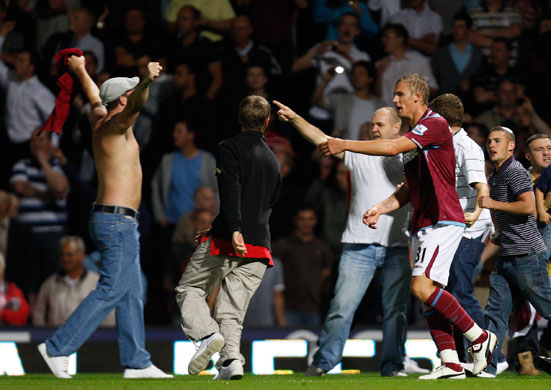
"A certain element smiled when West Ham and Millwall were drawn together, while the rest of football held its head in its hands. When those two teams meet it goes beyond football and the game should not be punching itself on the nose over what happened." So says ex-hooligan Cass Pennant about last Tuesday's events - which have now been dubbed the "2009 Upton Park riots".
Those of you who watched the film “Green Street Hooligans” will remember the part in which bitter rivals West Ham FC and Millwall FC are drawn to play each other in the cup. Various hooligans punch the air, children cheer, while Elijah Wood’s character exhales sharply - “Ooof”. When the League Cup draw was made in mid-August and the two teams were pitted against each other in real life, “Ooof” seemed the most appropriate response, then, too.
The match was to be the first time the clubs had faced each other in over four years. Meanwhile, West Ham fans needed no reminding that it was eighteen-and-a-half years since they had last beaten their opponents. The League Cup second round, one of the least inspiring dates in English football, had a decidedly spicy appeal to it. While other cup matches around the country experienced lower-than-average attendences and little or no interest, the game attracted the largest audience of the night (although the lack of women and children at the game was noticable and reflective of the match's imfamy).
What happened before, during and after the match has been reported and televised non-stop. Before the game the opposing sets of fans clashed, resulting in a man being stabbed (he is in a stable condition) and over twenty other men being injured. During the match (and it is strange to think behind all the violence a fairly meaningless football match was taking place) the pitch was invaded by West Ham fans three times. After the match fans and police again clashed.
The most powerful aspect of the above video is the noise at the 50 second mark. The wall of shouting men, stamping boots, obscenities and missiles. Its been decades since that wordless sound has reverberated around London and its football grounds, but on Tuesday it was back with a force. The 1980s-esque hooliganism was backed up by 21st century technology, with forums and messageboards being used to organise clashes. "Bring your bats and don't bring your kids" read one of the posts.
The threat of copycat events in the coming weeks is a worry, as is its effect on England's bid to host the 2018 World Cup. The most worrying aspect of the evening, however, was that is stamped out the belief in this country that football was now hooligan free.