Showing posts with label Television. Show all posts

Replacing Dellacamera

Wednesday, March 02, 2011 | View Comments

- Jason Davis

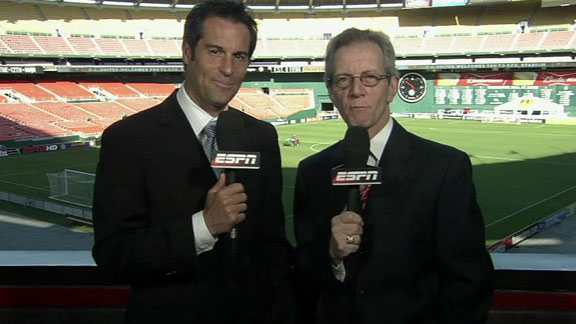
Love him or hate him, JP Dellacamera has served American soccer admirably during his three decades calling every form of the game imaginable. In recent years, as the lead American voice on ESPN, Dellacamera called the MLS weekly broadcast as well as National Team games for both the US men and women. That run has now come to an end with Dellacamera switching over to FSC.


A few months back, when reviewing my television service, I made a bold decision:


It was time to switch to DirecTV.


Now, there were several factors that played into my choice to switch, not the least of which was some potential savings (at least for awhile) and a wider selection of HD programming. I'm not necessarily an HD snob for most things, but I do enjoy sports in high definition; I bought the HDTV, I should get some use out of it, right?


One of the HD channels I assumed would be added to the DirecTV lineup, and the one I was most excited about getting, was FSCHD. Fox had finally made the investment in their little soccer channel and bumped up production to the current standard for signal quality; considering that Fox Soccer Channel is home to EPL, MLS, and Serie A matches, this was big, big, news for any footy freak. Finally, the glories of Anfield, Old Trafford, etc. (to say nothing of their MLS Game of the Week), would be visible in a crisp, clear picture more often then the once a week provided by ESPN.


I waited anxiously, expecting the usually-prompt DirecTV to add FSCHD at the earliest possible date. I gritted my teeth every time Christian Miles told me that a game was broadcast in glorious high definition, and I fumed when the network put the "HD" symbol in the top right corner of the screen.


HD? What HD? I don't have it in HD, so why are you saying it's in HD?!


Still, my frustration with FSC is a bit unfair. I know they're providing an HD signal, and it's not their fault that DirecTV hasn't added it; so even though they're technically lying, someone somewhere is watching the game in high def. Just not anyone subscribed to DirecTV.


Eventually, I stopped worrying about it. Even though I still saw the "HD" symbol on my grainy picture, I simply assumed that the channel would be added shortly, I'd forget about my anger, and everything would be right with the world. Besides, the DirectTV twitter account had responded to my question about FSCHD and said something about a new satellite. It had to be coming, they said it was coming. So when is it coming?


It's April, and there still is no word on FSCHD being added to DirecTV. It won't be added in May, either, according to an announcement by the satellite company on new HD channels.


I'm feeling like quite the sucker today.


I'm sure there are many of you who either don't have DirecTV or don't care about HD enough for this to be an issue. Good for you, really. But I and many others are more than a bit annoyed at this point, and I think it's time for a bit of action.


If you have DirecTV and want FSCHD, send them an email demanding it be added. At this point, all I can find is an email form through their website, which means entering your info; if I can find a direct email address, I'll update this post.


I'm sure people have contacted DirecTV about this over the course of the last few months, but we need a concerted effort here. The more emails, the better, so let's hit 'em hard and fast.


Get everyone you know involved, and give DirectTV no choice but to get Fox Soccer Channel in HD added to the lineup.


MLS First Kick or March Madness?

Thursday, March 25, 2010 | View Comments
Qwest Field

Here we go. First kick is here, and I'm beyond ready. I'm so ready, in fact, that I completely forgot that NCCA basketball tournament Sweet 16 games start tonight, going directly up against the Sounders-Union showdown in Seattle.


I know what I'll be watching, and I know a small and dedicated MLS fan base will forsake the basketball games for the soccer match; but I doubt that will be the case for most casual sports fans, and even some soccer die hards will struggle to switch from CBS and the Sweet 16 to ESPN2 and MLS at 9:30 ET.


So is it just a matter of poor planning on the part of Major League Soccer, or are they snake-bitten when it comes to going up against higher-profile sporting events?


I tend to put it in the latter category, especially since MLS is beholden to ESPN for their season debut. It's likely Bristol that presents the league with dates to kick off the season, and I have trouble believe Garber and co. would choose to battle college basketball unless they had no choice.


MLS has refocused their energies on the passionate soccer fan, a smart move in an country where snagging casual general sports fans was always going to be extremely difficult. Because of that, perhaps the thinking is that the head-to-head with the NCAAs is of little consequence, because their core audience will watch First Kick and any causal interest would be minimal and outside of their target anyway.


And yes, I realize that's a weak rationalization. Just thinking this through.


Would tonight's match do better without the competition? Possibly, though I don't think it's a slam dunk (pardon the metaphor), and might make little difference in the final rating anyway. We've learned that MLS matches just don't do that well, no matter the night of the week they're on (though there was a small bump last season when ESPN moved their broadcasts around rather than locked them into Thursdays), or the programming they are up against. The league and the network need to find a way to attract American soccer fans who haven't previously given any of their time to MLS before they worry about the lack of casual sports fans who might wander by and stick with the game.


But for those of us interested in both events, it does present a bit of a problem. I'll be watching Seattle-Philly because I've committed so much of my time and energy to the product and I'll take much more from the start of a new MLS season from a stadium with 35k fans than I will a third round tournament game for a sport I only follow in March.


There might not be that many like me, though.


Do you have any issues with First Kick going up against the NCAAs?


While debating the issue of ESPN signing up only British voices for their World Cup match coverage on the most recent American Soccer Show, I found myself arguing more strenuously against the problem of American soccer appropriating English/British football culture than the actual announcers themselves.

This is a pervasive problem (and if you have an issue with my characterization of it as a "problem", you're more than welcome to disagree in the comments) that extends not only to the soccer fanatic's general preference for English announcers, but to more widespread issue of taking our cultural cues from the Old Country.

This all stems, of course, from the common language. Without it, England would be just another football-mad country that cares about the game way more than we do, no different from Spain, Italy, Germany, etc. But because information flows freely across the Atlantic without the need for pesky translation, Americans absorb the English game and opinion on it naturally and without effort. It's why the English Premier League has so many fans here, and why a strong streak of inferiority runs through too much of American soccer's fan culture. Still, it would be amazing if we didn't defer to our colonial progenitors in some way.

Which is why I struggle with the larger question of just how much of an imperative there should be for American soccer to develop its own identity. And by "American soccer" I mean less the youth team machine, which is a major part of any discussion but remains oddly detached from the highest levels, and more the appreciation of the professional game; we have our own leagues, we have a pretty good national team, and we have a history. So why then should the English version of things have such an impact on how we view ourselves?

I'm generalizing, of course, because it's the easiest way to paint the picture and the simplest way to convey my thoughts. There are many, many, Americans who can both appreciate the English and Scots, enjoy their brand of football, and listen to them pontificate without turning their noses up when their Yank counterparts get in on the act. But there's also a large segment of the American footy-loving populace that refuse to believe Americans capable of much when it comes to the game, be it playing it, announcing it, or otherwise. This attitude holds America back from developing its own unique soccer culture, one that sets it apart from our Anglophone cousins while properly recognizing the strong connections that exist between us.

We're conditioned, as fans, to believe British is better. ESPN's decision on their World Cup announcers is just another example that the media decision-makers understand that fact; add that the country's highest profile/most popular soccer radio show is hosted by Brits and that Brits populate the analyst chairs on our studio shows, and it's clear that as a soccer nation we struggle to assign credibility to those with American accents. The inevitable consequence is that aforementioned inferiority complex; not only do we defer to the British on matters of opinion, we begin to feel anything done by Americans is inherently less valuable. This sense of inferiority colors how many of us view any domestically-bred soccer, including our nascent top-flight club competition, the efforts of our national team, Americans as players, coaches, etc.

If it's American, it's can't possibly be good.

Back to that pesky ESPN World Cup announcer for a moment. How much of the backlash I've received for my stance on ESPN's decision is related to conditioning? I believe that people are being honest when they say that the choices are good because "there are no good American announcers", but the cynic in me finds it hard to accept that that at face value; American announcers are held to such a different standard than their British counterparts that I wonder if fans aren't simply deferring to the accent rather than objectively assessing the abilities of the announcers in question.

Any criticism of Martin Tyler is anathema, of course, so I play with fire as I type.

But focusing on the individual comparison (i.e., Martin Tyler v. J.P. Dellacamera) misses the point; the issue isn't "who's better", but rather why an American network is turning wholesale to foreign voices. Again, the common language makes it easy, but that doesn't mean that there's not room to question the cultural (strictly in terms of soccer) implications. The continued appropriation of English football culture for a burgeoning American soccer culture does this country no favors as it grows with the game.

The English invented the game. They took it around the world, spawning soccer-mad cultures in nation after nation. Those countries made the game theirs, developing their own unique flavors and idiosyncrasies that make the sport the world's game not just because it fit in so many cultures, but because those cultures made it fit them. In a time before instant communication and where language was a serious barrier, the Italians, Germans, Brazilians, Argentines, and others were able to create their own soccer bubbles where an organic cultural growth wasn't hindered by the expansive shadow of the English originators. In terms of a more popular American sport, this is similar to the growth of and development of baseball in Japan; the game is the same, but the culture, approach, and style is something different.

The modern world of television and the Internet might mean we'll never escape that English shadow. A distinct, separate, and unique American soccer culture will always be slow to develop as long as the English loom just over the horizon, ready to critique and influence everything we do. Fans here might always defer, always see themselves as more inclined to the British game and voices, always unsure that Americans can fill any of the roles as competently. If we've passed to point of no return on becoming hopelessly conditioned to English football over American soccer, it's probably too late.

Elitism, combined with the sense of inferiority, has too many Americans ashamed of their nationality when it comes to the sport of soccer. It's not enough to love the game, appreciate it in all its forms, and accept that things here will be just a little different. The uphill battle to respectability for our leagues, our players, and our media (announcers included) will be a long and difficult one as long as Americans can't see value in soccer being American, and that being just fine.


***

I realize that I've probably offended a few people with this, or that it might come off as jingoistic (it's not). All I would ask before you lambaste me via the comments (which you're certainly allowed to do) is to think critically about what I've put forth here; if you have never questioned why you might prefer English to American, now might be a good time for self-examination. And with that being said, I'll admit to my own prejudices, and note that my opinions here are born somewhat out of my own desire to understand the phenomenon as it relates to my soccer appreciation.


There's nothing wrong with preferring English accents, or identifying English soccer as better (of course it is); there is something wrong in my mind, however, with preferring English over American to the full exclusion of the American.


American Soccer Has TV Issues

Wednesday, February 10, 2010 | View Comments
Three Smiling Men Watching Television

Taking a cue from Ginge (which I try not to make a habit of), I've decided to address some TV news just released today; per Fox, the 2010 UEFA Champions League Final will be broadcast on their over-the-air flagship station, and ESPN has announced that a deal with Fox Sports International will allow them to broadcast 83 English Premier League matches, up from the 48 shown this season.


Wow. That's pretty exciting stuff if you're a fan of the European game, and the UCL announcement alone has many buzzing about the potential rating the match could do. Between ABC's broadcast of the England-USA World Cup match and the Champions League Final, 2010 should be the biggest ratings year in the history of soccer TV in America.


But as Ginge points out, there's a disappointing issue with all of this; while Americans can now watch more European (and therefore top class) soccer than ever before, domestic league matches are frustratingly far less available. Sure, you can buy the league's Direct Kick package if you'd like, or pony up a smaller fee for the Internet version; but as more and more Americans discover the sport, it's worrying that they can watch a foreign product much more easily than our own American league.


I get it. I understand why English football is popular here in the States, and I generally don't blame fans for gravitating to the richest league in the world. The language is the same, the players are recognizable, and quality of play is obviously top notch. I also don't blame ESPN, FSC, or any other television concern for leveraging American interest in English soccer. Still, I have to wonder if all of this Euro love is stunting American soccer.

"Here in the US, it's easier to watch an EPL match than it is to watch a match in our own domestic league."
Ginge Talks The Footy


MLS will always remain a second class citizen in the United States as long as it's taking a back seat to leagues from distant shores. While the lack of visibility and money constraints are the major reasons for that situation now, television will play a large part in the future. Though watching the English game (thanks to the time difference) doesn't preclude people from watching MLS as well, the juxtaposition of the two does the American product no favors.


Some of the blame for the situation certainly falls to MLS. Ginge believes MLS has been ineffective in marketing themselves; I think that's true to a point, though I'd argue that the league's hands are tied in many cases. At least they're making money from television now.


I'd be lying if I said I wasn't excited for more EPL matches in HD on ESPN and a Saturday Champions League Final on Fox. But there's a part of me that wonders if the explosion of European soccer coverage in the US is doing more harm than good; while it's nice that our soccer-playing kids can now watch the best in the world do their thing (and hopefully pick up a thing or two), it won't matter if our domestic league can't gain enough traction to be a proper place for those kids to develop and play.


TV money is the lifeblood of any professional sports league. MLS needs more, but it's the European leagues that are getting the most exposure.


Ladies and gentlemen, boys and girls, I give you ESPN's World Cup broadcast schedule.


I bring this up not because I don't think you've heard about it (I assume you have), but because it's worthy of comment. Lots and lots of comment.


There's simply nothing more glorious than soccer in HD (and yes, I include MLS in that statement), and ESPN is giving us every World Cup match in high definition. The schedule is comprehensives and is backed up by a commitment by ESPN to provide pre-game, and half-time, and post-game analysis.


Even better, the USMNT's opening match against England, highly anticipated and full of intriguing story lines, will be on broadcast television (ABC) June 12th. There is simply no reason to believe that it won't be the highest rated soccer match ever shown in the United States. Besides the obvious Anglophone connection, the big brother-little brother dynamic, one which works in both directions depending on subject, the game will likely be even more visible thanks to the amazing story of Charlie Davies. Much could still go wrong for Davies, but if he's playing, in the squad, and in uniform in Rustenburg, media outlets everywhere will inundate the American public with his saga. Fine by me.


Though the ESPN coverage schedule is enough to make footy fanatics shed a tear of joy, it still only represents a practical choice on the part of the network. They paid a lot of money for the American broadcast rights, and the only major sports in season (that ESPN also broadcasts) being Major League Baseball and the NBA, showing every game is a smart business decision. The comprehensive coverage doesn't represent a massive shift in the status of soccer in the United States, but it might indicate a rising water level.


Despite the tired opinions the old-timey sportswriters like to crank out (or recycle) in which they moan cynically about the soccer explosion that they believe will never come, the professional game will not vault into the American consciousness overnight. Even a high-profile Saturday match like USA-England won't make a drastic difference immediately; more fans will be attracted to the game, but the path to day-to-day relevancy is a slow and winding one. Still, ESPN's coverage of the World Cup does show that the market exists (why else would they buy the rights and commit the resources they will), that progress is happening, and that soccer's place in America is secure.


From a fan's perspective, provided I'm able to avoid work long enough to enjoy it, ESPN's coverage is an amazing, amazing thing. I'm ready for June right now. Longer term and bigger picture, I'm hopeful that more casual and resistant fans come to the game because of it. There's not better showcase for the sport than the World Cup, and with every game on, every game in HD, and every game framed by proper commentary, there's a very good chance of that happening.


It should be noted that this is not the first time ESPN will broadcast every game of the tournament live and in HD; they did the same in 2006. The major difference this time around is the wider reach of HD, the additional commitment to on-the-ground coverage, and the lucky break of the USMNT opening with England. All that should make for the best performing World Cup in American television history (not a high bar, admittedly), and probably by a wide margin. That performance should convince other networks and corporate concerns that soccer is worth an investment, hopefully leading to more coverage, better quality coverage, and a resulting increase in the number of people interested in the game.


Now, if you'll excuse me, I need to go fill out a leave request form.


U.S. Fans Watch World Cup Match vs Ghana

If you haven't heard, some soccer on TV ratings came out yesterday. FSC, America's preeminent all-soccer broadcaster, became Nielsen-rated just about a year ago. Since then, the network's ratings have been of supreme interest to cadre of soccer observers (meaning everyone with too much time on their hands and an opinion about the place of the game in the US, myself included). Throw in the ratings from ESPN for both MLS and their newly acquired European properties (but mainly English Premier League games), and suddenly there's more than an few number to bat around and analyze.


What do they mean?


Is soccer actually watched in large numbers in this country?


Does EPL outperform MLS?


Those are all pertinent questions I suppose, though I think that they all cloud the issue, and some more than others. The nature of the numbers, and what they indicate about about the United States as a consumer of soccer is important; TV, more than attendance or jersey sales, drives revenues, budgets, balance sheets, and projections. The more people watching soccer on TV, the more advertisers will gravitate towards the game, and the larger the infrastructure grows; when there's money to spread around, the number of people it can be spread around to increases. We want the game covered by the media in greater numbers and with greater quality, and it will be TV viewership that makes that happen.


Still, it's important to realize that Nielsen isn't perfect. While the ratings convert (somehow) into "hard" representations of total viewers, they should be taken with a grain of salt. In order to turn around the information they provide so quickly, Nielsen is working with small sample sizes and extrapolating them into a larger picture. I'm no statistician, but the problems with that process are obvious; when the ratings company says 250,000 people watched a particular soccer game, there's really no way of knowing exactly how accurate that number is.


Not that it matters. Advertisers and networks use the number in the game they play, so in the end, perception is reality. Nielsen is accepted as the authority, and if they say 250,000 people watched a particular telecast, then for all intents and purposes, that's how many watched. The network sets their ad rates based on those numbers, and the advertisers buy time with those numbers in mind.


I've failed to get to my point. All this talk about TV ratings and what they mean has only led me off my intended path. The TV ratings from FSC, augmented by those of ESPN, has led to much discussion of Major League Soccer's ratings as compared to those of the English Premier League. The weak sister of soccer in America, the country's own domestic league, cannot seem to get away from the bully on the block.


It's natural to want to compare the ratings of the EPL to those of MLS. It's all soccer, after all, and the leagues are ostensibly doing the same things, running professional competitions of the world's most popular sport. But beyond that, the two leagues are so different that it's almost not fair to compare them; while the EPL consists of massive clubs, spending tens and hundreds of millions of dollars a year on players, Major League Soccer tightly constricts their spending to the point of ridiculousness. When clubs are prohibited by the rules from even chartering flights for their players, the discrepancy is to obvious to ignore.


MLS is an American product, and is therefore looked upon by many as the barometer of the sport's popularity in the United States. But MLS is an infant in the footballing world, operating on a level more Double A to the EPL major leagues than as a direct American analogue. How is it fair to believe that soccer fans, both those who have followed the game for years as well as the new fan attracted to the biggest and best, would tune into a league whose best players often make less than a European superstar's weekly wages?


I watch MLS, and I know plenty of people who do. Our reasons vary, from true passion for a particular club to a sense of obligation to support the American professional league. Often, even as we watch, we disparage the quality, bemoan the poor officiating, and grumble over terrible production. No matter why we watch, we realize that what we're seeing isn't the best, and we don't pretend it is; there's a reasonable argument to be made that soccer junkies who make sure to follow MLS despite having "better" options like the EPL and La Liga are doing more for the growth of the game in the United States than those who don't. That's simplistic, and I don't mean to make MLS watchers sound "better" than those who ignore the American product; I get the allure of big time European football, and I though I wish more people would give the league a chance (there are other reasons to watch than quality alone), I get it. Americans like their sports to be the best.


There's a reason that the UFL will likely ultimately fail, despite the voracious appetite American have for football of the gridiron variety; it's not the NFL. There's a reason that Americans are barely aware of sports leagues that exist outside of the United States but play the country's biggest games; they're not the NBA, NHL, or Major League Baseball. The history of inward focus, bred of continental separation and a feeling of world superiority is easily transferred by Americans who pick up a love of soccer to the biggest and the best abroad. The world is getting smaller, and that means soccer-loving Yanks who are already predisposed to sporting snobbery have an easy out when it comes to the game in the United States. The American don't do it best, so let's transfer our attention to the most popular league in the world where, as luck has it, the language is one we understand.


American soccer fans won't stop watching the EPL anytime soon, and they certainly won't be trading in English football for American soccer. ESPN sub-licensed rights to the league because they knew that the interest would be there, at a time of day when anything beyond the hunting and fishing crowd is a bonus. MLS is a different animal, and while its audience is largely the same (or should be), it shouldn't be held to a standard set by the EPL. There are many ways that yesterday's ratings can be taken; they seem to indicate improvement for MLS but are being viewed by many through the EPL prism, which immediately leads to the minimizing of their importance.


Stop it. Stop it now.


MLS and EPL are not direct competitors. Major League's Soccer's success or failure does not hinge on how their TV ratings compare to those of the Premier League's. It shouldn't matter to anyone, least of all fans of MLS, if one is "beating" the other.


Bob Bradley, Head Coach

Now that it's confirmed the United States will be participating in next year's World Cup, the American sports media will be ramping up their coverage of soccer here in the States. It's the way of the world that mainstream outlets only really care every four years; as we get closer to 2010 and the run-up to South Africa, the number of places to find soccer news is steadily increasing. Subtle signs of things to come have to be promising to American soccer fans, even if the amount of coverage the game receives here might never actually satisfy.


ESPN is, and always will be, at the forefront of any discussion on sports coverage in the US. The "Worldwide Leader" is finally coming around on the beautiful game, having recently invested in English Premier League and Spanish La Liga matches for ESPN2. Ratings for those matches have been solid by most reports, and though it's discouraging that more Americans aren't giving their domestic league more of their attention than they already do, the overall affect of success for European soccer on ESPN can only be positive. ESPN's turn toward European soccer, both with broadcasting matches and disseminating more soccer news, is encouraging. Unfortunately, it doesn't seem as though that increased coverage has completely translated to the US National Team, which only seems to be featured in the hours immediately preceding and following a match.


Still, it's something, and ESPN can at least be said to be creeping slowly towards wider coverage. Distinguished and credible ESPN voice (one of very few at the network) Bob Ley anchored coverage of the US-Costa Rica game from RFK on Wednesday night, perhaps a sign that the network realizes the need for stronger coverage. Ley was also in San Pedro Sula, Honduras last weekend to cover the Americans' trip there, as well as Mexico City back in August; this despite the fact that ESPN was not broadcasting either game.


ESPN owns the American television rights to next year's World Cup, and is already promoting the tournament during soccer broadcasts. That should naturally intensify over the next six months; it would stand to reason that news and analysis would increase as well, the better to augment that promotion and push more casual American sports fans toward their World Cup broadcasts. The investment is not insignificant, and it behooves the network to be as proactive as possible, even months out from kickoff, in driving up interest. The ancillary benefit of that push could be education of fans who need it, and gratification of fans who just want to see more soccer content.


ESPN's investment, and their interest in seeing that investment succeed, makes it difficult to use their increased coverage as a barometer of American attitudes towards the sport. Instead, it's probably more proper to check other outlets to see if soccer is beginning to hit the mainstream. Newspapers, local media, and secondary sports networks without a incentive to push the game, and for whom resources are at a premium, better indicate the general public's tastes. While they are often slow to respond to trends, they usually catch on eventually.


Unfortunately, I have no statistical data to illustrate how those outlets are covering soccer. I can say, however, that the number of credible and respected news outlets with strong Internet presences covering the game seems to be increasing. Newspapers may be dying a slow death, but their online dissemination of news is still important, and is becoming a more significant part of their footprint. Often the stories that appear on those sites is Associated Press or Reuters content, meaning that it's not originally produced; though that weakens the argument that soccer news appearing in those spaces means something, it still indicates the desire of the newspaper to give a sport its due that previously received zero space.


My perception is that things are getting better. Flipping through TV channels or scanning the web yields more soccer content than ever before, a trend that should only become more pervasive as the World Cup approaches.


Share your thoughts on the current state of soccer coverage-are we in store for a massive increase, or is it likely to be a slow burn until the World Cup?


I was tempted to comment on the widespread reporting of Charlie Davies' tragic car crash, but decided against it. The fact the Davies' plays for the US is the reason it received so much interest, but it would be incorrect to relate that interest to increased soccer coverage in general.


    KKTC Bahis Siteleri, Online Bahis

    Legal


    Privacy Policy