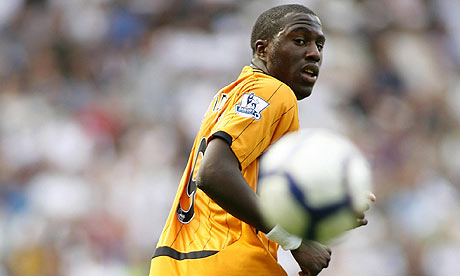
Showing posts with label Jozy Altidore. Show all posts
By Jason Kuenle

When Jozy Altidore first began to work his way into the USMNT, I along with most other observers thought he had the size, skills, and potential to play the role reserved for Brians McBride and Ching in the US player pool: target striker. His early scoring for the national team accentuated that persception. Header goals against Mexico and El Salvador combined with his finishes against Trinidad and Tobago to show a well-rounded striker, physical striker. The directness and physicality of his goal against Spain, was the height of this perception. A disappointing goal total during his stint at Hull was somewhat offset by the development of his hold-up play and his demonstrated ability to draw fouls and penalties. All of the pieces continue to be there, but in the past few weeks, I’ve seen and read a number of things that make me wonder if the lack of strikers in the US player pool has blinded us to who Jozy Altidore really is.

The primary impetus for reevaluting Altidore was this article. Particularly this quote: “Jozy, however, is still not an instinctual No. 9. He looked far more comfortable against Argentina and Paraguay drifting out to the flank than he did getting into the mix in the final third.” And then I started to put the pieces together. Altidore has seen time with five different senior teams: New York, USMNT, Hull City, Villareal, and Bursaspor. Running in chronological order and taking off the “Altidore = target striker” glasses, a sustained pattern appears.

When Jozy first began receiving playing time with New York, Bruce Arena used him basically as an inverted winger, letting him cut in from the left and take long distance shots on goal. When he did solidify his place in the top line for New York, he was partnered with a traditional number 9 in Juan Pablo Angel and allowed to play off Angel’s center forward position. From there, he moved to Villareal, where he received a couple of starts opposite Giuseppe Rossi and a few sub appearances before being loaned to Xerez, but more on Villareal in a bit.

At that time, Jozy began to make his push into the national team picture; first, in two “B” team starts in the semifinal round of qualifying after the US was assured of moving through. Then, as a sub against El Salvador and starter against T&T in the Hex, Altidore was very effective in combination with Brian Ching. As the summer of 2009 went on, he partnered with Charlie Davies. Again, he played in a role where he was free to drift out wide, with Donovan, Dempsey, and Bradley tending to fill that space by making runs from their midfield positions.

After a solid run in qualifying and the Confederations Cup, Jozy was loaned to Hull City where he featured opposite either Vennegoor or Fagan again playing in an off-center forward position. While he was working on his hold up play, this was because of the size of the space between Hull's strikers and their midfield even though he was generally receiving balls wider than a traditional target forward.

After the injuries to Davies, Altidore was partnered with Casey, Cunningham, and Findley, all of whom naturally act as more of a center forward than Jozy does. All of these players were basically pawns used to move defenders and create structure for Altidore, Donovan, Dempsey, and Bradley to take their most natural roles. With Jozy pulling one center back out wide, the other center back being disposed by the other forward, Donovan and Dempsey making diagonal runs from the wings, and Bradley entering the box just in time for a cut back pass or rebound from a shot.

This brings us to the current season. Altidore again started the year at Villareal seeing time in the Copa del Rey, Europa League, and La Liga. Villareal gave Jozy a slightly different look from the systems that he has been in, that can be described in the below quote from a recent Zonal Marking post: “The problem with facing Giuseppe Rossi and and Nilmar is that they make unusual runs, from inside to outside – if they’re tracked too far, it leaves the centre of the pitch completely open.” Now, if that is starting to familiar, it should. Even in arguably the first system that Altidore has played in where he has not been paired with a traditional center forward, Villareal’s system is still based on the types of runs that Jozy has been making throughout his career. Finally, over the winter transfer window, Jozy was loaned to Bursaspor, where he has been asked to truly play away from center as a right winger making the same runs from the opposite side as when he began his career in New York.

A retrospective focused on what position he has been asked to fill by his coaches, versus the position that USMNT fans want him to fill because of the current void in center forward, leads to different conclusions about his play. To make a parallel to MLS, and RSL specifically, Jozy has been repeatedly asked to field the role of Espindola, but is being judged on his performance filling the role of Saborio.


His hat-trick against T&T is a perfect example of what Altidore’s natural role is. On the first goal, Ching knocks a long-ball down for Donovan, who plays across to the back post run of Altidore. On the second, Ching makes a near post run to open space for Jozy who is coming in behind him. On his final goal, Altidore, despite being the only forward on at the time, is the fourth US player to enter the box and puts away the shot. In rewatching these highlights, I was reminded of the runs of Clint Dempsey. In dissecting their styles of play, the parallels only grew stronger.

Seeing the physicality of Dempsey as evidenced by leading Fulham in fouls suffered by 30 and the hacking that he took in the recent Paraguay match, reminded me of the foul drawing capacity that Altidore showed in his time at Hull. Both prefer to take people on through dribbling and neither are the playmaker off the pass that Donovan is. Though Altidore's heading ability is often questioned, he has put away his fair share of aerial chances on very similar runs to Dempsey. Their career goal and assist rates are not dissimilar, especially considering that Dempsey was in his first year of MLS at Jozy’s current age.


There is some divergence between the two, based largely on their routes to becoming the players that they are. Dempsey’s fitness and defending are better having been primarily a midfielder in his early career. Altidore’s hold-up play is better at his age for the opposite reason.

If Altidore and Dempsey are from similar molds, then it makes some sense why Bradley would be hesitant to start them up top together, opting instead for a center forward place holder. The question remains going forward; what is the best use of offensive talent up top for the US? With Jozy never being asked to take a center forward role at the club level, his development into that role with the national team will be unnatural and therefore slow, as evidenced by the games with Jozy as the lone striker. In a 4-2-3-1, playing Jozy on a wing with Donovan and Dempsey being the other two in that line makes some sense, but that continues to leave the question about the center forward position and further compresses a crowded and talented midfield. Charlie Davies return to fitness could be an answer to that first issue, as could the emergence of Teal Bunbury.

Jozy Altidore is probably not the short or long-term solution to the center forward problems of the US. This does not mean that he will not develop into a great player, nor does it mean that he should not have a place in the USMNT. It does mean that comparing him to center forward may be misguided. For better or for worse, a player’s development will be dictated much more by his club managers than his national team. With Jozy’s club managers not playing Jozy in a center forward position, it’s probably better to embrace the road that Altidore appears headed down. If Jozy does become the heir to Clint Dempsey, he will probably turn out a pretty nice career for himself.


Friendly Takeaway

Wednesday, October 13, 2010 | View Comments
USA's midfielder Jermaine Jones (15) battles for the ball with Colombia's midfielder John Valencia during their international friendly soccer match in Chester, Pennsylvania, October 12, 2010. REUTERS/Tim Shaffer (UNITED STATES - Tags: SPORT SOCCER)


Why all the hate of the 4-3-3? Yes, it turned into a 4-1-4-1. Yes, it looked uncomfortable. Yes, it produced no shots on goal. Well, I guess with these factors going against it, I can understand the hate. But, I find myself in counterpoint again to a vocal portion of the US fan base. Here’s what I saw in these two games that gives me hope.

The fan base has been clamoring for a change to a more attacking, possession based formation. They got what they wanted in the 4-3-3.

And it wasn’t effective.

This was particularly the case on the front line. So, let’s break down that line in this formation. Jozy isn’t yet to the level that he can be effective as a single striker. Holden is much better passing the ball than making runs at defenders. Shea, while skill-wise is a good fit for that wing position, received his first cap and showed the accompanying nerves. With this the case, it should not be that surprising that the US struggled to create opportunities. Contrary to popular belief, there is a reason that the US has played a 4-4-2; its players are currently best suited for a 4-4-2.

Transitioning to a possession oriented, attacking team is not going to be pretty. Too many of the traits and tactics that made the 4-4-2 effective for the US are counterproductive in an alternative formation. For example, the dump pass into the deep corner works great in the 4-4-2. Either the side midfielder receives the ball and has two targets in the box or one of the central forwards peels out and the side midfielder makes a diagonal run into the space left by the forward. We’ve seen this second tactic consistently in US games over the last couple years. Long ball down the side, Altidore peels off, receives the ball, makes a move, passes to the diagonal run of Dempsey or Donovan.

In the 4-3-3, this tactic doesn’t work if it is the striker receiving the ball in the corner. If Altidore receives the ball in the corner. There is not another striker in the middle to create space for the diagonal run. Leaving a cross or back pass as the only options. The cross is not a solid option because only the opposite winger is in a good position in the box. This leaves the attack killing backpass as the best option. Too often, Altidore was on the receiving end of long balls into the corners because the wingers weren't there.

The wingers weren't there because, there are tactics that don’t work in the counterattacking 4-4-2 style that are essential to an effective 4-3-3. In the 4-3-3, more of the width needs to be provided by the side backs. This allows the three midfielders to stay central and dominate possession and the two wingers to stay forward. This didn’t happen last night. With Spector rarely getting forward, Holden was forced to check down. The experience on the left side was similar, but to a lesser extent. With the wingers checking down to provide the width, the formation changes into a 4-1-4-1 which is why it was Jozy chasing down the balls in the corner.

For the side backs to provide width, they need time to get forward. This time can be created by the interaction of the central defenders and the central midfield. A ball turned over played into the central midfield, back to the central defenders, then back up to the central midfield gives the side backs time to enter the attack from their defensive positions. On the second possession by the central midfield, the passing options should have developed; internal passing among the central midfield, passes outside to the sidebacks, diagonal balls to the wingers, and the through or over the top ball to the striker. The time necessary to get into these positions, of course, stymies the counterattack and deep long ball on which the US has survived. But if the goal is possession, the counterattack should not be the primary option after a turnover.

This summer, I discussed at length where I thought the US should be heading based on the projected talent pool in 2014. These past two matches has done little to change my opinion. Jermaine Jones looks capable of playing any of the three central midfield positions. Eric Lichaj looked very good going forward and his defending was solid for a first cap. Outside of blown clearances, the defense was solid, even without Onyewu being match fit. While playing in the 4-4-2, the offense had rhythm even without Donovan.

If the US is to use a possession oriented formation, its going to have to sacrifice results. Villarreal generally plays with two up top. So for Jozy to develop into a player capable of playing as a single striker, he is going to have to get that experience (and the poor offensive performances that come with this) with the national team. For the side backs to find the right balance, they are going to get caught out occasionally. For the central midfielders to find their short passing rhythm, there are going to be bad turnovers that lead to breakaways.

Effectively playing a possession oriented formation will require growth from the players in the talent pool. With that growth, there will be growing pains. The US is not in a position where it can seamlessly transition from one style to another. If we really want to see the US become a team that can hold possession and work an offense, its going to require time and patience.


June 26, 2010 - Rustenburg, South Africa - Jozy Altidore of USA reacts during the 2010 FIFA World Cup soccer match between USA and Ghana at Royal Bafokeng Stadium on June 26, 2010 in Rustenburg, South Africa.


Jozy Altidore's club situation is yet to be settled, but an interesting thing happened over the weekend; the American striker scored for his current club, Villareal, against his rumored future club, Besiktas.


The transfer window may be closing shortly, but Jozy's ultimate fate could go down to the final hours. His goal, admittedly in a pre-season friendly, could either encourage Besiktas to consummate their acquisition of him, or give Villareal pause about letting him go. One goal won't be the deciding factor, but it would be wrong to ignore it as a an element. The fact that Jozy scored in a game involving his current club and one said to be interested in him is interesting to say the least. But rather than simplify his future, it might have complicated it.


Assuming Villareal has any interest in keeping Jozy around. Most reports indicate that he's superfluous to their needs, or that his abilities are a poor fit for their system. If that's true, Altidore is better off elsewhere, where he can contribute on a regular basis and continue his growth as a player. To this point, only Jozy's loan to Hull has benefited him as a player since Villareal purchased him from MLS in 2007, and even then perhaps moderately so. Altidore's progress, despite his importance to the USMNT, has been slow.


Of course Altidore wants to prove himself in Spain, and justify Villareal's investment in him. As noble as that desire is, and as much as it gives me reason to believe Jozy is committed to turning himself into a high-caliber player, he seems better off moving to another club where playing time is more certain.


American fans just want the kid to play, especially ahead of a meaningful Gold Cup next year.


Last season carried more weight in the development of Altidore because it fell directly ahead of a World Cup year. Jozy needed to get better quickly because the thin American striker pool meant he would be heavily relied upon. Despite the modicum of US success in South Africa, Jozy's play was largely disappointing. For the Americans to take the next step, goal scorers are desperately needed, and with Charlie Davies' future even more uncertain, Altidore will continue to carry most hopes.


When Robbie Findley, Edson Buddle, and Herculez Gomez are the best Bob Bradley can scrounge up for a high-profile (60k+ attendance high profile anyway) friendly against Brazil, the imperative for Altidore to get better is obvious. He won't do that at this stage of his career without regular playing time. If he's given the choice to stay at Villareal with his role uncertain and Besiktas, where he could be a first choice player with the right attitude, Jozy need to get to Turkey ASAP.


Altidore has shown us all enough to be excited about his future and convinced he can be a great American player, and he certainly has the natural talents. 2010-2011, with the right situation, needs to be a corner turned.


Still Waiting on Jermaine Jones

Thursday, August 05, 2010 | View Comments
July 18, 2010 - 06191502 date 18 07 2010 Copyright imago GEPA Pictures Football DFL Schalke vs Bialystok try out Irdning Austria 18 Jul 10 Football IFCS 1 German Bundesliga Ekstraklasa Training camps FC Schalke 04 vs Jagiellonia Bialystok Preparation game Picture shows Jermain Jones right Schalke PUBLICATIONxNOTxINxAUTxITA men Football 2010 2011 try out Action shot Vdig 2010 Square premiumd.

Just when you thought we'd finally get a chance to see Jermaine Jones wearing US colors comes word that he won't be making the trip over for Tuesday's friendly.  I'm hardly crestfallen to hear the news, and a not at all shocked it played out the way it did.  Why would Schalke be okay with Jones playing for the US before he returned to the field for them?


The midfielder's return from the lower leg injury he suffered all the way back in June of last year is the definition of "protracted."  For the same reasons Oguchi Onyewu wasn't called in for this match, neither should Jones have been; in the end, it looks worse for US Soccer to have released a roster with Jones' name on it only to have to replace him than if they had simply passed on the opportunity.  In the end the investment is Schalke's, and they should naturally have the right of refusal when the international means a whole heap of nothing.


After waiting as long as we have for Jones to make his switch official by actually playing, it is mildly frustrating for his first call up to turn out this way. But Jones' switch is irreversible as I understand it, so unless he decided he never wants to play as a full international, he'll be lining up for the Yanks at some point.


A statement from Jones per Soccer Insider:

"I would like to thank Bob Bradley and the U.S. federation greatly for my first official invitation," Jones said in a prepared statement. "It is an honor that I have been working towards for over a year, and while I initially felt like I was ready to make my first appearance, it is also extremely important to me that I am 100 percent fit for my first national team game and that I make a good impression on the manager and my teammates. I hope to receive another invitation and finally fulfill my goal of playing with the U.S. national team in the very near future."

Hindsight is 20/20, and clearly Bob Bradley and US Soccer thought they'd take the first possible opportunity to integrate Jones into the team. If the friendly means nothing in the end, then it's only fair to sweep this little bump aside and move forward. No harm, no foul, even if there's a bit of egg on a few faces.


In addition to Jones, Chad Marshall has also been replaced. Dealing with a dodgy knee, and with his Crew playing meaningful games, his pulling out makes sense as well. Omar Gonzalez steps in, giving the Galaxy defender and perceived future National Team centerback an opportunity to cut his teeth further.


Jozy Altidore replaces Jones. That move doesn't make much sense if Jozy is in fact headed to Besiktas in Turkey to play his club soccer and needs time to acclimate, but perhaps the deal's not done and he's without any pressing commitments. I hope that's the case.


June 23, 2010 - Tshwane/Pretoria, Guateng, South Africa - 23 JUN 2010: Jozy Altidore (USA). The United States National Team defeated the Algeria National Team 1-0 at Loftus Versfeld Stadium in Tshwane/Pretoria, South Africa in a 2010 FIFA World Cup Group C match.

by Warren Lent


His feet have too much potential to even think about giving up on him, but impatience can drive any club to make rash decisions. The curious case of Jozy Altidore continues, with the usual twists and turns one would expect from a transfer season.


Jozy Altidore became the most expensive US international ever after his $10 million transfer from the New York Red Bulls to Villareal in 2008. The La Liga club had high expectations for the 18 year old. Villareal gave Altidore decent playing time, but thinking about long term development, the club sent him on a loan to Xerez while they were in the Segunda Division. Playing time was expected to be in abundance for Jozy, but a freak toe injury kept him off the pitch for the entire 08-09 season.


The beginning of the 2009 brought another setback when Villareal brought in fellow forward Nilmar from Internacional of Brazil. Nilmar is thought to be in the prime of his career as a forward, and the need for a player still developing like Jozy was non-existent for Villareal.


The 09-10 seasons had Altidore on the loan train once again to England as Hull City acquired him. A single premiership goal in 28 appearances, and a head butt to end his disappointing stay, has Jozy Altidore's young career somewhat uncertain heading into the 2010 season.


Reports have surfaced that a sale transfer of Altidore from Villareal may be possible, instead of another loan spell. Ajax seems perfect for a player like Altidore, but whether or not they would be willing to buy his rights has yet to be determined.


Although many Ajax supporters are hesitant to admit it, the Dutch club is known for being a launching pad to help many budding stars burst onto the scene. Ajax is the club of Luis Suarez, the striker who played a pivotal role in Uruguay’s impossibly deep run in the 2010 World Cup. The striker gained worldwide praise (and a fair share of jeers toward the end of the cup) and a transfer to a prestigious club elsewhere in Europe seems imminent. The reputation for Ajax as a top developmental club can only bring more hope to fans of Altidore if he were to make the move to Amsterdam.


If Ajax is not the next stop for Altidore, where would he be best suited to perform at a high level?


The answer is extremely tricky, because everyone that has been around Jozy believes that it is just a matter of time before he explodes. But another nagging question: when will this explosion finally happen? Unfortunately, motivation in training was an issue while Altidore was in Hull City, and has nagged him throughout his brief career. Natural ability alone will give him a good career, but supporters across the globe hope Jozy has the desire to be great.


Greatness may come at Villareal, but at this point it seems very unlikely. For better or worse Jozy Altidore holds the future in his own hands.


SOCCER 2010 - USA Beat Turkey 2-1

Jozy Altidore sprained his ankle in training yesterday. His status is listed as day-to-day, and I'm guessing the young striker won't be suiting up against Australia on Saturday.


This, by itself, is pretty big news on the eve of the World Cup. Any injury, even a "mild" one, is scary when there are only twenty-three men in country, game plans are being laid out for crucial group openers in training, and any loss, much less one of front line talent, might mean going into the fire with a hole in your suit. Jozy is important. This is not good.


The situation was exasperated, at least in the minds of the fans, when ESPN decided to send out their Twitter and SMS update (which I received while out to lunch - not like the local ESPNRadio station was going to report it) with the word "hospitalized" in the text.


Wait, hospitalized? Jozy sprained an ankle and was hospitalized? Who ever heard of such a thing? WORLD CUP OVER!


Only, "hospitalized" really meant "had X-Rays taken at the hospital". This, I can understand. Sprained ankles, especially nine days before the tournament begins, are nothing to take lightly. Jozy reportedly picked up the injury yesterday (Wednesday); so either he went to the hospital shortly after it happened and had X-Rays done to make sure it wasn't more serious than it seemed, or he went today after sleeping on it. The latter seems worse than the former, but neither of them constitute his being "hospitalized".


The X-Rays were negative, by the way.


And so ESPN had an unfortunate choice of word (or flat out failed), gave the American soccer fan base on Twitter a collective heart attack, and continues their reign of terror over our game (I'm kidding).


Just please be careful next time, World Wide Leader. Our hearts can't take it.


I'm off to look for a silver lining. Nine days with no use and proper treatment of a mild sprain might have Jozy just ready enough to play on June 12th. Cross your damn fingers.


I forgot to include this when I posted earlier. Courtesy of Ben Rycroft (Follow him on Twitter) of It's Called Football, a handy meter for all of us Yanks panicking over Jozy's ankle:


Jozy and The Rolling Ball

Wednesday, May 19, 2010 | View Comments
Sports News - April 24, 2010

A ball is rolling down a hill. At the bottom of the hill is a sign that says "BRAT" in sloppily drawn letters, as if way the letters look themselves is mean to convey the nastiness of the word. The ball, a shiny top-of-the-line number with undulating lines and a hefty price tag, is stamped with four bold letters of its own. Though it is difficult to read the word they form as the spheroid picks up speed, we already know that it says "JOZY".


Make no mistake, the ball was kicked from the top of the hill by the young American striker whose name emblazons it. He showed up late. He appeared to sulk during games, visible petulance growing every moment with his team's inability to get him the ball. His managers, two of them, criticized his commitment and he ended his English stay with an ugly head butt to an opposing player. Yes, the kick with which he sent the ball on its way was swift.


As the ball bounds quickly away from him, the young striker can only watch as even his slightest transgressions are turned directly into new momentum for its journey down the hill. Writers and observers are more than happy to give it an extra push, pulling alongside the zooming orb and slapping it forward with accusations of bratitude, their own questions on his commitment, and a propensity to seize on anything and everything he says or does. A twist of the striker's intent here and there turns an innocuous bit of chatter with an English contemporary in public into a new burst of attitude-problem energy.


It seems he's helpless. Utterly helpless.


Or is he? Can he possibly catch the ball, which is now but a speck in the distance and perilously close to the end of its journey? Can he bring it back up the hill in any measurable way, putting separation between it and the scarlet letters B, R, A, T?


Perhaps simply stopping it is the first step.


Jozy, the hill, and his rolling ball will all be transported to South Africa in a few weeks time. Between now and then, a stint at training camp with his USA teammates should be a quiet one. He will play in warm up friendlies against the Czech Republic and Turkey, and while those matches aren't quite opportunities to slow the ball down, he can do some good just by playing hard and not providing it any more momentum.


No quit, no attitude, no problems. Once the ball is rolling, the standard for behavior gets that much higher; it's not enough to be like everyone else, Jozy has to be better if he wants that ball to stop.


In South Africa, the ball's ultimate fate could be decided. The right kind of performance augmented by a clear commitment in both training and matches, and he might be able to catch the ball, trap it under foot, rear back, and blast it back up the cursed hill. If he hits it just right, it might even stay there.


Do the opposite, throw a tantrum or anything that might be viewed as a tantrum, take the wrong step, become frustrated in a match and lash out, pick up a team-crippling card, or just simply fail to work hard enough, and that classy high priced ball will go sailing straight into the looming sign with the damning word. Once that happens, getting back up the hill and removing the stigma of the word will be like climbing Mount Everest with goalposts tied to one's feet.


Maybe it's all unfair that the ball is flying down the hill at such a rapid clip. Maybe Jozy's not a brat, nor should he be headed towards the label. But perception is everything in the world of soccer, and as long as the ball is rolling, danger lurks ahead.


A ball is rolling down a hill...


Sports News - February 06, 2010


by Vlad Bouchouev

With the World Cup less than a month away, people can only speculate about what Bob Bradley’s final 23-man roster man will look like. We obviously have a good idea of who the majority of the players will be, but these next couple of weeks may prompt Bradley to make some surprising decisions. The most intriguing part of the final roster selection will undoubtedly be picking the forwards. With about six (or eight, depending on just who is a forward) to choose from in camp, Jozy Altidore is the only forward who seemingly has a ticket to South Africa already booked.


That’s right, that ambitious 20-year-old youngster from New Jersey whose best case for starting for the U.S. at forward came after making a sly turn around defender Joan Capdevila and striking a dinky shot past keeper Iker Casillas in last year’s Confederation’s Cup semifinal.


All jokes aside, we know the guy can play. We’ve seen it with his days with the New York Red Bulls and the US U-20 Men’s National Team. The biggest discomfort with Jozy Altidore has been caused by his recent form. After Hull City threw Altidore a lifeline last summer, he returned them the favor by scoring a whopping two goals in all competitions. He did little to help prevent Hull City’s relegation. You may say that’s a little too much to ask for from a developing player who is testing the European soccer waters, but hey, if you’re going to start as a forward with the US National Team at this year’s World Cup, you’re going to have to at least live up to some minimum expectations. Two goals? Really? Karim Benzema got hacked from the French team for only scoring eight goals for Real Madrid this season, and that kid too has proved that he can play on the international level.


As far as I am concerned, no American forward should be guaranteed a spot on the final roster for the 2010 World Cup, and certainly not a starting one. The battle between the forwards for these roster spots should be an exciting one and I can only imagine the atmosphere that will be surrounding the Princeton camp in the next several weeks. Every forward that Bob Bradley has called up has a legitimate shot at making the final cut. Even Robbie Findley.


All in all, there is some obligation on the part of Altidore to not only show up to the camp next week, but to be the dominant force that he can be. Otherwise, guys like Edson Buddle and Herculez Gomez are going to be making a serious case for a starting place in South Africa. Buddle has his connection to Landon Donovan connection going for him and Gomez has the Mexican Primera Division scoring title under his belt. Eddie Johnson is currently making fans at Greek club Aris and Robbie Findley is the closest thing that we have to a Charlie Davies stand-in. Brian Ching is an experienced physical target man who happens to also be the man-crush of both Bruce Arena and Bob Bradley. In my opinion, the guys who should really be considered for striker role are the likes of Landon Donovan and Clint Dempsey – two guys that know how to score and who ironically have had more success in the Premier League than Jozy.


All we know thus far is that we have a few options but no guarantees. But with only one goal in the League Cup and another in the Premier League this season (granted, one of the best leagues in the world), I just wouldn’t want to see Jozy become, as Ian Dowie put it, a “could-a-been” this World Cup or in the years to come. My old coach used to say, “no one is guaranteed a spot” and I think the same rule will apply for Altidore this month. Two goals for Hull City should simply not lock you in for the World Cup.


Vlad Bouchouev is a student at Carnegie Mellon University and a new contributor to MFUSA.


Football - Hull City v Aston Villa Barclays Premier League

As I begin this post, Hull is beginning the second half of a crucial EPL fixture with Sunderland, and doing so without Jozy Altidore. The young American striker was sent off for violent conduct late in the first half, when he lashed out after Sunderland's Allan Hutton tossed the ball at Altidore's head while the latter was on the ground. It was an ugly scene that leads to questions over's Altidore's maturity.


It will also likely be the last thing Jozy ever does in a Hull shirt. The loan that sent the American to England from Villareal, after he struggling to find a game in Spain, comes to an end after the season. Hull has the option to buy Altidore, but that seems unlikely if they are relegated, and that ignominy seems almost a certainty now.


Hull is a poor, poor team. While the excitement, at least for American fans, that followed Jozy's loan to Hull was rightly placed, with a young player who needed time landing at a club that would likely play him in one of the world's best leagues, it was always going to be an up-and-down proposition. Make no mistake: Altidore has played enough for the loan to be termed a success from an experience standpoint, despite a few fits and starts. But if frustration won out, as it seemed to today, then we must wonder if the stint has done more harm than good. Is Jozy Altidore a better player today than when he arrived at Hull in August?


Again, from a purely physical standpoint, it would be difficult to argue that Altidore has regressed; playing is always better than not, and even in a bad team that struggles to consistently mount an attack (meaning Altidore sees the ball rarely), Jozy's skills look to have improved. There have been more than one occasion, despite a lack of goals, where Altidore was Hull's lone bright spot. Winning balls, pressuring the defense, and drawing fouls; it's not flashy, and it's not clear-cut evidence that Jozy is getting better in a way that would make USMNT fans comfortable, but it is something.


But what about his head? Today's transgression isn't Altidore's first issue with maturity. He started his Hull stint on the wrong foot last year, arriving late and being admonished for tweeting about his omission from the match day roster. A manager change, the stress of a relegation battle, and larger problems at the club have only made it more difficult; it might even be fair to call Hull's environment "toxic", a situation ill-suited for a player of Altidore's age and experience.


That's not to give Jozy a free pass. It's up to him to commit himself, perform professionally, and not allow his frustration to carry over into his actions. His sending off today will only have people asking if he will ever grow up, or if his attitude and penchant for stupid behavior will inevitably lead him to a disappointing career.


Everything that Altidore does is subject to close scrutiny in the US because of his status as a entrenched USMNT starter (in part due to lack of better options) and his being one of a handful of American regulars in England's top division. If Altidore was a rising American player, but one whose performance at his club was not seen as directly related to US chances in South Africa, would we have so much criticism for him?


Maybe. From certain segments of the American fan base, always. The fortunes of talented young players is the subject of obsessive analysis because there are still too few. Altidore, for better or worse at twenty years of age, is an important player in a World Cup team despite his lack of professional credentials in Europe. Such is the state of Bob Bradley's team.


And so Altidore's Hull experience is probably over. I might be the first to attempt an assessment of his time there, but I certainly won't be the last. More important for Altidore is how he leverages his experience; was it simply a frustrating exercise in futility, both from a team and personal standpoint, that ended sourly and spiraling him downward, or was it something to be learned from, a bit of adversity that will serve him well as he strives to fulfill his potential?


I have a sense that Bob Bradley will play a role in the ultimate fallout. The timing could not be better for Altidore now, to leave Hull after a terrible ending and head directly into US camp for the World Cup. Altidore has been at his best in an American jersey, and if there's any way to mitigate the damage from this debacle, it could be found back in Jozy's home state of New Jersey.


Maybe Jozy is a brat. Maybe his development is stunted by a poor attitude, and much of what happened this season at Hull is direct evidence of that.


He's still very young, and playing on a bad team has detrimental effects on many players. Let's hope the adversity is just rough patch on Jozy's road to ultimate success.


Football - Hull City v Arsenal Barclays Premier League

Hull City fired manager Phil Brown today. For USMNT fans, that news would have little impact save for the little issue of our starting striker's fortunes with the club; now that Brown is out, with Hull in the relegation zone but just three points from safety, what does the future hold for Jozy Altidore?


I actually addressed this issue way back in September, when it appeared Brown was already on his last legs. It took an additional five and a half months, but the inevitable finally happened; the question now, because Altidore has established himself in the Tigers squad, is how much this affects his playing time, and whether the club will exercise their option to buy him at the end of the season.


The latter is more an issue of survival than anything else. Hull won't buy Altidore from Villareal if they drop down to the Championship, nor do I believe any of us would be keen on them doing so. Altidore is a first division player at this point, and it would slow his development to play in England's second level (even though it's a strong league and the competition is still fierce). More likely is a recall to Villareal, who would either try to sell him (which might depend on his World Cup performance), or loan him out again before the start of next season. Altidore has certainly made strides at Hull, and though his value is debatable, there's no reason to believe he can't catch on somewhere and become an important contributor.


Back to the present. Hull has named assisstant Steve Parkin caretaker manager for the balance of the season. What this means for Altidore, I'm not entirely sure. Hull's sole and most important task is to avoid relegation; does that mean the young American is marginalized because of his lack of experience and paltry goal scoring record? Perhaps. But from most accounts, Altidore has been more consistent and troublesome for defenses than Hull's other forward options; that should mean he'll keep his spot in the rotation.


The only thing we can be sure of right now is that things are uncertain for the young American. From a distance, it appears Hull has been good for him, both on the field and in terms of maturation. Hopefully that leads to Jozy Altidore playing an important role in Hull's bid for survival the rest of the way. Our first indication will come on Saturday when Hull takes on relegation zone-mates Portsmouth at Fratton Park.


Hull is going to need hungry, energetic players in their push for crucial points down the stretch. I'm admittedly biased, but it would seem to me playing Jozy Altidore, who fits that bill, would give them their best shot of staying a Premier League club in 2010-11.


Jozy Takes Another Small Step

Monday, February 08, 2010 | View Comments
Hull City vs Manchester City

Finally, Jozy Altidore has scored in the English Premier League. After eighteen matches with Hull City, the young American striker put his name on the score sheet for the first time in Saturday's win over Manchester City.


More than the goal itself, what should be encouraging for USMNT fans only five months ahead of the World Cup is Altidore's overall improvement; his size and strength give him an advantage over almost any defender he faces, but it's more subtle things like Altidore's movement to the right place at the right time (which he did on the goal) that indicate that his time in England has been fruitful.


To state the obvious, a striker's job is to score goals. Altidore hadn't done that in the Premiership to this point (he did have a cup tally), making many fans a little nervous. The last thing the United States can afford in South Africa is an attacking player with no confidence. If Altidore can turn his first into several more, it will quickly eliminate questions over his move to England.


Altidore is still very young, very raw, and only beginning to tap his potential. Barring a catastrophic injury or poor attitude, there's no reason to believe that he won't only get better. Phil Brown's confidence in him is also heartening; with Hull fighting for every point to avoid dropping down, Brown could easily go with a more proven player in Jozy's spot.


As I wrote after Altidore's first appearance for Hull, there's a real possibility that he could be the player American kids come to idolize. Nothing is easy, and rarely, at least for Americans, does development and the fulfillment of potential follow a straight line; Altidore may very well find himself on the bench in a month, causing the same kind of grief and writing off that has followed the original superstar-in-waiting, Freddy Adu.


But while Freddy stagnated on benches across Europe, Altidore was clearly getting better. At this point, that's just about all we could ask for.


A thought that just occurred to me, that maybe someone can help with: Jozy has to be the youngest American ever to score in the Prem, right? There have to be some other firsts with his goal as well...


US soccer player Freddy Adu in Thessaloniki

Take what is already an established fact, that on the whole US National Team fans overreact to almost any event involving an American player, add the pressure of a World Cup year, and things ratchet up to a fever pitch.


To wit: Jozy Altidore, as little as a week ago, was the focus of "come home to MLS" calls by certain segments of the American soccer community. He wasn't playing in England, the World Cup is only five months away, and MLS provides a nice safety net. Better to have him playing in a lesser league than riding the bench Europe.


Except, those lamenting Jozy's situation either discounted his team authorized bereavement leave due to the disaster in Haiti and overreacted anyway, or were not aware of it. Jozy returned to the Hull lineup yesterday, figured prominently in the Tigers' draw with Wolves, and suddenly appears to be back on track.


In a culture that values recent and singular results to the detriment of the bigger picture, every player's last game is his most important. While Jozy returned and played well, appearing to prove that calls for an MLS return were premature, Eddie Johnson and Freddy Adu jumped back into the discussion with one nice play in their new club's win on Sunday. Johnson scored on a pass from Adu, with each showing glimpses of what made them promising talents in the first place. But does one goal, no matter how nice, really put either or both players back in the National Team picture for South Africa?


Not in my mind, it doesn't, but that won't stop some fans from getting disproportionately excited. With a talent pool as shallow as the United States', every American abroad with a name and a pedigree (which both Johnson and Adu have despite their recent struggles) is grist for the mill; while Johnson and Adu have a long way to go until they can be viewed as viable contributors on the international level, that doesn't mean they won't have their fair share of backers if they play well in Greece. At the very least, we shouldn't completely discount their chances.


Last week, it was Altidore, his "problems" and concern over his form and development. This week it's Johnson and Adu and their exciting combination, a tantalizing bit of quality from attacking players. Next week, it might be Cooper jumping back into the mix if he scores for Plymouth Argyle, panic for Stuart Holden if he's unable to make the Bolton team, or any number of possible events that will send the American fan base into hysterics.


The World Cup makes us all a little bit crazy.


The MLS Safety Net

Tuesday, January 26, 2010 | View Comments
Jozy Altidore

After soliciting for suggestions for my next post, my being full of writing energy but missing an area of focus, I was asked to present an argument for whether Jozy Altidore should return to MLS.


But I'm not going to, yet. Instead, I'm going to first do what I usually do; take a specific issue and step back to take a more general view, hoping to either draw conclusions or raise relevant questions that might not seem obvious on the surface.


I suppose it's a good thing that Major League Soccer provides young American players with a safety net. Not getting enough playing time abroad? Well come on home, young man, and we'll find a spot for you! Sure, the competition isn't as good (generally), you probably won't make as much, and there's no real fame to be gained by being a footballer in a country that puts the sport about as high as BMX racing and stuff that happens in an "octagon", but hey, what else are you going to do? It's a World Cup year, remember?


There's a large segment of the American soccer community that reacts, for lack of a better word, violently the moment a young player hits a rough spot in Europe. The calls for an MLS return are loud and impassioned, usually based on the idea that the player in question would find themselves on the field here rather than rotting on the bench there. But, would it really be what's best for them? Is throwing in the towel the right move? How would that affect the player's psychological makeup and development in the long run?


Unfortunately, no one really knows, and the basic truth that playing is always better than not playing carries a lot of weight.


None of this is to say that certain players might not be better off back in MLS. It's truly up to the player and comes down to the state of their career; for some, MLS would be a step back, a last ditch resort, and an admission that their career is on life support. Not because MLS is a terrible place to play, but because they've invested so much to making it in Europe that the only mental effect possible is a destructive one.


On occasion, "coming home" is absolutely the right move. Sometimes, when a player is either out of options, finds the going too difficult in Europe, or simply wants to be a part of a burgeoning league in the country he's from, Major League Soccer is an attractive landing spot. But there needs to be less calls for Americans to return to the US and the warm bosom of MLS and more push for those players to show resolve.


Back to the specific. Jozy Altidore is going through a rough patch at Hull, not helped by the recent tragedy in Haiti, and finds himself without consistent playing time less than six months before the World Cup. His club is acquiring more talent, players who will make it even more difficult for Altidore to get on the pitch. This has some asking if Jozy might not be better off back at home, where playing time is guaranteed and his World Cup form can better be maintained.


In essence, people are saying Jozy should quit.


I'm just not a fan of that. Whether it would help the fortunes of the National Team or not, saying that because Jozy finds himself in a less-than-perfect situation dictates a step back from his goals is ludicrous. Last time I checked, Americans were known as stubborn go-getters, intent on making things go our way until there is absolutely no hope.


Okay, so I'm exaggerating, and there should always be pragmatic considerations; but ducking out at the first sign (or second perhaps, depends on how you count) of trouble will do him no good. He needs to stick it out, fight for a spot, and build a mental strength that will serve him well throughout his career. We know he has the ability.


Freddy Adu

Jozy Altidore is still searching for consistent playing time at EPL strugglers Hull. Freddy Adu's status is again in limbo after being sent back to Benfica (who don't really want him) by Belenenses. Eddie Johnson is headed to Greek Superleague side Aris FC after failing to break into the rotation at Fulham. Three young "name" American players, each with their own problems succeeding in the tough environs of European soccer, and ripe for criticism because of it.


To hear some tell it, the issues each player is facing, often viewed as self-inflicted by (reported) lack of effort, ill-advised public outbursts, and general bad attitude, is indicative of a wider problem with young Americans employed abroad. Be it generational and cultural, there must be something intrinsically wrong with American footballers, because this evidence seems bears it out.


Except that the evidence, as one would expect with across a range of examples, is by no means uniform. In fact, the number of American players "failing" in Europe, an assessment that naturally depends on the how success is defined, is relatively small. For every Freddy Adu or Eddie Johnson, there's a Mike Grella, Marcus Tracy, or Alejandro Bedoya; players without the name recognition but who have worked hard and carved a niche for themselves in various leagues. To say that a singular "American attitude" pervades the player base plying their trade abroad outside of the United States, is disservice to those who are taking full advantage of their opportunities.


Our natural inclination as observers is to group like things, then draw conclusions using those shared elements. We want to lump Adu, Altidore, Johnson, and others together because they share a common nationality and upbringing; American soccer exports are few enough that each case is imbued with more significance than it probably deserves, making the disheartening cases all the more visible. It therefore seems logical that at least some of their failures (again, relatively speaking) is attributable to the the origin of their passport.


Each of the players in question, as well as Charlie Davies, Clint Dempsey, Michael Bradley, Benny Feilhaber, and a multitude of others, carries the burden of American soccer's emergence with them. As more and more players head overseas, the largest amount of individual scrutiny will be saved for the most-hyped among them. That is certainly the case for Altidore and Adu, two young players whose personal reputations have somehow become tied to a wider view of American talent. Because they get the headlines, have the largest transfer fees, or garner attention from quarters that generally ignore soccer, their cases take on added importance.


That flawed thinking not only goes for soccer minds in Europe and elsewhere, but for Americans analyzing and observing the game. The psychology involved is complicated, but two main factors seem to be at play; knowledgeable Americans, those who view themselves as authorities, respond to the overrating of some players with harsh assessments that often involve generalizations, while also exhibiting aspects of an inferiority-complex. They're American, and they're countrymen are stagnating in Europe, so their reaction is to downplay those players as "not good enough in the first place" in order to deflect any ridicule they might receive from their colleagues abroad or the better to reinforce their own expert credentials. Hard to blame them.


That's not to say the players should be beyond reproach or that every analyst is guilty of the above. But the unavoidable fact that not every hyped player can "make it" gets lost in all of the noise. Scouting in every sport is hit-and-miss, and even the most intelligent soccer minds tap up youngsters that never amount to anything more than reservists. We remember those that rise from starlets to stars and laud the ones that fulfill their potential, but what about the rest? How many Americans succeeding in Europe, as have more than a few, will it take before those that fail are no longer evidence of some American pandemic of bad attitudes?


Each player, regardless of his provenance, is deserving of critique if he fails to live up to his presumed talent. Clubs don't buy or take players on loan that they do not think can help them win or have sufficient ability to progress to that point, so when the player fails to make an impact it's difficult to find any explanation than that his mental strength and discipline are lacking. Still, so many factors go into a players development that it's difficult to pinpoint any one as the source of the issue; does Freddy Adu or Jozy Altidore's origin mean more than the coaching, environment and training techniques to which he's exposed?


There may not be a widespread bias against American players (and if there is, it's fading considerably), and there may be less generalization of their abilities than in the past; but there likely remains a sense, both in their own home country as well as abroad, that Americans are collectively guilty of certain things. Rarely are stereotypes fair to the entirety of a population, even if a portion of that population embody it. The labels of "lazy" and "entitled" are starting to stick to young American players because a few bad apples; that's not only unfair, it's the result of a flawed assessment.


There is no over-arching problem with American players, but there are a few giving their fellow countrymen a bad name.


Why Did Brown Bring Jozy to Hull?

Monday, November 16, 2009 | View Comments
Jozy Altidore

A friend of mine sent me an email yesterday, consisting of a simple question:


Was the Jozy Altidore signing simply a Phil Brown PR move? He had the crowd cheering USA! USA! in his first game and hardly anything since.


My initial reaction to the question, before I attempted to intelligently respond to his suggestion, was "Huh. I hadn't thought of that."


As disheartening as it may be if true, it's certainly possible; Altidore hasn't exactly burned up the EPL since arriving at Hull. He's been a late game sub and an occasional starter, but his overall impact has been minimal, and there should even be some question as to whether moving to Hull was the right thing for his development. How much of that is on Jozy (attitude, effort, etc.) and how much can be chalked up to Brown knowing from the outset that the young American wouldn't be a major part of his plans is impossible to know.


I don't think I agree with the implication that Brown brought in Jozy just to create a little buzz, though. Brown's job was going to be difficult enough without spending money on an unproven player if he didn't think that Altidore had something to offer the squad. My gut tells me that Jozy's lack of impact has more to do with an adjustment period than anything else, though that leads to the obvious question of his short-term future; will Altidore remain with Hull in January, or return to Villareal where his playing time might will be at an even higher premium?


At the time of Altidore's loan announcement, I was hopeful yet wary. Seeing another American in the Premier League was of course exciting for us, but the potential pitfalls were obvious. If Altidore didn't see playing time, or if he couldn't adjust quickly to the rigors of top-flight English football, the potential for wasting a crucial time in his development was high. We now have a few months of evidence with which to judge Jozy's time in England, and it would be difficult to call it a success. I'm not sure it was the wrong move for the American at the time, but it clearly has not worked out the way so many of us hoped.


Hull is in trouble, their manager is in trouble, and the World Cup is a scant seven months away. As I've suggested in the past, a manager holding on for dear life, whether he was integral in signing a particular youngster or not, isn't likely to rely on unproven players. The addition of Dutchman Jan Vennegoor of Hesselink to Hull's roster only pushes Altidore further down the pecking order, and barring inury, Jozy is dealing with an even tougher fight for first team time.


Phil Brown is an enigmatic guy, suicide counselor or not, so my friend's suggestions is interesting. Putting it past Brown to make a move for an exciting young American, who had just tasted international success at the Confederations Cup. would be naive. Maybe it's the optimist in me that wants to believe that the Hull manager truly did believe that Altidore could help his team. Maybe I overrate Jozy as a player.


I'm curious what you make of the suggestion; is it possible Phil Brown brought in Jozy Altidore just to make a splash, without really intending to use him in any meaningful way?


Premier League: Hull Survive Despite Losing To United

If you haven't noticed, things aren't going so well for the Hull City Tigers. Assumed to be relegation candidates before the current Premier League season started, the Tigers are living up to that billing in spades.

Their most recent misadventure, a 6-1 thrashing at the hands of Liverpool at Anfield, is not disappointing for Hull in terms of result (a win over a top four opponent away was never going to a likely proposition) but in the nature of that beating that they took. Hull's battle to stay up will be more about getting points out of matches with clubs like Birmingham (to whom they've lost) and Bolton (whom they've beaten) than doing well against the likes of Liverpool and Chelsea.

But the Liverpool defeat on top of some other recent poor results has lit the burner under Phil Brown, and the Hull manager is staring to feel the heat. For most Americans, beyond those who have fully taken to Hull as passionate fans, the question of Phil Brown's potential sacking might now matter if it weren't for one rather large question:

If Brown is fired, what happens to Jozy?

Jozy's not going anywhere, of course, and should be with Hull for the balance of the Premier League season. But if Brown, the man ostensibly behind the acquiring of the young American on loan from Villareal, is no longer manager, where does that leave Altidore's prospects for playing time?

Altidore has yet, and may never, entrench himself as a first team choice for the Tigers. He entered this weekend's match as a late-game substitute for Geovanni, at a point in the action when the outcome was well decided; with several more experienced forwards options available, spot minutes may be the best that we can expect for Jozy. Managers in peril tend to rely more on seasoned players they're familiar with than unknown youngsters for whom consistency is still an issue; it's also unlikely that would change under a new manager, since a new man would probably do the same in an effort to save the club from relegation.

Either way, it's a tough time for American fans tracking Altidore's progress, and it shows not signs of getting better. He can still make his mark at Hull, and the hope and belief is that he can be a starter in the Premier League before too long. Unfortunately, it's difficult to see a path that leads there at the moment, and perhaps we should (and some certainly did) have seen the problems coming. Clubs bound to struggle cannot afford to wait on young talent, no matter how much potential there might be, while their chance of remaining top-flight slip away with every dropped point.

The World Cup is rapidly approaching, and Jozy Altidore is already a prominent part of the US National Team. The more time on field, especially for a player of his age, the better; at twenty years old, Altidore cannot afford to be wasting away on the Hull bench when so much of the American hopes in South Africa will be tied to his performance.

Phil Brown has received the dreaded (I'm required by the sportswriters' code to describe it as "dreaded") vote of confidence from Hull's chairman, which probably means he'll receive his walking papers shortly; even if he doesn't, as a manager under fire from multiple angles, he's not likely to take chances or be experimental. Would a replacement, either a caretaker or a newly installed permanent manager, be more likely to put Jozy on the pitch?

Maybe Jozy's just damned either way.


Jozy's First Goal for Hull

Wednesday, August 26, 2009 | View Comments
Just in case you haven't seen it, here's Jozy's first goal for Hull in the Carling Cup match with Southend United. Gotta love these guys that take video of their TVs.


Jozy Altidore, Wael Gomaa

It's only one game, and sixtieth minute substitute appearance at that, but Jozy Altidore's English adventure has gotten off to a rousing start. His first touch set up Hull's winning goal in their victory over Bolton on Saturday, and the Tigers fans took to their new American starlet immediately.

From afar, it looks like Jozy might be the new American idol, the player that kids all over the US (and there are millions of them) will look up to; running around fields from California to New York, more and more young players will be emulating Jozy Altidore.

That can only be a good thing for American soccer. The sport has needed a young star to capture young players' attention, and as good as Clint Dempsey and Landon Donovan are, neither is in a position to fill the role. Dempsey lacks the "it" factor, that indescribable charisma that brings public attention. Donovan, at least until he returns to Europe, isn't on a big enough stage to have the impact that his talent should allow him to otherwise. When kids look for footballing heroes, it makes sense that they would look to the world's highest profile league.

Hull is by no means a massive club, and it would obviously increase Altidore's impact if he was playing for a world-renowned name like Manchester United or Liverpool; but short of a starting role in the lineup of a Champions League contender, which Jozy is clearly not ready for, playing against those clubs and on television gives him enough of a spotlight to elevate him quickly to soccer idol.

For many of us, growing up in a country where soccer was widespread as a participation sport but was not yet a major spectator sport, there simply was no major American star to emulate. The connection that exists between young dreamers and idols in baseball, football, or basketball aids in turning those dreamers into serious athletes, and when they can no longer play, rabid fans. The United States' dearth of those connections in the sport of soccer is just another factor in why the game is only slowly taking root here.

Altidore has the potential to be America's first breakout, crossover, media star. The Lebron James of soccer, if you'd like, a player who's image is perhaps even better know than his considerable talents. While Lebron is arguably the best in the world at what he does, Jozy is just a young player with natural talent still learning his craft; but that doesn't mean that he can't capture America's attention while he performs in a top European league.

Whether Jozy transcends soccer and becomes a popular culture icon is yet to be seen. The place of the game here still makes it an impossible thing to predict, no matter that Altidore possesses all of the attributes to do so. Still, young American soccer players may finally have an player truly worth idolizing; a young star who will score goals in the world's biggest league, against some of the world's most recognized footballers, all the while growing up before our eyes.

I can only imagine what it must be like for a twelve year old American soccer player to watch Altidore play on television while Hull's home supporters chant "USA! USA!" over and over.

Jozy Altidore, American Soccer Idol.


Just Give Him A Minute

Monday, August 24, 2009 | View Comments

Jozy Altidore could be forgiven for feeling a little pleased with his Hull City FC debut on Saturday - his first touch of the ball in the EPL was an effective if perhaps fortuitous assist for the game-winning goal.

Minutes later he saw his shot power over the opposition goalie but wide of the post. Another chance soon followed but again he was unfortunate not to score. And all this in the half an hour he played after coming on just after the hour mark. Talk about an impact substitution.

Despite only having seen 30 minutes of him play, the Hull City fans were more than pleases with his contribution. The message boards were buzzing with compliments (“Looked brilliant going forward for us and linked well"), comparisons (with Carlton Cole, Emile Heskey and Ruud Van Nistelrooy) and chant suggestions (the most amusing of which was - to the tune of ‘Que Sera Sera’ - “Jozy Altidore/He's magic like Dumbledore/You give him the ball he'll score/Jozy Altidore). Already his Wikipedia entry has dedicated as much detail to his 30 minutes with Hull as it has with his spells at Villareal and Xerez which, for Generation.com, is complimentary indeed..

What was especially promising about Jozy’s debut was the immediate partnership forged with striker Kamel Ghilas (and a goal within one minute of the partnership forming on the pitch is certainly immediate). The players gelled at once, exchanging crisp passes during the game, and enjoying after the game. For a team not renowned for being exotic, Hull City appear to have stumbled upon an American-Algerian partnership that shows much promise.

Hull manager Phil Brown (having previously lambasted his team in a humiliating on-pitch team-talk, and enjoyed some impromptu karaoke) is hardly one to shy away from a bit of drama - and his post-match comments reflected this. "I looked into the whites of his eyes and asked him if he was ready to play". It's fair to say that he was. After visa trouble, a swine flu scare, and a frustrating and barren last 14 months of football, it was clear that Jozy was simply relieved to see things finally click on the pitch.


This week Jason and Zach tackle "The Everton Way", MLS news and the importance of the CONCACAF Champions League, the potential sale of USL, and some news and rumors on Americans Abroad.

Match Fit USA, part of the Champions Soccer Radio Network.

LISTEN in the CSRN media player

DOWNLOAD the show

SUBSCRIBE in iTunes

RSS FEED

This was the third attempt to stream the show live as we record it, so make sure you check the UStream player on the right side of the page for the scheduled start time of next week's show (generally Sundays around 1 PM ET).


    KKTC Bahis Siteleri, Online Bahis

    Legal


    Privacy Policy