


You're not a real soccer writer until you've used that pun in the title.
- Keith Hickey
Coach Sweats has released his roster for the USMNT's friendly with Spain and the 2011 Gold Cup, and while most of the group was as expected, there are a couple of selections and omissions that raised some eyebrows. The most notable inclusion was that of the former child prodigy himself, Mr. Freddy Adu.
Showing posts with label Freddy Adu. Show all posts
Showing posts with label Freddy Adu. Show all posts

Yeah, it's the second division in Turkey. Still a sweet turn and strike from Freddy. A flash of brilliance like this is why I'm still have a tiny bit of hope that he'll be back on the map in a few years.
-JD

Freddy Adu is back in the news, such as it is, for yet another instance of failure. Danish side Randers, best known to American soccer fans as the club Yura Movsisyan currently calls home, brought in the disappointing American for what was either a trial with a potential contract at stake or a no-expectations training invitation, depending on the particular report. With Adu, the spin goes both ways. Pinning down whether Freddy blew his chance or if there was a chance to be had at all is difficult.
If he wasn't Freddy Adu, deposed golden boy of soccer in America, the story would be nothing but a blip on the Yanks-abroad radar manned by various sites and message boards. As it is, Freddy's continuing descent into career oblivion is an opportunity for some to revel in the downfall of a player who was probably never good enough to deserve the praise - and money - he received. Though the labels and accolades thrown Adu's way were not of his making, and it's likely the hype irrevocably damaged his development as a player, his failure to live up to his promise makes him an easy target. It's simpler to assume that Freddy doesn't work hard enough or has an over-inflated ego (which, though pumped up by the American media and corporate money, we indict him for not shedding by now) than to imagine that he's just not good enough.

The saga of Freddy Adu, from his sudden explosion in the mainstream consciousness to his current state of forgotten-about-super-bust, plying his trade in Greece for a club of which many have never heard, fits nicely with the definition of the phrase "cautionary tale."
Freddy didn't (has yet to?) turn into the world class player so many thought we would, and the over-hyped nature of his rise soured many on both the player and the promotion machine that built him up. His story is now grist for the anti-soccer mill, occasionally brought up by talking heads and radio sportstalk hosts as evidence that soccer in the United States is just one big joke.
It's unfortunate then, that there seems to be little appreciation for how Freddy's experiences contributed to his thus far supremely disappointing professional career. That reality is a major focus of Grant Wahl's recent Sports Illustrated piece on Adu, with knowledgeable soccer men from Freddy's past and present tying many of his issues to the thrown-into-the-fire nature of his teenage years.
In light of Adu's meteoric rise and ultimate fall, the question should be asked: Has American soccer, and those entities with a direct investment in the game, learned its lesson? Will another Adu, given too much attention (and therefore pressure) come along only to be damaged by unrealistic expectations and a "messiah" label that no young player should be forced to carry?
Since Adu was named the "next big thing", no other player has been pushed in the same way. That doesn't mean it won't happen again, simply that none have come along with the cadre of eye-catching skills that made Adu a superstar before he had ever proven himself on the field. The attitude of America, a culture that often chews up phenoms in frenzied mastication before ultimately spitting them out onto the scrap heap of the forgotten, is always capable of repeating history. For every LeBron James there is a Sebastian Telfair, for every Tiger Woods, there is a Michelle Wie.
The soccer community, thanks in part to watching Adu fall out of the sky so and into relative obscurity, could not be blamed if they have a skeptical attitude towards whomever might be named the next big thing. Even if the rest of the country and media goes gaga for a young player, and no matter the amount of potential he seems to hold, an ardent cynicism will be the order of the day; buying into the hype might only lead to ultimate disappointment or worse, as it did with Adu. Why should soccer fans be forced to defend Freddy Adu, or any other named star-in-waiting for that matter, if the player ultimately fails to meet expectations and sullies the name of American soccer in the process? Better to get out ahead of the game and make overarching declarations that no one unproven should be given the keys to the US soccer kingdom than face the ignominy of being proven wrong when the player never lives up to what will likely be unrealistic expectations.
American soccer doesn't need a messiah, and Adu's story only highlights that conclusion. The country is turning out more and more solid professional players every year, a development that will serve the sport better in the long run than one supposed superstar bursting onto the scene and finding himself incapable of meeting an impossible standard imposed by a general public with little appreciation for the game. Unless America produces a talent on the level of Lionel Messi, an improbable task if there ever was one, there's no reason for the hype machine to turn its gaze to this sport again, at least for the foreseeable future.
Kids here, even the extremely talented ones who might have bright futures in a game the country is just beginning to truly appreciate, don't need the pressure felt by Freddy Adu seven years ago. That tale just doesn't end happy often enough.
It's impossible to stop the machinery of corporate America once it latches onto the a exploitable commodity. Let's hope then that they too have learned the lesson taught by the hyping of Adu and will leave soccer's younger generations alone; but even if they haven't, American soccer fans certainly have. Maybe that will be enough to save whatever chosen one emerges next, or keep them from emerging until they're actually ready.

If you haven't heard, Freddy Adu scored in Greece yesterday. It was a game winner, Freddy's first goal in...well just about forever, and adds another small item to the young American's still meager World Cup resume.
That hasn't stopped a response to Adu's recent play (not just in today's match, but his larger Greek body of work to this point) from coming, namely that of MFUSA contributor Matt over at his own blog.
I'll forgive Matt his excitement, and he certainly does admit that some will see his theory that Adu should even be considered for South Africa as ridiculous. I know how Matt feels; sometimes, even presenting a reasonable argument can be difficult to do when you perceive public opinion to be against you. But Matt makes a decent case for Adu, equal parts Freddy's own form and the lack of quality wide midfielders available to head man Bob Bradley.
I'll let you decide for yourself how much merit Matt's argument has, and whether or not Adu is an actual factor in the potential World Cup squad. My focus, though, is on the crux of Matt's argument: form.
In Adu's case, good form is so brand new as to almost be an aberration. When I noted earlier that Freddy's goal yesterday was his first in forever, I wasn't kidding; it was actually his first in three years. While Matt sees more potential in Adu's play than I do, the question is a relevant one; why shouldn't Adu's form, no matter the struggled he's had over the past few seasons, not push him into the World Cup conversation?
The United States simply doesn't have enough high-caliber players to dismiss one simply because he took time to find a soft landing spot in Europe. Nor can Bob Bradley dismiss a player because injury has stolen playing time from him heading towards June. It's a given that Dempsey, Onyewu, and Davies will be on the list of twenty-three when the Americans kickoff in Rustenburg, if healthy and able to go one hundred percent, because they are that important; their previous play leading up to the tournament matters less because they have track records and performances on the international level.
Of course players like Johnson, Adu, etc., don't get the same kind of leeway. But should we dismiss them as possible contributors just because they didn't spend the last three plus years on top of their games? Wouldn't it make sense to take fringe players who are peaking at the right time rather than those who might have better past resumes but are flailing a bit now? By that logic, Adu should at least in the mix even if he ultimately doesn't make the squad.
I don't see any way that Freddy Adu makes the US World Cup team, no matter how well he plays in Greece. But that doesn't mean I can't see the validity of Matt's point, that when it comes to the most important international tournament, form should trump almost everything else.
If, when Bob Bradley fills out his roster for June, Freddy Adu, Eddie Johnson, Kenny Cooper, or any number of other players on the bubble are among those in the best form at their position, shouldn't that count for something?

by Keith Hickey
If there's one thing American soccer fans love, it's beating Mexico two-nil. But if we're allowed a second, it's surely got to be our habit of routinely naming some poor kid "The Savior of American Soccer™", the player who will be so successful and popular he vaults our beloved game into the permanent American sporting consciousness, to the point where trucker-hatted Nebraskans talk about weather, corn, and last night's MLS game. Landon Donovan, Clint Dempsey, DaMarcus Beasley, Eddie Johnson, Jozy Altidore, Freddy Adu and Charlie Davies have all been tagged with the label at various points in the past decade (and it's invariably an attacking player-saviors have to inspire and perform miracles, not hack at ankles, no matter how good they are at it). It was even outsourced to David Beckham for a little while. There are probably some who are ready to slap the label onto youngsters like Charles Renken and Luis Gil.
To me, this phenomenon of would-be phenoms stems from a two-headed inferiority complex. American soccer fans see how popular the sport is in other countries, and being used to the glitz and glamor of American sports, want soccer to have the same treatment. We want the prestige of the Premiership, the star power of La Liga, and the rabidly passionate fans of the Serie A, all wrapped up in the same shiny package as the NFL is delivered to our TV screens in every Sunday. The problem is, American soccer, in league or international form, doesn't have the decades of high-profile coverage that these other leagues do. Ask an NFL fan about the 80s. They'll tell you about Joe Montana, Mike Ditka, and... other important things (I'm neither a child of the 80s nor the biggest NFL fan). Likewise, a fan of the Premiership could talk about Gary Lineker, Liverpudlian domination, and the Heysel and Hillsborough disasters. All soccer fans had were the death throes of the NASL heading a list of an alphabet soup of failed and floundering leagues (ASL, NASL, MISL, NPSL, USL, WSA, LSSA). The truth is, our domestic league is neither as strong as some foreign leagues nor is the sport as a whole as popular as other American sports in the United States. In past years, soccer has been about as cool as Voyager fans at a Star Trek convention. (full Disclosure: I have never been to a Star Trek convention, and I'm sure Voyager fans are lovely, well-rounded people).
But importantly, this is changing. Decades of grassroots popularity and sporadic successes on various higher levels (England in 1950, Pele et. al in the NASL, World Cup 1994) have gained a substantial foothold for soccer, enough that the Dark ages can be confined to the pages of history. Soccer-Specific stadiums are concrete and steel testaments to Soccer's new found permanence. Every four years, the World Cup attracts incredible viewing figures in the United States, rivaling those of other American Sports' championships. New clubs in Seattle, Houston, and Toronto, have been almost unqualified successes for MLS, and forthcoming teams in Philadelphia, Portland and Vancouver look well-equipped to continue that trend. Continued hard work and creativity are what is needed to "grow the sport". Soccer no longer needs to catch lightning in a bottle, and has grown beyond the need for a "savior". That being said, I'm ready to name all of my future children "Landon Donovan" should we win the World Cup in South Africa.

Only in the modern world where footballers regularly share their thoughts on Twitter can so much of a player's future be tied to a throw away comment.
If you blinked you missed it; Freddy Adu, he of the cancelled Beleneses loan and uncertain next destination, let it be known that he has a decision to make before fueling the rumor mill by following up with a whimsical shout to his friends in Greece (Eddie Johnson) and England (Jozy Altidore).
The tweet in question, which amounted to "Hull or Aris?" and has since been deleted, become fodder for on at least one well-known American soccer blog, backed up by reports out of England that Hull is indeed looking at the young American. For what it's worth, reports linking Adu to Aris also preceded his tweet.
Transfer rumors are notoriously unreliable, and there's no reason to believe that these are any different; even if both clubs mentioned are legitimately interested in Adu, boiling his choice down to just those two clubs would be premature. Believing Adu's tweet to be a joke and the speculation to be spurious, I tweeted my assessment. It was only a short time later that I received a reply from Adu's twitter account (we can only assume it was Adu himself that sent it) saying "smart man". That message has also been deleted.
Either Adu was backtracking after making a mistake with the first tweet, or I was correct in my view.
As for why those message are now gone, I can only assume that either Adu himself thought better of them being in the public domain while his status is in question, or his agent directed him to remove them for the same reason.

Jozy Altidore is still searching for consistent playing time at EPL strugglers Hull. Freddy Adu's status is again in limbo after being sent back to Benfica (who don't really want him) by Belenenses. Eddie Johnson is headed to Greek Superleague side Aris FC after failing to break into the rotation at Fulham. Three young "name" American players, each with their own problems succeeding in the tough environs of European soccer, and ripe for criticism because of it.
To hear some tell it, the issues each player is facing, often viewed as self-inflicted by (reported) lack of effort, ill-advised public outbursts, and general bad attitude, is indicative of a wider problem with young Americans employed abroad. Be it generational and cultural, there must be something intrinsically wrong with American footballers, because this evidence seems bears it out.
Except that the evidence, as one would expect with across a range of examples, is by no means uniform. In fact, the number of American players "failing" in Europe, an assessment that naturally depends on the how success is defined, is relatively small. For every Freddy Adu or Eddie Johnson, there's a Mike Grella, Marcus Tracy, or Alejandro Bedoya; players without the name recognition but who have worked hard and carved a niche for themselves in various leagues. To say that a singular "American attitude" pervades the player base plying their trade abroad outside of the United States, is disservice to those who are taking full advantage of their opportunities.
Our natural inclination as observers is to group like things, then draw conclusions using those shared elements. We want to lump Adu, Altidore, Johnson, and others together because they share a common nationality and upbringing; American soccer exports are few enough that each case is imbued with more significance than it probably deserves, making the disheartening cases all the more visible. It therefore seems logical that at least some of their failures (again, relatively speaking) is attributable to the the origin of their passport.
Each of the players in question, as well as Charlie Davies, Clint Dempsey, Michael Bradley, Benny Feilhaber, and a multitude of others, carries the burden of American soccer's emergence with them. As more and more players head overseas, the largest amount of individual scrutiny will be saved for the most-hyped among them. That is certainly the case for Altidore and Adu, two young players whose personal reputations have somehow become tied to a wider view of American talent. Because they get the headlines, have the largest transfer fees, or garner attention from quarters that generally ignore soccer, their cases take on added importance.
That flawed thinking not only goes for soccer minds in Europe and elsewhere, but for Americans analyzing and observing the game. The psychology involved is complicated, but two main factors seem to be at play; knowledgeable Americans, those who view themselves as authorities, respond to the overrating of some players with harsh assessments that often involve generalizations, while also exhibiting aspects of an inferiority-complex. They're American, and they're countrymen are stagnating in Europe, so their reaction is to downplay those players as "not good enough in the first place" in order to deflect any ridicule they might receive from their colleagues abroad or the better to reinforce their own expert credentials. Hard to blame them.
That's not to say the players should be beyond reproach or that every analyst is guilty of the above. But the unavoidable fact that not every hyped player can "make it" gets lost in all of the noise. Scouting in every sport is hit-and-miss, and even the most intelligent soccer minds tap up youngsters that never amount to anything more than reservists. We remember those that rise from starlets to stars and laud the ones that fulfill their potential, but what about the rest? How many Americans succeeding in Europe, as have more than a few, will it take before those that fail are no longer evidence of some American pandemic of bad attitudes?
Each player, regardless of his provenance, is deserving of critique if he fails to live up to his presumed talent. Clubs don't buy or take players on loan that they do not think can help them win or have sufficient ability to progress to that point, so when the player fails to make an impact it's difficult to find any explanation than that his mental strength and discipline are lacking. Still, so many factors go into a players development that it's difficult to pinpoint any one as the source of the issue; does Freddy Adu or Jozy Altidore's origin mean more than the coaching, environment and training techniques to which he's exposed?
There may not be a widespread bias against American players (and if there is, it's fading considerably), and there may be less generalization of their abilities than in the past; but there likely remains a sense, both in their own home country as well as abroad, that Americans are collectively guilty of certain things. Rarely are stereotypes fair to the entirety of a population, even if a portion of that population embody it. The labels of "lazy" and "entitled" are starting to stick to young American players because a few bad apples; that's not only unfair, it's the result of a flawed assessment.
There is no over-arching problem with American players, but there are a few giving their fellow countrymen a bad name.

Courtesy of SBI by way of a Portuguese report, it appears that Freddy Adu has been dumped by Belenenses.
Adu's will return to Benfica, where it's unlikely he'll remain very long; after failing to secure regular minutes at Belenenses, Benfica may find it in their best interest to mutually agree to cancel Adu's contract. That possibility, perhaps augmented by hints Adu has dropped on Twitter in recent days about personal decision looming, might see him move back to the US and to Major League Soccer.
Whether Adu's struggles can be put down to attitude, lack of work ethic, or his simply not being good enough, there would certainly be a place for him back on this side of the Atlantic.
After hitting dead end after dead end during his European stay, Adu's travails are now well beyond "broken record" proportions, and the final nail in his 2010 World Cup hopes has long been driven; but there's still hope he could be a minor star in the US and slowly turn his career around.
While you ponder what exactly the TPL might be, I've managed to collect a few intriguing links from around the internet to further stimulate your mind.
Soccer, perhaps more than the traditionally relevant and entrenched sports leagues in the United States, is about looking to, and preparing for, the future. Intelligent people are on the job all over the country, including L.E. Eisenmenger at Soccerlens; her piece there today proposes a youth transfer fee system in the United States, something which could help bridge the gap between the massive youth clubs our country possesses and the new-on-the-scene MLS clubs.
L.E.'s suggestion makes sense on several levels, and while the details would certainly have to be worked out, fixing the disconnect should be a priority for US Soccer, Major League Soccer, and those that run youth clubs around the country. If the clubs have incentive to develop players for the professional ranks, much of the animosity that exists between the two levels could be washed away, making for a more productive environment for the game in the U.S.
- Also a nod towards the future and building the game in the US is the launch of USSoccerProject.com, a site that will provide a free online hub for the sport in America. Audacious in its aims, the US Soccer Project's corporate backer, Elite Design Corporation, plans to purchase a European club "to enhance player development and bridge the gap between the U.S. youth system and the structure of youth soccer around the world". It will be extremely interesting to see where this site goes, and if their ambitious goals are achievable.
- Coming on the heels of last week's announcement that the MLS Cup Final will be moved to prime-time as well as cable comes one writer's call for the game to move away from neutral sites. The argument here is that MLS is wrong to follow the "NFL model", and should instead move to be more in line with South America's Copa Libertadores (a two-legged final). I'm fine with a two-legged final in each finalists home stadium, but I chafe a bit at the idea that the series should take place on consecutive Wednesdays in order to limit competition for attention. Then again, does MLS really need to play their final on a weekend up against American football?
- Our last link for today relates to a unfulfilled future, and one that has faded fast in recent times. Extrafootie remembers when Freddy Adu was America's chosen one, and throws salt in the wound with a video highlight package of the young phenom. I still feel for Freddy, who was never placed in a position to develop naturally because of the hype that surrounded him. You have to wonder if he would have become a great player if he was either not American or had come after someone else had blazed the trail that it seems he was forced to. Although different players in style and talent, it's worth considering whether Jozy Altidore would have become the player he is today if Freddy Adu hadn't come before him.
And now the part I always forget: Deep Cuts will attempt (but not always manage) to bring you soccer links from off the beaten path on a daily basis. If you come across something you think would make a good Deep Cut, please send it along to matchfitusa@gmail.com.
Freddy Adu's immediate, and possibly distant, footballing future rests on the transfer deadline today. The young player is desperately looking for a loan move away from Benfica, who seem to have no plans to play the American.
Magnakai Haaskivi at Avoiding the Drop posted that this week could be the biggest of Adu's career; while I agree with that sentiment, I'm hesitant to buy into the thought that "there’s a very real possibility that his career is already over."
I find myself feeling for Freddy. He's not faultless in creating his own struggles, so I'm not shifting blame elsewhere; I'm just always loathe to judge a young player with so much pressure on his shoulders, when I myself have no real way to relate.
And so we wait, as the clock ticks down and the future of Freddy Adu rests in the balance. Freddy himself seems down about the prospects, if his Twitter updates are any indication:

I'll be back to update this post with whatever the outcome may be for Adu.
If Freddy isn't able to get his loan, and therefore playing time, we can pretty much write him off as a possibility for the World Cup roster next year.
*UPDATE* And just that quickly (maybe even before I posted this) comes reports that Adu is headed to Lisbon side Belenenses for a year long loan. Belenenses is in the Portuguese first division, avoided relegation last year on a technicality, and might give Freddy a chance to play regularly.

Greg Seltzer reports that Freddy Adu's loan prospects with Danish side Odense are bleak, after negotiations with Benfica broke down.
The American forward/midfielder will continue to train with his Portuguese club in the interim; a loan deal would still appear to be in the cards at some point, with Adu not figuring in Benfica's immediate plans.
Seltzer's information is that the snag occurred over Benfica's portion of Adu's salary during the loan; Odense wanted them to pay more than they were offering (I assume). The report also indicates that while the loan deal is off for the time being, talks could restart at a later date. It's unclear if another club's interest has affected Benfica's position, or if another deal is imminent.
This isn't good new for those of us who truly want Adu to get a chance to succeed; Denmark, Portugal, Holland; at this point, it doesn't matter, and Adu just needs to play. The chances of his making the World Cup roster next year (especially in light of the emergence of Stuart Holden) are growing dimmer by the day, and a loan with playing time assured is the first step towards him getting back into the national team picture.
For all of the setbacks that Adu has brought on himself, it's unfortunate that something like this, typical loan negotiations gone bad (for now) that are out of his control may put off his growth once again.

Charlie Davies is on fire. He's a young American striker who can't stop scoring; not only was he one of the lone bright spots for the USMNT in Mexico City on Wednesday, he also scored two second half goals against French Ligue 1 champions Bordeaux for his new club Sochaux on Saturday. Along with another young American striker, Jozy Altidore, Davies is a promising, exciting, potential-filled player who's career arc is headed sharply upward.
Meanwhile, Davies' countryman Freddy Adu find himself in soccer purgatory. Techincally a Benfica player, Adu does not figure in the Portuguese club's plan, and is desperately hunting down a loan deal elsewhere in Europe. Rumored links to clubs in Denmark and Holland in the last few weeks are promising, but have yet to come to ultimate fruition. Without a loan, Adu may spend another year in Europe not playing, a terrible circumstance for a young player in dire need of experience.
Two players, two paths, two spotlights; while Davies has seemingly come out of nowhere (for all but the most in-tune USMNT fans), Adu has been heralded as the "next big thing" since his adolescent years. Adu jumped into the professional game at an early age, while Davies worked his way through the typical American player path of college-to-pro. Turning down an MLS contract to head overseas to Sweden, Davies has steadily worked his way up the ladder to become the American starlet of 2009, while Adu has faded into the background, becoming a peripheral player for both club and country.
Davies' story is refreshing, and his success encouraging, mostly because he represents the typical American story; his emergence stands in direct contrast to the over-hyped nature of Adu's lack of impact, one that has seemingly turned off many in the American soccer community who bought into Freddy's "savior" potential.
Perhaps Davies has risen up the ranks thanks in part to the lack of attention. The weight places on Adu's shoulder was not only unfair, it may be been cripplingly detrimental to his development. When a young player is given the type of attention that Adu received at at a young age, it's often difficult for them to keep up the motivation needed to improve. It's human nature; not everyone is equipped to deal with premature stardom properly, and Adu's exit from both DC United and MLS indicate that he may not have understood the sacrifice needed to turn himself into the soccer messiah that everyone thought he could be.
Now Adu finds himself stagnating, be it though his own hubris or a simple matter of circumstance. Time has not run out on him necessarily, but the completing the road to redemption and summarily reversing his career arc are a long way off.
Davies has no such pressure. While a star both at high school in New Hampshire and in college at Boston College, Davies received none of the widespread media attention that Adu attracted. The label "phenom" never came into play with Davies, and his path from amateur to professional soccer took a more mundane route. Heading to Sweden after college seemed an odd choice considering that Davies would have been a high MLS draft pick and a sure bet for a Generation Adidas scholarship; but it set the stage for the young American to turn heads on the continent that might not have otherwise taken notice had he played professionally in the United States. Able to contribute immediately in the second-tier European league that is Sweden's Allsvenskan, Charlie improved dramatically as a player. When given the opportunity to showcase himself on the international stage of the Confederations Cup, Davies seized it completely, adding to his resume. His effort paid off on the club level when Hammarby sold him to Ligue 1 side Sochaux, a step up for him and an indication of his overall growth as a player.
Since his transfer, Davies has scored once in World Cup qualifying for his country, and twice for his new club in France. "Hot" doesn't begin to describe his form.
Rarely will a player, massive potential or not, be forced to endure (or be lucky enough to receive) the type of attention that Freddy Adu did as a youth. Whether Adu would have come to this point in his career without that attention is impossible to know. But it's worth asking; would Adu have become a better player had the spotlight not fallen on him at such a young age?
The system for player development as it currently existe in the United States means that most will finally themselves on the Charlie Davies path. From youth, to college, to professional, they chip away, constantly working to get better, hoping to find themselves fulfilling their potential in their early-twenties. Two such players, Anton Peterlin and Cody Arnaux, are doing just that, and are now signed to contracts with a high-profile English club in Everton. Add college star Marcus Tracy, whose situation more closely parallels Davies' at this point in his career, and examples pile up. Anonymous names not too long ago, they are now seen as possible future players for their country; if they had been pegged as sure things at fourteen, would they have made the same leap?
Identifying promising talent in a country of 300 million will never be an easy task. The college system and MLS draft serve as stop-gap approaches to filling professional rosters in the United States and Canada because the work of scouting and development is so daunting and expensive. To damn that system because it doesn't fit the world standard is understandable, and the future still probably lies with overhauling the process. But for now, while prodigies and phenoms are chewed up and spit out by the media and hype machine, it seems clear that sometimes the status quo can produce quality players. Anonymity is a powerful motivator.
Case in point, Charlie Davies.

A few notes on three young Americans attempting to make their way in Europe, one playing, two not.
Jozy Altidore
If you missed it, Altidore was unable to make his debut for Hull today, as he is still working out work permit issues. Altidore remained in the States after coming back from the USMNT qualifier in Mexico City. Altidore's new team fell to Chelsea at Stamford Bridge, a Dider Drogba goal in the 90th minute doing them in.
Freddy Adu
Adu is still on the hunt for a loan deal, and despite reports last week that one was imminent with Danish side Odense, he is still with Benfica. Freddy's always one to drop hints regarding his status through his Twitter account, and he did so again today.
First, a cryptic note:
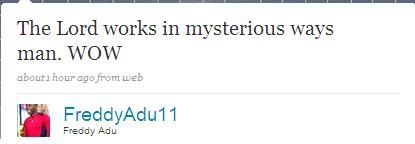
Then, shortly thereafter, a little more information:
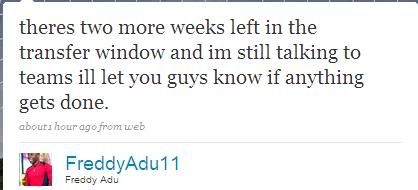
Adu seems destined to move somewhere, but without an announcement from Odense, where is anyone's guess.
Charlie Davies
Davies came on as a second half substitute in Sochaux's match with defending Ligue 1 champion Bordeaux, and scored a wonderful goal, his first for his new club. Davies took a pass in the box and turned on his defender, hitting his shot hard enough that Bordeaux's keeper could not keep it out. Davies is obviously in-form, and could set himself up for an ever bigger move next summer if he can score regularly for Sochaux.
*UPDATE* That's what I get for posting it before Sochaux's match was over; Charlie scored two, getting his first brace in Ligue 1.

Desperately seeking a situation that would allow him to get on the field has led Freddy Adu to seek a one year loan deal with Danish side Odense, according to Steven Goff at Soccer Insider. This move comes after weeks of speculation over Adu's future, much of which centered on the young American potentially landing in Holland.
Odense finished as runners-up in the Danish Super League last year, and is competing in the freshly minted Europa League as well.
Without any assurances that he'd play at Benfica and apparently without takers in a higher-profile league, Adu's move to Denmark makes sense. His focus is likely on securing a spot on next year's World Cup team, and to do that he needs regular playing time. Denmark, and Odense, obviously represent an opportunity for that to happen.
Things have not gone as planned for the (still) young Adu since he engineering a sale to Benfica from MLS after the 2007 U-20 World Cup, and the previously rising star has found himself without regular minutes for two full years.
Adu's transfer is not yet official, though Goff characterizes is as in the final stages of negotiation.
Thoughts? Does Denmark make sense for a desperate Adu at this point?
*UPDATE* Goff has posted an update; it seems that Benfica and Odense are in the midst of the dance, with OB refusing to go beyond saying that they have interest.
Freddy Adu and Michael Bradley are on distinctly different career paths, with Bradley star rising and Adu's stuck in place. They have something in common today, however; each is being mentioned in relation to the Eredivisie in Holland.
For Adu, it's a plea for a club in Holland to come and get him out of exile at Benfica; Freddy has issued a "come and get me" statement in the Dutch magazine Sportsweek, and continues to mention a possible move on his Twitter account.
Bradley, on the other hand, hasn't need to plead for anything; despite moving to the Bundesliga from Holland just a short time ago, he is reportedly the target of two of the Eredivisie's bigger powers. Feyenoord and PSV are the clubs in question, according to the Dutch site Sport1 (to be fair, it is mentioned in the "hearsay" section.
Adu desperately needs playing time, and the Eredivisie would seem a good place to get in in light of his skill set; Bradley is playing consistently for Borussia Monchengladbach, and so a move for him would simply be about European football.
Without any reports of actual interest, I wonder if Adu is even on the radar of Dutch clubs. I just want to see him play, and wouldn't be concerned if he ended up in a less glamorous league then he himself might want to play in (think second division).
As for Bradley, I'm not sure why he would want to go back to Holland, if the interest of Feyenoord and PSV is real. While Gladbach isn't a big club, it is in a stronger league; if he plays well there, he's bound to find himself with other opportunities besides a return to Holland.

Freddy Adu's Gold Cup is over. As part of what Bob Bradley called "the arrangement from the start", Adu is heading to Portugal to participate in pre-season training with Benfica.
Adu himself had indicated that he hoped that his Gold Cup performance would lead to playing time in Europe; he clearly played uneven, inconsistent football during his two matches, though he scored and play reasonably well against Grenada.
Ending his national team duties for now is probably the best thing for the youngster. After not seeing the field in the Confederations Cup and showing signs of rust in the Gold Cup, it's more important that Benfica's coaching staff get a chance to put him through the paces than for him to play more games against CONCACAF competition. If those in charge at Benfica are going to be swayed towards playing Adu, he needs to be top of mind and in front of them showing what he can do.
As always, we have to keep in mind that Adu is only 20; while he desperately needs regular time with his club team, the clock hasn't quite run out on him. Hopefully returning to Benfica after his worthless stay in Monaco will give him that chance. The Portugal club do have an investment in him, of course, and if there are no takers in the transfer market, they have motivation to get the most out of him.
It's obvious from Bob Bradley's words that Freddy is going to have to improve in several areas if he is going to be part of the USMNT heading into 2010. While fans and observers have called for Adu to play a larger role due to his creative abilities, it seems that Bradley wants more two-way play out of him. If his return to Benfica can lead to a stronger player with more defensive commitment, perhaps we'll see Freddy finally fulfill some of his promise.
As of now, simply from what I've heard out of Bob Bradley and seen on the field, I expect Adu will not be on many rosters for the rest of the year. I believe he still should be, and is a dangerous option off of the bench at the least; but interpreting the words of those in charge leads me to believe that as long as Adu is not playing regularly with his club (and it remains to be seen if that will change) and exhibiting increased defensive abilities while doing so, he won't be in Bradley's plans.

It seems that once you start doing something, you have to follow through with it.
And so I present to you Freddy Adu's latest hint about his club future:
FreddyAdu11 as of now im going to preseason with benfica unless something changes.could be spain,holland, a different country or staying at Benfica.
There's absolutely nothing I can glean from this, other than to suppose that Adu is making contact with clubs in the countries he mentioned. Spain and Holland would be fine places for him to play, but without specific club names to go on, there's really no way to know for sure.
Digest this news as you will.

The actual US Gold Cup 23-man roster was released this morning, and it only bears a passing resemblance to the preliminary roster that I and so many others posted last week.
Here's the list:
Goalkeepers: Perkins, Robles, Busch
Defenders: Pearce, Goodson, Marshall, Cherundolo, Conrad, Parkhurst, Heaps
Midfielders: Beckerman, Rogers, Pause, Holden, Colin Clark, Cronin, Evans, Arnaud
Forwards: Davies, Ching, Cooper, Adu, Quaranta
It looks like Adu should actually see the field in this tournament, unlike the Confederations Cup, and he desperately needs the time. Interesting to see Conrad's name on the list; his rumored "fallout" with Bob Bradley is apparently finally mended.
I'm happy to see Parkhurst, Goodson, Quaranta (who we knew about thanks to Goff), and Cooper in the squad.
I'm not really sure why Jay Heaps is on this team, but as I'm not putting too much into the Gold Cup from a fan perspective and only really want to see the younger guys play, it doesn't bother me too much.
The surprise of the group for me might be Sam Cronin; I know he's good, and that's he's played well for Toronto, I'm just surprised to see him brought into a US camp at this point.
Your thoughts?

Freddy Adu is once again on the mind of American soccer fans, as the US National Team's sojourn to South Africa is set to kick off in a few days, and the diminutive midfielder/forward figures to play some (as yet undetermined) role.
Freddy's struggles on the club level are not only well documented, they're downright overwrought. Adu's move to Europe hasn't exactly gone to plan, and after a stint on loan with Ligue 1 side Monaco, the future is uncertain for the former Great American Hope.
Yet, all is not lost. In fact, I might argue that it's more than just "not lost", it's not even been found yet. Lest I remind you, Freddy Adu is only twenty years old.
But, you knew that. Right? You didn't forget that Adu is still just a kid, barely out of his teens, no where near the age that any player could be called "washed up", did you? No matter Adu's struggles in Europe, or his inability to break into the National Team on a regular basis, you kept in mind his relative youth, and realized that he still has plenty of time to get settled with a club, gain valuable experience, and become a solid contributor to American efforts on the international stage-didn't you?
Patience is not something sports fans possess in abundance, no matter the game. Add to that lack of calm the passion and desperation that comes with supporting the still-evolving USMNT program, and rationality is rarely on display. Adu is not only a victim of the ridiculous hype he received as the youngest ever professional athlete in a top-level American sports league, he's also the victim of millions of impatient critics, all anxious for him to fulfill the long talked about potential that they've heard about for what seems an eternity.
It just feels like Adu is old. It just feels like his time is slipping away, and if something doesn't change soon, he might actually fade away into oblivion. While twenty isn't exactly young in international soccer terms, it's still entirely too young for a player to be written off. Simply as a point of comparison, think of Sacha Kljestan; a young player with a bright future who appears to be on his way to National Team prominence, Kljestan is already twenty-three years old, with twenty-four approaching rapidly. Kljestan is a product of the American college soccer system, and while that may not be the preferred path for up-and-coming players, it does serve as a reminder of just where Adu is in his maturation process. If Adu had not turned pro so young, and had played for a few years in college, the excitement about his future would only now be building, rather than hitting the lull that it seems to be now.
Adu has a long way to go, that much is clear. A move to a club where playing time is more likely might be in the cards, and Freddy has intimated as much through his Twitter feed. That would surely be the first step towards him reviving his career, and provide more pressure for Bob Bradley to put him on the pitch for the Nats. Playing time is crucial to Adu's further development, and nothing will happen without it.
It won't be an easy road. Freddy Adu is still nowhere near where we thought (or were told) he would be at twenty years old. His club future is uncertain, his National Team role unclear. He's not the savior of American soccer, and he's not our first truly world renowned star as we hoped he'd be. He's barely a blip on the radar at the moment, a player with more skill and flair than most we produce, but is ultimately a disappointment at the moment, no matter how you look at it.
But, like I mentioned, he's only twenty years old. It's not over yet.


