


-Jason Davis
In a move certain to reverberate across the American soccer Interwebs as tens of people to spew forth angry missives on the intransigence of the league, MLS President Mark Abbott once again reiterated that the top level of the sport in the United States and Canada will not adopt any of the following at any point that anyone with the leadership of MLS can foresee:
1. Promotion/Relegation
2. Single Table format
3. Change of seasons to "traditional" (read: European) calendar
Showing posts with label Pro/Rel. Show all posts
Showing posts with label Pro/Rel. Show all posts
Mark Abbott Reiterates That MLS Will Continue to Annoy Pro/Rel, Single Table, and Season-change Advocates


Scan the American soccer blogosphere any given week and you're likely to come across something that hits on at least one of the following topics:
Promotion/Relegation
Youth Development
Signing/Finding Talent
Sometimes, the pieces written on these subjects are intelligent, well-reasoned, and unique. More often than not, however, they're none of the above; predominantly, they're shallow, naive, simplistic, and ignore serious problems with the approaches they present.
Although not a blogger in the usual sense, Jimmy Conrad has decided to weigh in with his own thoughts on each of the above mentioned topics. It's the question everyone wants to ask, and so many think they might have the answer to: How do we, the American soccer community, take the game to the next level in this country?
Jimmy's first suggestion, a two-tiered MLS that includes promotion and relegation, goes nowhere unique, even if it is a reasonable approach to the "problem". But Conrad, who says twenty MLS teams could be divided into two leagues of ten, glosses over that tricky issue of forcing certain teams to start in the second division, using arbitrary criteria and exceptions to determine the split of first level and second level clubs.
Where Conrad has struck a chord was with his second two suggestions, both related directly to player development; unfortunately though, the prerequisite action, having MLS become a "monopoly" by buying up every professional American soccer league (including indoor), is so large a leap for MLS that it makes me cringe to read it. Why would an organization that imposes strict budgetary control and limits costs in every way possible step up and make such a large financial commitment? The league's owners may have deep pockets individually, but they have shown that as a collective group frugality wins out over all else. The move makes sense as a way to gain control and restructure an American soccer pyramid that has entirely too many cooks in the kitchen at the moment, but it would also be incredibly expensive. It's tantalizingly visionary, but depressingly impossible.
Delving into Conrad's thoughts on what to do with those lower division and indoor leagues once they're under the MLS umbrella seems pointless because it's so unlikely, but he does make solid suggestions for how to help young players gain crucial experience. Most unique is his thought on having young MLS player under a certain threshold of playing time in the outdoor season (he set this as 1,000 minutes) play indoor during the winter; with the greater pressure and faster pace of indoor soccer, the idea is that young players will improve their skills, speed up their development, and be better prepared to play in Major League Soccer. I can find no fault with Conrad's logic.
Following this portion of his column, Conrad asks a cynical question that had certainly run through the mind of many an MLS fan:
What is the main goal of having MLS in place? Is it about land and money and tax write-offs, or is it about something more?
Conrad closes out with his thoughts on the draft, calling for it to end and end immediately. I agree wholeheartedly, and find Conrad's suggestions for signing college players reasonable. My thoughts on the draft continue to be that it does not force MLS clubs to build a proper development system, and the longer they wait, the longer it will be until MLS is able to completely stand on its own as a respectable and established professional football league. Delaying the inevitable is doing MLS no good, and the first step in making the clubs learn to fly is to push them out of the nest without the net of the draft to catch them.
Again, Jimmy treads no ground that hasn't been covered many, many times before. But he does present specific ideas on how to make the system better, and while deeper analysis, not to mention that annoying business a multi-million dollar investement, might poke holes in his concepts, it's nice to see someone who actually plays the game step out with radical thoughts.
I'm curious as to what the MFUSA readership makes of Conrad's vision of the future, so don't hold back.

I find the "club v. country" debate, at least when it comes to players, to be terribly tedious. It only seems to matter when a big club is involved, and while they have a right to be upset about their investments getting hurt while on national team duty, they know the deal when the sign world class talent. Don't want to risk losing a player to an injury picked up while he's away playing for the glory of his country? Then don't sign internationals.
I'm using a facetious argument, but I do feel frustrated that we must go through the nonsense of it all every time. Of course I bring all of this up because AC Milan President Adriano Galliani wants the USSF to pay Oguchi Onyewu while he recovers from a knee injury sustained in the United States' draw with Costa Rica last night. Galliani's moaning makes me want to scratch my eyes out; suck it up, Milan.
- Expect the World Cup bidding race to get awfully smoky over the next year, as much of the stuff will be blown around. FIFA leadership, bid organizers, and political figures will be blabbering on about this bid and that, saying little of consequence while making a lot of noise. Case in point: Sepp Blatter telling Russian President Vladimir Putin that Russia has a "good chance" to win one of the two World Cups up for grabs. Russia may very well have a shot at hosting in 2018 or 2022, but that doesn't mean that Blatter is revealing anything. Telling a powerful, and intimidating, figure like Putin that his bid is strong is while visiting his country is just being polite.
- From The Stanford Daily, a lament from an English ex-pat that the American sports franchise system runs counter to the "American Dream". I agree for the most part, but I don't really see the point of attempting to connect our social ideals to the way that professional sports business is conducted. From the very beginning of pro sports in America, rich men with selfish interests and total control have dictated; the distance between our major population centers, even in the late 19th century when baseball went professional, simply didn't allow for the "open" model of clubs that sprang up in England. America has always been about business from the very beginning; the rest of the world just took longer time to come around to that reality, allowing for the proliferation of clubs that the author writes references. But it's clearly about business now, and the idea that starting up more teams and instituting promotion and relegation (in this case, in American football) will fit more with American ideals doesn't jive with me.
- Although we saw a few missives on the nonsense that surrounded the TV rights for the US-Honduras match ahead of the game, I never got around to writing an opinion on the way FIFA handles them myself. This will have to be my stand-in, though I don't know that I would have used quite as much hyperbole in describing the momentum lost by not having the game be widely available in the post-Confederations Cup evironment: "Just as the sleeping giant awoke, it was laid back to rest." Still, it's not a bad line, and I agree with the sentiment of the piece that FIFA needs to reconsider their broadcast rights rules.
Deep Cuts appears every weekday, and highlights American soccer-related items from around the web. If you have a story for Deep Cuts (even shallow ones), you can send it along to matchfitusa@gmail.com.

American soccer fans, because the US remains a country with unfulfilled potential, are notorious for finding the bad in a good situation. It just comes with the territory; we can't seem to allow ourselves to be happy, no matter how much celebration makes more sense than hand-wringing.
I'm generalizing, of course, and I'm not necessarily saying there's anything wrong with the constant questioning, diminishing, and pessimism. There's a place for all types, and far be it from me to tell you how to feel. Extremes seems to take over, though, and it bothers me that fans/bloggers/analysts are labelled either "Chicken Littles" (or worse) or "Pollyanna" with no room in between.
Still, it does get me down a little to see how many people just can't enjoy being a fan when the team is up. The United States qualified for next year's World Cup on Saturday, and yet I get the sense that many are swimming in pools of "we're not good enough" rather then "WORLD CUP HERE WE COME!". Again, not criticizing, just observing. I suppose those making derogatory statements would defend themselves as realists and pragmatists rather than wet blankets and "haters". In some case it's a reasonable defense; in others, not so much.
- Conor Casey's brace on Saturday doesn't mean he should be a first team regular, argues Compelling Soccer. There's an element of Eurosnobbery here, but I'm finding it hard to counter his argument; I certainly wasn't happy to see Casey in the lineup on Saturday night, and I don't know that I'll be banging the drum for him to start again, no matter the brace. Still, I can find fault with the criticism of Bradley because of his explanation as to why Casey played. Bradley got it right, and that's all that matters; to withhold credit from him because his thought process didn't match up what you wanted to hear is completely unfair. Bradley is the head coach for a reason, obviously knows his team, and led them to a victory not everyone believed was possible. Does that mean you have to jump on the Bob Bradley bandwagon? Of course not, but stop looking for reasons to diminish his leadership.
- Promotion/relegation based on financial concerns is something that has bounced many American soccer minds; Only One Football uses the USL/TOA disagreement as a reason to tread that path, using a potential MLS2 as a feeder league for MLS. I created my own wacky pro/rel system not too long ago, incorporating attendance as an element of the process, which was my nod to finances being part of the mix in the United States. Only One Football's approach is much more pragmatic, even if it is completely untraditional, but makes sense on many levels. It's voluntary, meaning that an MLS2 club can only move up if an MLS1 franchise chooses to go down. That wouldn't satisfy those who want to see a pyramid modeled after Europe, but might actually increase the reach and stability of pro soccer in the US. Still, I can't see it happening any time soon.
- >
- Lamenting the lack of access American fans had to the Honduras match is likely to continue for a few days. Out of Southern Illinois University comes a good example, in which the writer argues the the US always comes just short of getting over the public-awareness hill. "It’s the major problem for the American soccer team: Every time it has a chance to put the elusive spotlight on the sport, its poor performance or the powers-that-be have dashed any hopes." I think that's just a little harsh, and doesn't address the extenuating circumstances that surround each "chance". In the case of Saturday's match, it was the inability of American leadership to dictate where the game would be shown; we can whine and moan that US Soccer should have stepped up and made sure the game would be available to the widest audience possible, but without all of the relevant details (price, logistics, scheduling, etc.) I have a hard time justifying any explosive criticism. The fact remains that if more Americans were interested the TV situation when the US is playing outside of the country in qualifying would improve. At least we won't have to worry about it for awhile.
Shallow Scratches finds stories that anyone else can find and points them out. Sometimes that means relevant commentary, and sometimes I just write stuff to make the post look good. If you want to contribute to Shallow Scratches (or hell, take it over), step right up and send an email matchfitusa@gmail.com.

Alright, so I intentionally left the words "promotion" and "relegation" out of the title of this post for a very specific reason; I'm solidly, completely, and ridiculously confident that there will never be promotion/relegation in the United States, and I didn't want it to appear I was changing that stance.
And I'm not. Really. I swear.
But since it is on the minds of many American soccer fans again thanks to the rumors about MLS interest in buying USL, I thought I'd address it. Not to suggest that it's possible, not to belabor that it's not (it's not), but to present a creative system that might be the only way it could ever come into the American/Canadian game.
Keep in mind that I'm not proposing this system as a practical solution to the question; I simply wanted to see if I could come with something that was even remotely possible in a country that has never had pro/rel on the professional level before and with a league whose setup use a franchise-model rather than one with traditional clubs.
These are the important points to remember, and why it's almost certain that pro/rel won't happen in American soccer:
The owners, specifically those who ponied up the expansion fee, would never go for it.
Makes sense. If you have an investment in something as dicey a prospect as professional soccer in the United States, you aren't likely to be okay with dropping down into a second division.
The American people don't understand pro/rel.
This one is overblown, but there is something to be said for it; casual fans can't be counted on to stick around if their club is wallowing in MLS2.
The loss in revenue for relegated clubs would be catastrophic.
Without a major TV deal, and with so many clubs playing in new stadiums that aren't going to pay for themselves, the decreased income that would surely result from relegation is a major, major problem.
There are other concerns, of course, but these are the big ones as I see them. In order for a system to mitigate any of those issues, a few things would have to change on the American soccer scene (i.e., the game would have to massively explode).
This means...
1. Larger TV contracts
TV contracts are any big sports league's lifeblood these days; without one/many bringing in millions upon millions of dollars, there simply can't be enough money to go around to make pro/rel worthwhile. I don't have an exact number in mind, but think north of "hundreds of millions".
2. Completely stable, no questions about health, financial footing
Part and parcel with a larger TV deal, the league must have zero questions about its long term viability; as long as city councilwomen and anti-stadium groups can continue to use the phrase "if it's around" when talking about MLS, nothing can change in the way the league operates (meaning a set number of teams with no pro/rel).
3. Second division franchises must be attractive investments
There doesn't seem to be a shortage of people anxious to get involved in MLS these days; every time we turn around, another city is being mentioned as a possible expansion candidate thanks to the backing of big time money. When and if those big money concerns are comfortable investing in second division teams, then maybe pro/rel could be considered a possibility.
That may be a lot of set up for what might ultimately be a let down, but here's my ill-conceived, completely-contrived, and admittedly-impossible promotion/relegation "plan":
Requirements for Relegation
1. A rolling three year point total average will determine the clubs to become relegation candidates; the bottom two clubs in at the end of any given season with the lowest average point total for the previous three seasons will become candidates for relegation.
An exception: clubs who qualified for the playoffs in one of the three seasons will be exempt from consideration even if their point average places them in the bottom two. If any team is exempt due to this playoff caveat, the next lowest non-playoff qualifying team from the previous three seasons will replace them as a candidate.
2. Only qualifying clubs via Requirement 1 that are in the bottom third of MLS average attendance over the same period (three years) will remain as candidates; if one or both of the teams qualified through Requirement 1 are in the top two-thirds of average league attendance, they will be removed from consideration and not be replaced.
If any club remains a candidate for relegation after these two requirements are applied, they will on be replaced if a promotion candidate meets the Requirements for Promotion.
Requirements for Promotion
1. The two clubs with the best average point total over a three season span will become candidates for promotion; however, if a team has multiple league titles over that span but are not in the top two average point totals, they replace the club with the second best point average automatically.
2. Clubs qualified via Requirement 1 must meet a minimum average attendance requirement over a three year period. This number is to be determined by the league office, but shall not be set below 10k/game.
3. Promotion candidate clubs must have stadiums that meet MLS standards, meaning a dedicated soccer facility with schedule and revenue controlled by the club, and a capacity not to be below 20k.
4. Promotion candidates will be required to pay an entry fee for the top division of an amount to be determined by the league (I almost set this at $20 million, which is arbitrary, but is half of the current expansion fee).
If and only if there are clubs that meet both sets of requirements will promotion/relegation take place. No more than two teams can be relegated from the first division in any given year, meaning that no more than two can be promoted.
Relegated teams will receive a parachute payment, also to be determined by the league, but perhaps equal to the promoted club entry fee.
Essentially, I've laid out a pro/rel plan that makes it extremely difficult to get relegated, and equally difficult to get promoted. In the end, it's possible that neither set of requirements would be met often or at all; MLS parity means that the playoffs are always within reach, and it's unlikely that a club that recently made the playoffs (within the rolling three year period) would be in the bottom third of average attendance.
Potential promotion candidates will find it equally difficult; even if the meet the requirements I've laid out, the entry fee to become a top-flight club may be too much. More often than not, second division clubs would choose to remain second division clubs even if a promotion slot was open.
It's only through a combination of on-the-field and off-the-field success/failure that I could see owners agreeing to any kind of promotion/relegation system.
But like I said before, it just isn't happening.
End of completely irrelevant nonsense.

Ben Rycroft of Metro News Canada and It's Called Football has a bombshell this morning: the USL (I believe Ben means USL-1 specifically, though it's not clear) is for sale and Major League Soccer has shown some initial interest.
The implications of MLS ownership of the de facto second tier of American and Canadian soccer are multiple and intriguing; if MLS controlled USL, the impossible dream of promotion and relegation might move a step closer to reality (as Ben suggests). I'm much more skeptical that pro/rel would even enter the minds of MLS' Board of Governors. For them, the purchase of USL would be more about extending their soccer reach and market penetration; a packaged MLS/USL would be more salable to advertisers.
MLS is said to be balking at the numbers Nike (who owns the controlling interest in USL) is throwing out. If that's true, then perhaps MLS interest in USL can just be chalked up to due diligence. USL isn't exactly "competition" for MLS, but it also doesn't make life easier for the top league. Any smart business interest would look into the purchase of a rival/nuisance if that entity was put on the market; this then, might just be that.
Rycroft's sources tell him that a private investment group are the front-runners, and are on the verge completing the deal. That might be disappoiniting news to some, and a welcomed relief to others; it might be worth studying just how control of both leagues would serve MLS interests, and whether that control would ultimately be a bad thing for soccer here on the whole.
It's no secret that the MLS/USL relationship is nonexistent at worst and dysfunctional at best. USL president Franciso Marcos has no interest in a cooperative effort with MLS, and sees the bigger league as a competitor and nemesis. But the "promotion" of some of the USL's flagship franchises to MLS is hurting the league significantly, and it's clear that something has to change in order for smaller league to stay viable.
My hope is that the new ownership, no matter who that might be, is open to working with MLS, ending the ridiculous "competition" between the two leagues and moving forward towards a new cooperative environment that will benefit soccer in this part of the world.
For a worthwhile read on a pro/rel concept that might work if MLS did take control of USL, check out Adam Soucie's three part series.
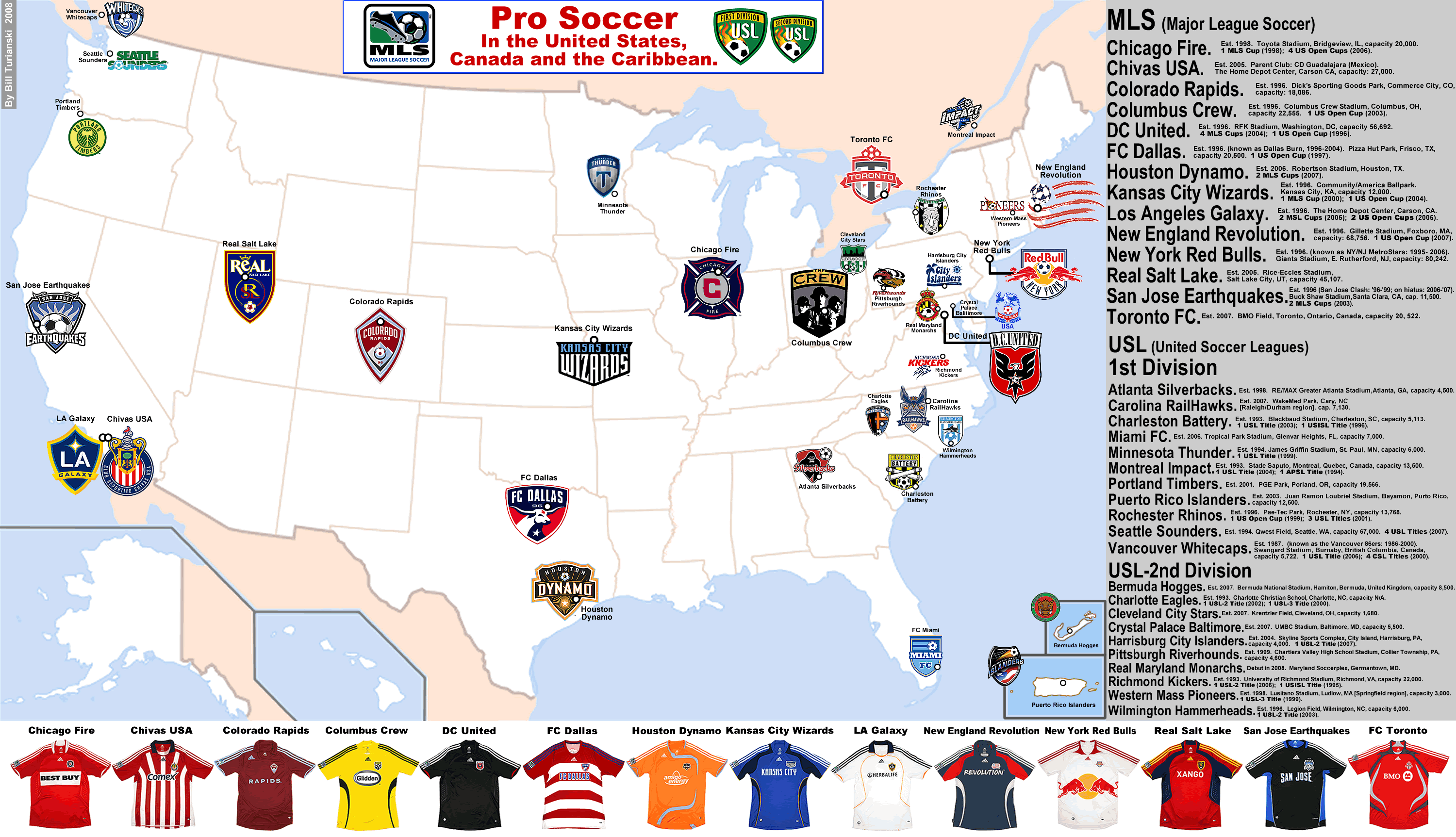
Editor's Note: A few months back, the idea of pro/rel was batted around at MFUSA; regular reader and commenter Vnice had an alternative idea. This is his presentation of a "farm system" for American soccer.
by Vnice
A few months back, Jason Davis posted an article advocating the creating of a promotion/relegation system between MLS and USL. It combined his thoughts with an article found on Soucie on Soccer. It’s a great idea, but personally, I think it would never work, so I proposed a farm system instead. The idea of a farm system between MLS and USL has been talked about on several blogs and websites around the internet for a while, especially as rumors surrounding USL’s imminent demise or restructuring continue to grow. Promotion and relegation is highly unlikely to ever happen in the North American sports landscape. But, I believe it doesn’t have to. A farm system is less exciting for sure, but it’s an effective and practical solution to how we can solve the divide between MLS, FIFA’s recognized top flight of American soccer, and USL, which comprises the 2nd, 3rd, and 4th tiers of the soccer pyramid.
“What’s a farm system, dude?”
Well, let’s say DC United of MLS has a USL-1 affiliate in Charleston, and a USL-2 affiliate in Bermuda. A player can start off with Bermuda and work his way up through the system until he is playing with DC United, and vice versa. Often, in major league baseball, stars that are injured or have surgery make their comebacks in a minor-league affiliate until he is up to par. A farm system would work to develop players all over the US and Canada. If a player on the Rapids isn’t cutting it, he moves down to a USL side to work on his skills, and vice versa. If a Puerto Rico Islander shows considerable progress and skill, he might get the call from his MLS parent club to play in the big time. Lots of sites on the internet can describe the technical aspects of a farm system much better than I, so go look them up for details.
So, let’s examine why this would be a good idea:
Development. A lot of people debate how MLS can sustain its player pool, and how the US National team can develop talent. A farm system would align the leagues in such a way that moving up and down becomes seamless. This makes it easy for teams to maintain effective squads, while identifying those who need more development. It also allows players who can’t quite cut it in MLS to maintain a professional career, and makes it easier to spot players going through a professional renaissance or rejuvenation. Obviously, the benefits more immediately impact the individual MLS teams, but that’s kind of the point. The top flight should have everything at their disposal to ensure player development. Imagine what MLS teams could do with the farm system and their academies at their disposal?
Ambition. Part of the America’s “soccer problem” is that its millions of youth players do not see soccer has a way to make a living. The farm system immediately creates a far larger, integrated infrastructure in which to make a living as a player, coach, front office personnel, etc. Now, it really is possible to work your way onto a Galaxy squad when you start at the bottom. The potential is easier to see, which immediately makes the talent pool in the US expand. With more youths giving soccer a chance, an increased number of superior domestic players will float to the top. All of this adds up to the US National Team (and Canadian, by the way) having an even bigger pool to draw from.
Settles the pro-rel argument. Look, MLS owners will NOT go for promotion and relegation. But, it will be open to a farm system, which strengthens and integrates the leagues to make soccer a force to be reckoned with.
No massive changes needed. The great thing about a farm system is that the USL does not need to sell out to MLS. MLS does not need to buy USL. They can be separate. In baseball, the National and American leagues remain separate entities from the minor leagues. The affiliation is where they have common ground. USL and MLS can each retain their ways of doing things. Players sign contracts with the respective MLS parent sides, and agreements would have to be made regarding league wage minimums, etc. But, I think these are obstacles that are easier to overcome than the actual merging of MLS and USL, or instituting pro-rel.
Now, there are a number of valid arguments against a farm system, so let’s take a look.
Pro-rel is better. Well, maybe it is in the grand scheme of world football. But, it’s not practical in the North American sports environment, nor would MLS owners go for it. Plus, many USL sides lack their own stadiums, or stadiums that would be acceptable in MLS. A farm system means that Austin Aztex, currently in a high school American football stadium, wouldn’t get promoted to MLS, and be an embarrassment of Astroturf and gridiron lines on TV. However, player development can still happen, which is the bigger overall goal here, anyway. Besides, if we forced pro-rel, a lot of the money bag owners would be alienated, possibly driving them away, and potentially ruining MLS.
Lower league teams would be filled with old guys. Not so, I believe. They, like MLS, would be comprised of players of all ages. Besides, a lot of the old guys are still burning up MLS (Keller, McBride, etc.). Also, how old is “old”, anyway? The same argument can be made for super young players. Blah blah blah.
A farm system is too radically different than the rest of the footballing world. It’s so…American. Well, of course it is. And while MLS has rightfully taken out a lot of “Americanisms” from soccer, some should remain. The calendar, for instance, should remain as is. The western European calendar makes no sense for MLS, weather wise, and would force it to compete with all the major sports except baseball. MLS should keep the current calendar, except for international play periods. Pro-rel just wouldn’t work here, either. Should we force it, because the EPL does it? No way. What’s good for the goose is not always good for the gander, so we shouldn’t force this issue either.
USL isn’t second division football. Yes it is. As long as FIFA says so, that’s the way it is, people.
To give you an idea of how this could work, here is a mock up of what it could look like. For the sake of this mock up, I combined USL1 and USL 2, and created a new USL 2 out of some PDL teams. It also looks at the landscape after Portland, Vancouver, and probably Montreal leave USL for MLS, and FC New York and Tampa Bay join USL. (I have seen better mock ups online, but frankly, I couldn’t find them. My apologies to anyone who feels ripped off…email me, and I promise to give you credit in this article. After all, I only wrote this after reading extensively on the issue). This mock up establishes team affiliations in a manner similar to that of professional baseball. If baseball can be successful with this, why can’t we? Anyway, here we go:

Of course, the rest of the current PDL could serve as the 4th tier of soccer, the footballing version of Single A minor league baseball. Now, this set up pays no attention to any practical aligning of the teams. It was kind of random, except for USL-2, where I just found teams near the parents MLS side. *shrug*. It’s a mock up…just a general idea. But, say Beckham got hurt. He stays out a few weeks, and makes his return via Hollywood United. Whoa, the attendance goes up for them. Maybe he stops through Rochester for a game, too, before heading back to Galaxy. A fun thought.
Anyway, I think the farm system is familiar enough to Americans to make it acceptable, and practical enough to work swimmingly. MLS and USL should give it a chance, and make it happen, for the sake of North American soccer, and for the US and Canadian national teams.
Image credit Bill's Sports Maps

Yes, we're talking promotion/relegation today. And yes, I realize that it's unlikely to ever happen, that MLS owners would never agree to it, and that the American franchise model makes it a difficult system to implement.
I also know that it's at the top of the wish list for many American soccer fans. The romance of it intrigues us, and I think the added pressure of possible relegation would push owners to make a proper effort to field a strong team (FC Dallas comes to mind), lest they go down.
While the current league situation makes pro/rel almost impossible, recent news leads some to believe that we could see a very different environment in the near future, one that would allow for a workable system.
Learn all about it after the jump.
Those events that may make pro/rel feasible? The demise of USL-1. Rumors are swirling (I'm not speaking to the validity of the rumor, I'm just mentioning it because they are out there, and it's necessary for the proposed system to work) that the league could be kaput if Montreal bolts for MLS (a possibility that is also being rumored). While the league may go away, there's no reason that the clubs have to: if MLS is able to get their hands on the operating rights, and FIFA comes through with second division certification, we might see MLS2 before long.
I realize that all of that is conjecture, but it is certainly within reason. With MLS and MLS2 representing the top two levels, promotion/relegation might be closer than we ever previously thought possible.
Trust me, I wouldn't bring up pro/rel, and beat the dead horse, if I didn't have something unique to share. This isn't your typical moaning about how the system would add something unique to professional sports in America (although I've made that statement before). Instead, I'm going to point you in the direction of Adam Soucie, the man behind the plan-
Common Sense: Making Promotion and Relegation Work
In Adam's system, the owners are protected to an extent, which continues to be the biggest reason most observers believe pro/rel can never happen here. Adam makes allowances for playoffs (which makes sense), discusses stadium issues (MLS2 clubs cannot move up without a proper stadium), and limits the clubs going up and down each year to one.
I'm intrigued enough to wonder if something like this could ever work.
It makes sense on so many levels that I'm hoping some of you with a little more time to break it down can help me find the chinks in the armor. Not because I want to tear down Adam's ideas, but because any proposed pro/rel system is bound to be put through the ringer by everyone in the soccer community.
My only concern is that it would take a much, much, larger TV contract to make it possible. The money to be shared needs to be of a greater magnitude in order for the owners to accept it.
Thoughts? Does Adam's system make sense? Oh, and be sure to add Soucie on Soccer to your footy rotation immediately; Adam's an excellent writer with a lot to say on the sport.


